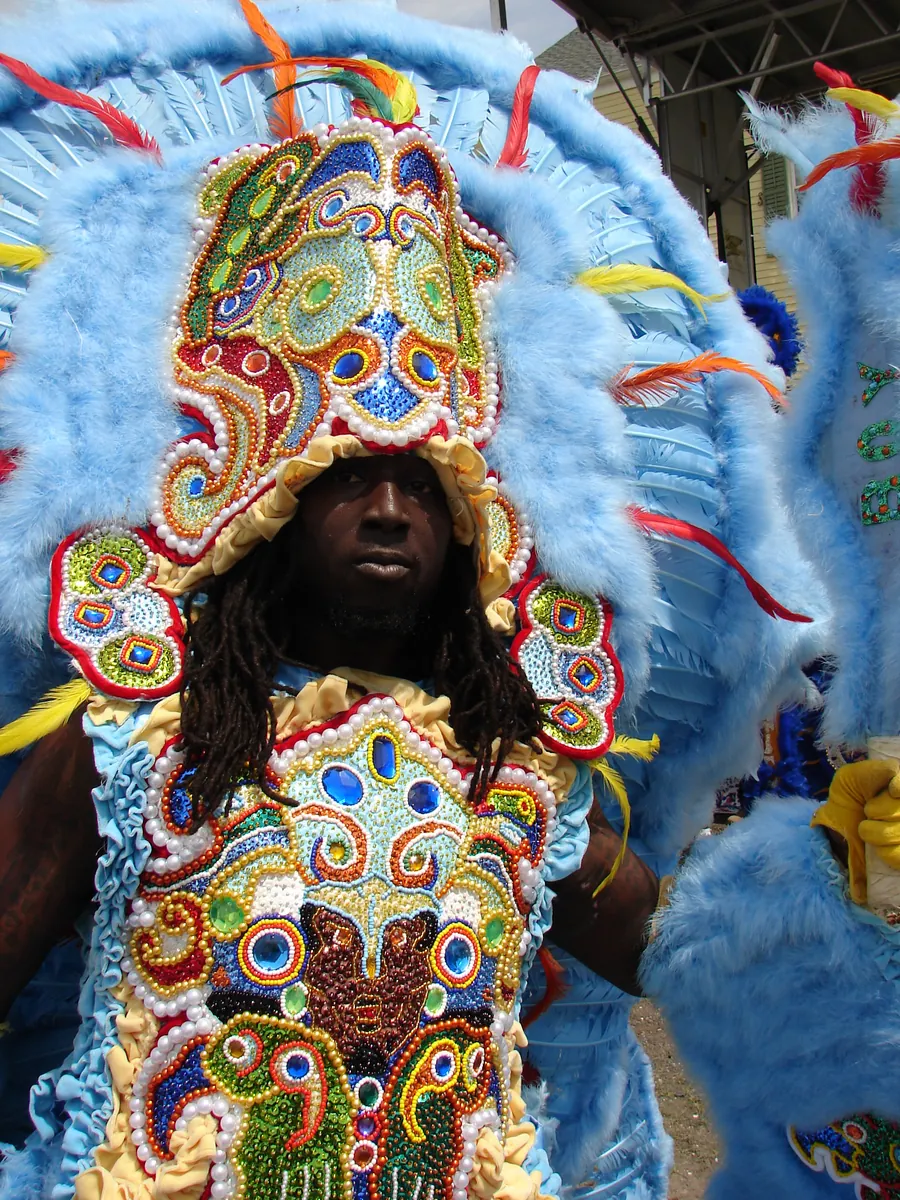
On Mardi Gras morning, somewhere in the back streets of Tremé or the Seventh Ward, a Big Chief steps into a suit that took him a year to sew. One hundred pounds of hand-stitched beads, feathers, and rhinestones — thousands of dollars in materials, thousands of hours bent over needle and thread. The work is described as entering a trance. The suit tells a story in color and texture, bead patches depicting ancestors, symbols, meaningful scenes. When he wears it, he becomes someone else. He becomes Big Chief.
The tradition dates to the 1880s, when Becate Batiste — a young Creole man of African, French, and Choctaw heritage — formed the Creole Wild West in the Seventh Ward. It began as cultural resistance. Black Americans were banned from certain Mardi Gras celebrations and could not wear masks. So they used war paint instead, then masks styled after Native American ceremonies once the state allowed masking from sunrise to sunset. The masking honors Native Americans who sheltered runaway slaves. When enslaved Africans escaped into the Louisiana swamps, they encountered Indigenous peoples who shared skills and resources. In 1729, during the Natchez Revolt, 280 enslaved Africans joined forces with Natchez people against French colonists. Until the mid-1760s, maroon colonies lined the shores of Lake Borgne and controlled passages from Lake Pontchartrain to the Gulf. Those alliances are what the suits remember.
More than 40 active tribes exist now, ranging from half a dozen to several dozen members. They organize largely independently, though umbrella organizations loosely coordinate the Uptown Indians and the Downtown Indians. Tribes take their names from street names, ancestry, important cultural figures. Each is led by a Big Chief who decides where to parade and which tribes to meet or ignore. The parade route is different every time.
On Mardi Gras Day and St. Joseph's Night — March 19 — the Indians emerge. Traditionally, these were the only times they appeared in full regalia. Spyboys in light running suits move ahead to scout for danger. Behind them, the first flag. Closest to the Big Chief walks the Wildman, carrying a symbolic weapon. Then the Big Chief. Behind them all, a second line of percussionists and revelers. During the march, the Indians dance and sing traditional songs particular to their tribe — call-and-response chants like "Indian Red" and "Shallow Water," passed orally through generations, sung in Creole dialects or patois loosely based on African and European languages.
When two tribes meet, they either pass by or face off. The tribes line up. The Big Chiefs taunt each other about their suits and their tribes. The drum beats intertwine. Then both tribes continue on their way. From the 1960s, Chief of Chiefs Allison Montana worked to end the violence that had marked earlier decades. "I was going to make them stop fighting with the gun and the knife," he said, "and start fighting with the needle and thread." Today the Indians settle their fights through the prettiness of their suits.
Uptown tribes tend toward pictorial suits; downtown tribes favor three-dimensional construction, both with Native American influences. The beadwork is entirely by hand, a combination of color and texture. According to Joyce Marie Jackson of Tulane University, the fusion of American Indian and West African motifs and music creates "a folk ritual and street theater unique to New Orleans." You find them or you don't. There is no schedule, no parade route map. The Big Chief decides where to go, and the tribe follows.
- ·Handmade suits of beads, feathers, and rhinestones take a full year to sew and can weigh over 100 pounds.
- ·The tradition dates to at least the 1880s and honors the alliance between African Americans and Native Americans who sheltered runaway slaves.
- ·Indian gangs are organized by neighborhood and led by a Big Chief; they compete on the street for the prettiest suit.
- ·The chants ('Indian Red,' 'Shallow Water') are call-and-response traditions passed orally through generations.
- ·Mardi Gras Indians emerge on Mardi Gras Day and St. Joseph's Night (March 19). Sightings are not scheduled — you find them or you don't.
Memories
Editorial content compiled with AI assistance. Place details verified against public records.