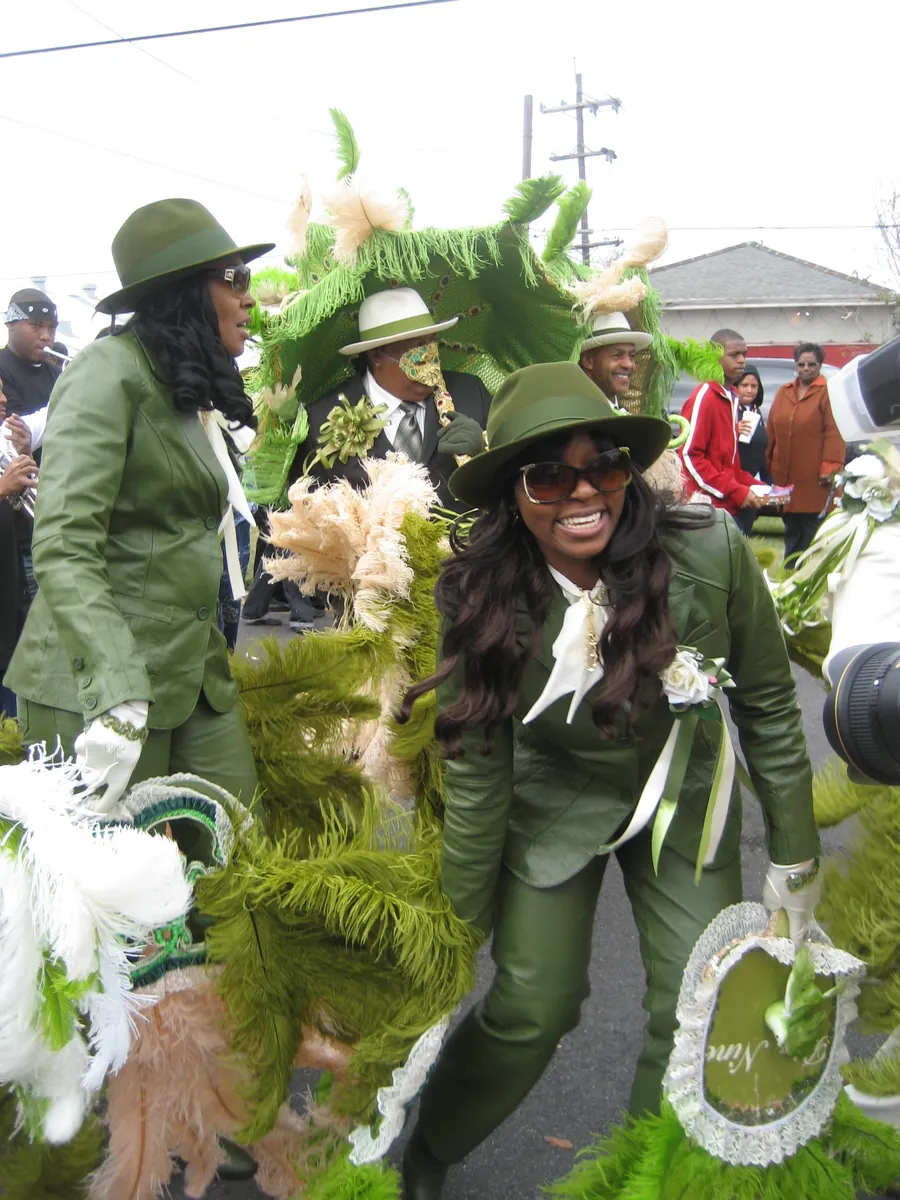
Every Sunday from September through May, somewhere in New Orleans, a Social Aid and Pleasure Club steps into its neighborhood with a brass band, a banner, and its colors. The first line — the club members and the musicians — sets the route. The second line is everyone else: whoever hears the horns, walks out, and follows.
This is the heart of Black New Orleans street culture. Not a parade organized for outsiders. A community ritual, continuous since the late 19th century, that belongs to the people who march it.
Each club has its own colors, its own banner, its own route. Some have marched the same streets for over a hundred years. The route is the club's — the neighborhood it claims, the blocks it walks, the place it returns to week after week, season after season.
You go because the second line is open. You show up, you follow the music, you join the line. That's the form. WWOZ publishes the weekly schedule and route maps at wwoz.org. Find the route. Show up. Walk.
- ·Second lines are neighborhood parades organized by Social Aid and Pleasure Clubs — the heart of Black New Orleans street culture.
- ·The 'first line' is the club and the brass band; the 'second line' is everyone who joins in.
- ·There are second lines nearly every Sunday from September through May, each following a route through the sponsoring club's neighborhood.
- ·This is not a performance for tourists — it is a community ritual continuous since the late 19th century.
- ·Each club has its own colors, banner, and route — some have marched the same streets for over 100 years.
- ·Check WWOZ (wwoz.org) for the weekly second line schedule and route maps. Show up, follow the music, join the line.
Memories
Editorial content compiled with AI assistance. Place details verified against public records.