The bluff is the first defensible high ground north of the river's delta, and every people who held this territory understood why. The Houma and Bayougoula marked the boundary between their lands with a red-stained pole at the top of it — Iberville noted it in 1699. The British built Fort New Richmond there in 1763; Gálvez captured it for Spain in 1779, a battle of the American Revolution fought in British West Florida. Federal gunboats shelled it in 1862 and the Confederacy lost the state. The USS Kidd sits downriver from the surrender bluff; the cemeteries hold both sides' dead.
The route
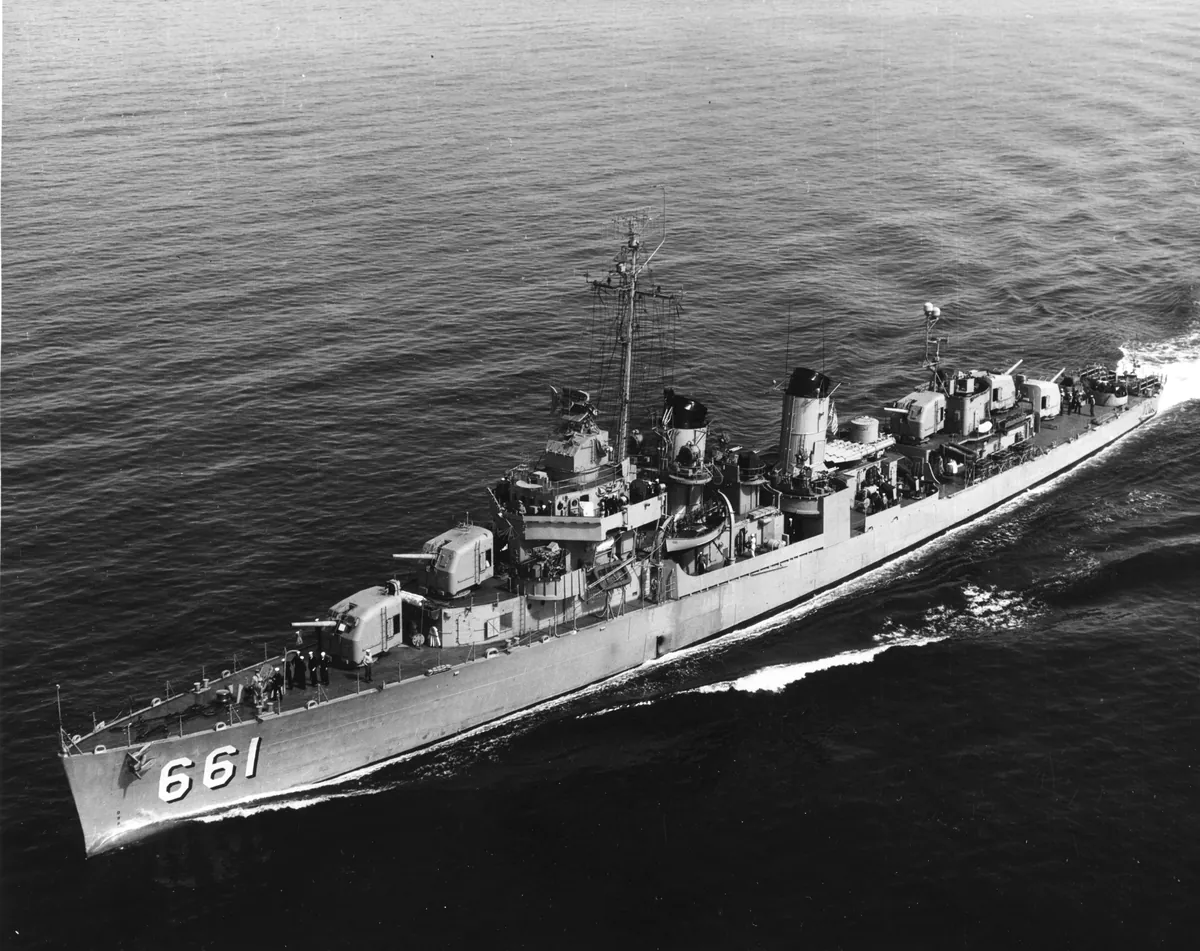 1Military·1943·NRHPUSS Kidd Veterans Museum
The Fletcher-class destroyer slid down the ways at Kearny, New Jersey on 28 February 1943, named for Rear Admiral Isaac C. Kidd, the first American flag officer killed in action—he died on the bridge of USS Arizona at Pearl Harbor. The widow sponsored the launch. But during the ship's initial cruise to the Brooklyn Navy Yard, she sailed across New York Harbor with the Jolly Roger flying from the foremast. The crew had adopted pirate captain William Kidd as their mascot and commissioned a local artist to paint a pirate on the forward smokestack. The skull-and-crossbones stayed. USS Kidd fought in virtually every major Pacific campaign from 1943 through the end of World War II. She screened carriers striking Wake Island in October 1943, rescued a downed Essex aircrew under Japanese attack off Rabaul in November while dodging torpedoes and bombs—shooting down three attackers—and bombarded Roi, Wotje, and Guam through the Gilbert and Marshall Islands campaigns. She entered Leyte Gulf on 20 October 1944 for the Philippines invasion, then joined Task Force 58 for Okinawa in early 1945. On picket station on 11 April 1945, a kamikaze crashed into Kidd, killing 38 men and wounding 55. Her fire drove off follow-up attackers as she limped south. She decommissioned in December 1946. Recommissioned in March 1951 for Korea, she bombarded targets from Wan-Do Island to south of Koesong through January 1952, then alternated West Pacific anti-Soviet submarine patrols with West Coast operations through 1959. After Atlantic Reserve training duty and a Caribbean "show of force" patrol during the 1961 Dominican crisis, she decommissioned for the last time on 19 June 1964. Kidd was never modernized. She is one of four remaining Fletcher-class destroyers in the world—the only one restored to her World War II configuration. Louisiana Congressman William Henson Moore selected her to serve as a memorial for Louisiana World War II veterans. She was towed from Philadelphia and arrived in Baton Rouge on 23 May 1982. She was designated a National Historic Landmark in 1986 as the best-preserved World War II destroyer of her class. Her special mooring in the Mississippi is designed to cope with the annual change in river depth, which can be up to 40 feet—half the year she floats as the river rises; the other half she sits on keel blocks, her entire hull visible when the water is low. In 2023, the Louisiana legislature approved approximately $10 million to fund drydocking after four small hull leaks appeared in September 2019—the ship had last been drydocked in Philadelphia in 1962. In 2025, the legislature approved an additional approximately $4 million to complete unanticipated repairs discoverable only after hull blasting. On 29 April 2024, Kidd began a three-day journey down the Mississippi, through the Gulf, and up the Houma Navigational Canal to Thoma-Sea Marine Constructors. She entered drydock on 13 August 2024. While there, the museum backfit two areas of the ship's interior, removing Cold War-era modifications to allow Kidd to become the only destroyer capable of presenting the segregated sleeping space for African American and other minority crew members that existed prior to 1948. She was repainted in her Measure 32/10D "dazzle" camouflage from 1944 as part of a limited-period rotating educational effort—she will ultimately return to her 1945 Measure 22 camouflage. Kidd left drydock on 11 November 2025 and was to remain in the shipyard until spring 2026, when the Mississippi rises high enough to allow her return to the mooring cradle in Baton Rouge. She is docked on the Mississippi in downtown Baton Rouge, accessible via River Road. Open daily 9:30am–3:30pm. Self-guided tours take visitors through berthing compartments, the bridge, engine rooms, and gun mounts. A P-40 Warhawk aircraft and Vietnam-era patrol boat are on display at the adjacent veterans memorial park. Admission charged.
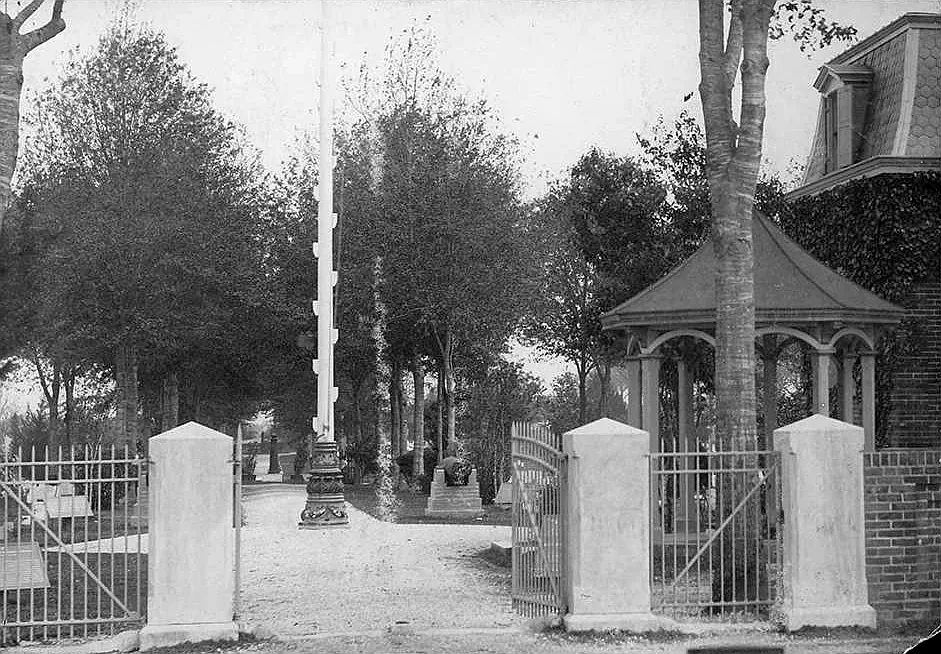 2Religious Site·1867·NRHPBaton Rouge National Cemetery
Burials started here in 1830, decades before there was a national cemetery, before there was a war that would make one necessary. The ground that would become Baton Rouge National Cemetery was already holding the dead when the war came to the river. During the Civil War, soldiers who died in Baton Rouge and at the battles of Plaquemine and Camden were buried here. In 1867, it became an official National Cemetery. The government offered rewards to anyone who could report the grave of a Union soldier so the remains could be moved to this ground. Over 3,500 Civil War dead are interred here, including hundreds of United States Colored Troops. Many have no names in the official records. In 1878, two men named Michael and Bernard Jodd were hired to build a brick wall around the cemetery, replacing the picket fence. Before they finished, both contracted yellow fever. They died in September 1878 and were buried here. Local laborers completed the wall. The cemetery sits adjacent to Magnolia Cemetery, the city's oldest burial ground — a continuous landscape of the dead from both sides of the war. As of 2020, more than 5,000 people were interred here across 7.7 acres. It is still an active national cemetery for veterans. New burials continue. General Philemon Thomas, who commanded the forces that captured the fort of Baton Rouge in 1810 and fought in both the Revolutionary War and the War of 1812, was reinterred here in 1886. Lieutenant General Troy Houston Middleton, a World War II veteran who became president of Louisiana State University, is buried here. In 1909, the Commonwealth of Massachusetts erected a monument honoring the officers of the 31st and 41st Infantry and the men from Massachusetts who died in the Department of the Gulf during the Civil War. The cemetery is maintained by the U.S. Department of Veterans Affairs. Open daily dawn to dusk. Free.
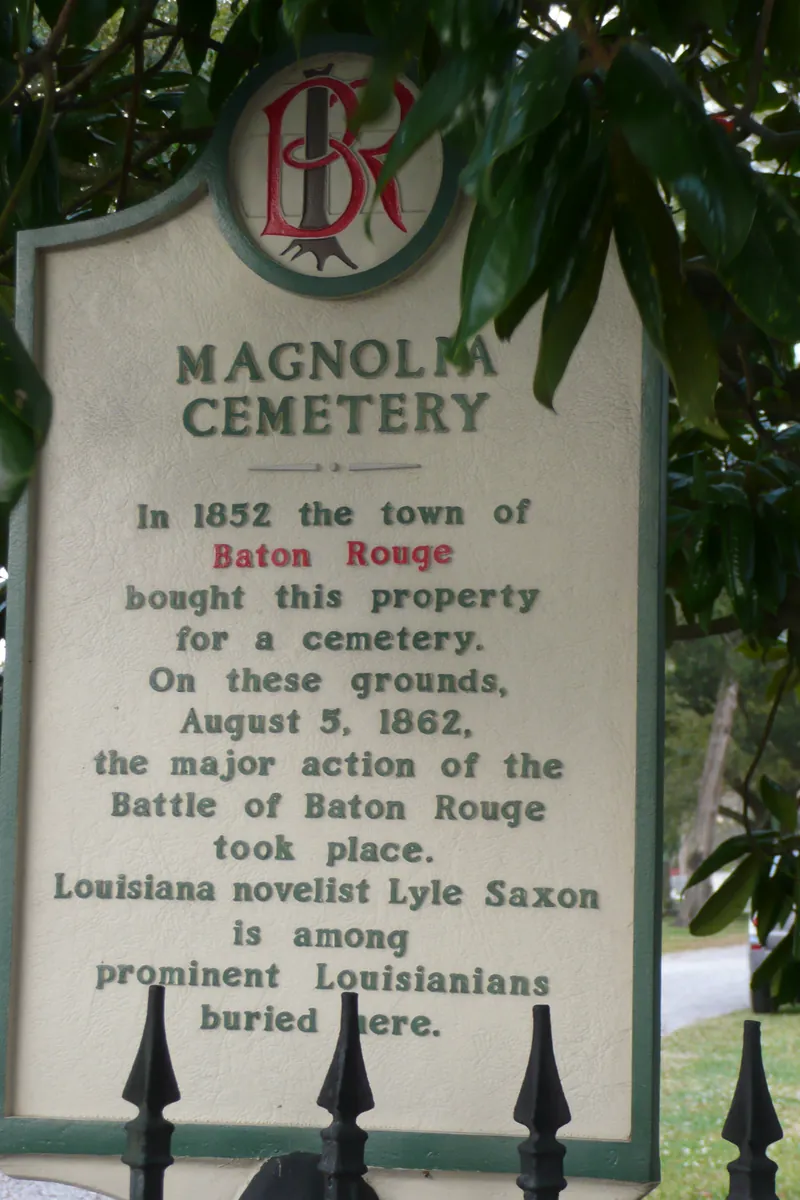 3Religious Site·1852·NRHPMagnolia Cemetery
Ten acres of marble and iron hold the names that built antebellum Baton Rouge. Established in the 1850s, Magnolia Cemetery is the city's oldest surviving burial ground — French surnames beside Spanish beside English beside Creole, the headstones reading like a ledger of who held power, who held land, and who worked it. Planters and politicians rest here. So do Confederate soldiers, and enslaved people whose graves mostly carry no markers at all. The cemetery sits adjacent to the National Cemetery on North 19th Street, between Capitol Lake and the rows of military dead. Its proximity to the battlefield meant it received the dead from both sides of the Battle of Baton Rouge on August 5, 1862. The fighting came close enough that the cemetery became common ground — Union and Confederate buried in the same ten acres. What survives is a catalog of who the city was before the war. The gates stay open daily. No formal hours. Walk the rows and you're reading the census of a place shaped by layered claims: French colonists established a military post here in 1721, at the site of the red stick boundary marker between the Houma and Bayagoula nations. The British took it after 1763. Acadian exiles settled the surrounding parishes, maintaining their Catholic faith and separate culture. By the time Baton Rouge became state capital in 1849, it had already been three different colonial possessions. The people who made it that way — the planters and politicians, the soldiers and the enslaved — are here, their names carved in stone or lost entirely, sorted by the same hierarchies that sorted them in life.
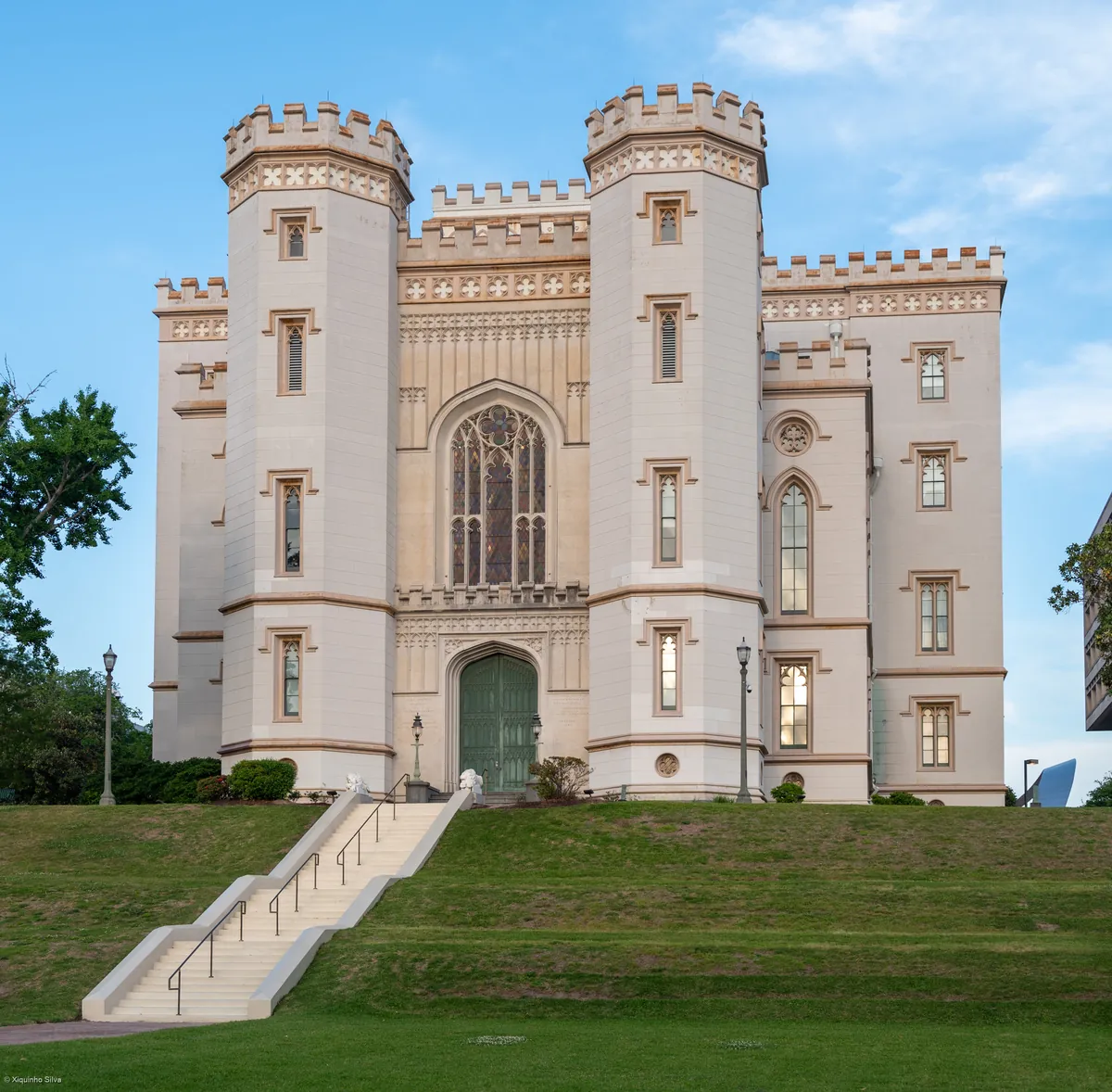 4Architecture·1852·NRHPOld State Capitol
Mark Twain piloted steamboats past this bluff in the 1850s and loathed the sight of it: "It is pathetic ... that a whitewashed castle, with turrets and things ... should ever have been built in this otherwise honorable place." The insult only increased its fame. The building had been designed by New York architect James H. Dakin after the state legislature decided in 1846 to move the seat of government from New Orleans to Baton Rouge—a city of 2,269 people facing down the fourth-largest metropolis in the United States. Representatives from other parts of Louisiana feared a concentration of power. Baton Rouge donated a $20,000 parcel of land atop a bluff facing the Mississippi in 1847, and Dakin gave them a Neo-Gothic medieval-style castle instead of the standard national Capitol knockoff most states commissioned. By 1859 it was featured favorably in De Bow's Review, the most prestigious periodical in the antebellum South. In 1862, after Union Admiral David Farragut captured New Orleans, the seat of government retreated from Baton Rouge. Union forces used the castle first as a prison, then as a garrison for African-American troops under General Culver Grover. The building caught fire twice while used as a garrison, leaving Louisiana's capitol a gutted shell. By 1882 architect William A. Freret had rebuilt it completely, installing the spiral staircase and stained glass dome that define the interior now. The legislature met here until 1932, when it was abandoned for the new Louisiana State Capitol building. Restored in the 1990s, it now houses the Museum of Political History—exhibits on Louisiana's governors, original gubernatorial ballots, an interactive gallery featuring figures including Huey P. Long. A theatrical production called "The Ghost of the Castle" brings visitors face to face with Sarah Morgan Dawson, a young Baton Rouge resident who loved the castle and wrote about it in her Civil War diary. Admission is free. The staircase and dome are reason enough to go.