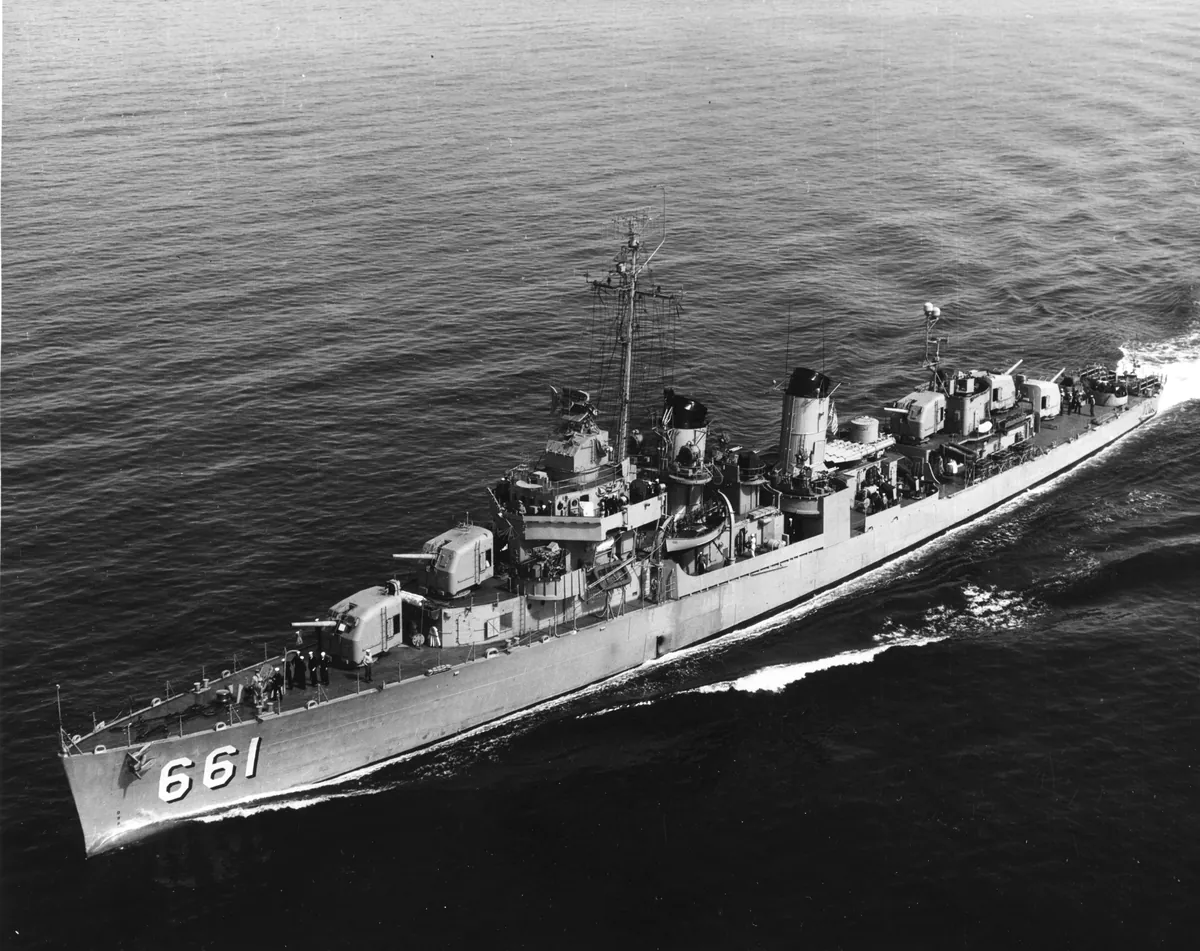
The Fletcher-class destroyer slid down the ways at Kearny, New Jersey on 28 February 1943, named for Rear Admiral Isaac C. Kidd, the first American flag officer killed in action—he died on the bridge of USS Arizona at Pearl Harbor. The widow sponsored the launch. But during the ship's initial cruise to the Brooklyn Navy Yard, she sailed across New York Harbor with the Jolly Roger flying from the foremast. The crew had adopted pirate captain William Kidd as their mascot and commissioned a local artist to paint a pirate on the forward smokestack. The skull-and-crossbones stayed.
USS Kidd fought in virtually every major Pacific campaign from 1943 through the end of World War II. She screened carriers striking Wake Island in October 1943, rescued a downed Essex aircrew under Japanese attack off Rabaul in November while dodging torpedoes and bombs—shooting down three attackers—and bombarded Roi, Wotje, and Guam through the Gilbert and Marshall Islands campaigns. She entered Leyte Gulf on 20 October 1944 for the Philippines invasion, then joined Task Force 58 for Okinawa in early 1945. On picket station on 11 April 1945, a kamikaze crashed into Kidd, killing 38 men and wounding 55. Her fire drove off follow-up attackers as she limped south. She decommissioned in December 1946.
Recommissioned in March 1951 for Korea, she bombarded targets from Wan-Do Island to south of Koesong through January 1952, then alternated West Pacific anti-Soviet submarine patrols with West Coast operations through 1959. After Atlantic Reserve training duty and a Caribbean "show of force" patrol during the 1961 Dominican crisis, she decommissioned for the last time on 19 June 1964.
Kidd was never modernized. She is one of four remaining Fletcher-class destroyers in the world—the only one restored to her World War II configuration. Louisiana Congressman William Henson Moore selected her to serve as a memorial for Louisiana World War II veterans. She was towed from Philadelphia and arrived in Baton Rouge on 23 May 1982. She was designated a National Historic Landmark in 1986 as the best-preserved World War II destroyer of her class. Her special mooring in the Mississippi is designed to cope with the annual change in river depth, which can be up to 40 feet—half the year she floats as the river rises; the other half she sits on keel blocks, her entire hull visible when the water is low.
In 2023, the Louisiana legislature approved approximately $10 million to fund drydocking after four small hull leaks appeared in September 2019—the ship had last been drydocked in Philadelphia in 1962. In 2025, the legislature approved an additional approximately $4 million to complete unanticipated repairs discoverable only after hull blasting. On 29 April 2024, Kidd began a three-day journey down the Mississippi, through the Gulf, and up the Houma Navigational Canal to Thoma-Sea Marine Constructors. She entered drydock on 13 August 2024. While there, the museum backfit two areas of the ship's interior, removing Cold War-era modifications to allow Kidd to become the only destroyer capable of presenting the segregated sleeping space for African American and other minority crew members that existed prior to 1948. She was repainted in her Measure 32/10D "dazzle" camouflage from 1944 as part of a limited-period rotating educational effort—she will ultimately return to her 1945 Measure 22 camouflage. Kidd left drydock on 11 November 2025 and was to remain in the shipyard until spring 2026, when the Mississippi rises high enough to allow her return to the mooring cradle in Baton Rouge.
She is docked on the Mississippi in downtown Baton Rouge, accessible via River Road. Open daily 9:30am–3:30pm. Self-guided tours take visitors through berthing compartments, the bridge, engine rooms, and gun mounts. A P-40 Warhawk aircraft and Vietnam-era patrol boat are on display at the adjacent veterans memorial park. Admission charged.
- ·Named officially for Rear Admiral Isaac Kidd, killed at Pearl Harbor, but the crew adopted pirate Captain William Kidd as their unofficial mascot and painted a Jolly Roger on the smokestack.
- ·The Fletcher-class destroyer served in virtually every major Pacific campaign from 1943 through the end of WWII, including Okinawa.
- ·The Kidd is one of only four Fletcher-class destroyers preserved as museum ships in the United States.
- ·The ship is permanently docked on the Mississippi River in downtown Baton Rouge, accessible via River Road.
- ·A P-40 Warhawk aircraft and Vietnam-era patrol boat are also on display at the adjacent veterans memorial park.
- ·Open daily 9:30am–3:30pm. Admission charged. Self-guided tours take visitors through berthing compartments, the bridge, engine rooms, and gun mounts.
Memories
Editorial content compiled with AI assistance. Place details verified against public records.