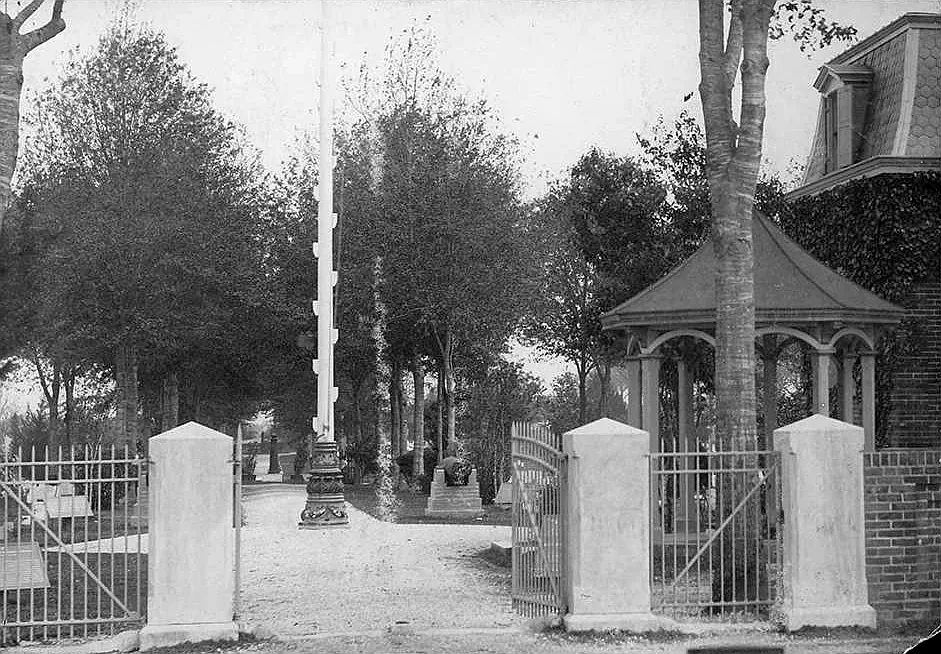
Burials started here in 1830, decades before there was a national cemetery, before there was a war that would make one necessary. The ground that would become Baton Rouge National Cemetery was already holding the dead when the war came to the river.
During the Civil War, soldiers who died in Baton Rouge and at the battles of Plaquemine and Camden were buried here. In 1867, it became an official National Cemetery. The government offered rewards to anyone who could report the grave of a Union soldier so the remains could be moved to this ground. Over 3,500 Civil War dead are interred here, including hundreds of United States Colored Troops. Many have no names in the official records.
In 1878, two men named Michael and Bernard Jodd were hired to build a brick wall around the cemetery, replacing the picket fence. Before they finished, both contracted yellow fever. They died in September 1878 and were buried here. Local laborers completed the wall.
The cemetery sits adjacent to Magnolia Cemetery, the city's oldest burial ground — a continuous landscape of the dead from both sides of the war. As of 2020, more than 5,000 people were interred here across 7.7 acres. It is still an active national cemetery for veterans. New burials continue.
General Philemon Thomas, who commanded the forces that captured the fort of Baton Rouge in 1810 and fought in both the Revolutionary War and the War of 1812, was reinterred here in 1886. Lieutenant General Troy Houston Middleton, a World War II veteran who became president of Louisiana State University, is buried here. In 1909, the Commonwealth of Massachusetts erected a monument honoring the officers of the 31st and 41st Infantry and the men from Massachusetts who died in the Department of the Gulf during the Civil War.
The cemetery is maintained by the U.S. Department of Veterans Affairs. Open daily dawn to dusk. Free.
- ·Established in 1867 to reinter Union soldiers who died during the occupation of Baton Rouge.
- ·Over 3,500 Civil War burials, including hundreds of United States Colored Troops — many unnamed in official records.
- ·Adjacent to Magnolia Cemetery, the city's oldest burial ground, creating a continuous landscape of the dead from both sides of the war.
- ·Still an active national cemetery for veterans — new burials continue today.
- ·Maintained by the U.S. Department of Veterans Affairs. Open daily dawn to dusk. Free.
Memories
Editorial content compiled with AI assistance. Place details verified against public records.