The Mississippi is the reason Baton Rouge exists — and the reason it almost doesn't. The Port of Greater Baton Rouge moves more tonnage than Los Angeles. LSU's Center for River Studies operates a 10,000-square-foot physical model of the delta where the Corps still tests scenarios. The Old River Control Structure, 30 miles north, is what keeps the Mississippi from abandoning Baton Rouge for the Atchafalaya — the most important piece of infrastructure most Americans have never heard of. The river is fought every spring.
The route
 1Historic SitePort of Baton Rouge
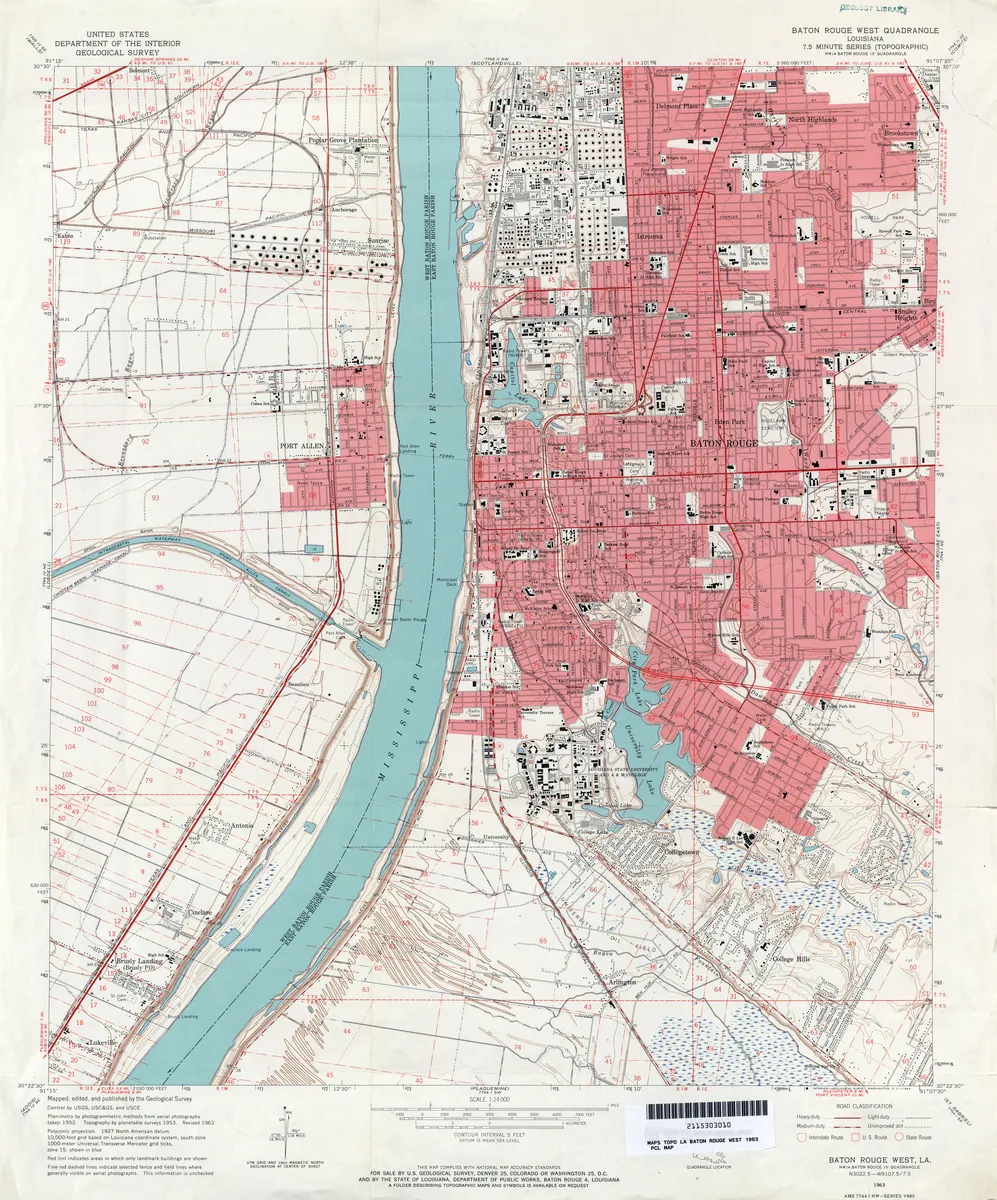
The Mississippi shapes everything here — the city exists because of the bluff, but it endures because of the port. This is the farthest inland deepwater port in the United States, 228 miles from the Gulf of Mexico, a geographic fact that made Baton Rouge indispensable before anyone knew what petrochemicals were. Ocean-going vessels from more than forty countries navigate upriver to dock beside the refineries lining the north bank, transferring cargo onto rails, pipelines, and barges before the river shallows and the Old Huey Long Bridge blocks passage for deep-draft ships. The port handles more tonnage than the ports of Los Angeles and Long Beach combined. It is the ninth-largest port in the United States by tonnage shipped and the farthest upstream Mississippi River port capable of handling Panamax ships. The city developed on the Istrouma Bluff — the first natural bluff upriver from the Mississippi River Delta — allowing a business quarter safe from seasonal flooding. That elevation made settlement possible in 1721; the depth of the channel made industry inevitable two centuries later. Baton Rouge's largest industry is petrochemical production and manufacturing. ExxonMobil's Baton Rouge Refinery complex is the fifth-largest oil refinery in the country and the tenth largest in the world. The refineries, the port, the river — this is why the city stays economically significant after the capital could have moved anywhere. The port is an active industrial facility, not a visitor attraction. The best vantage is from the River Road levee, where you can watch ships that crossed an ocean offload grain and chemicals onto a working waterway that has never stopped being the reason this place exists.
 2Military·1943·NRHPUSS Kidd Veterans Museum
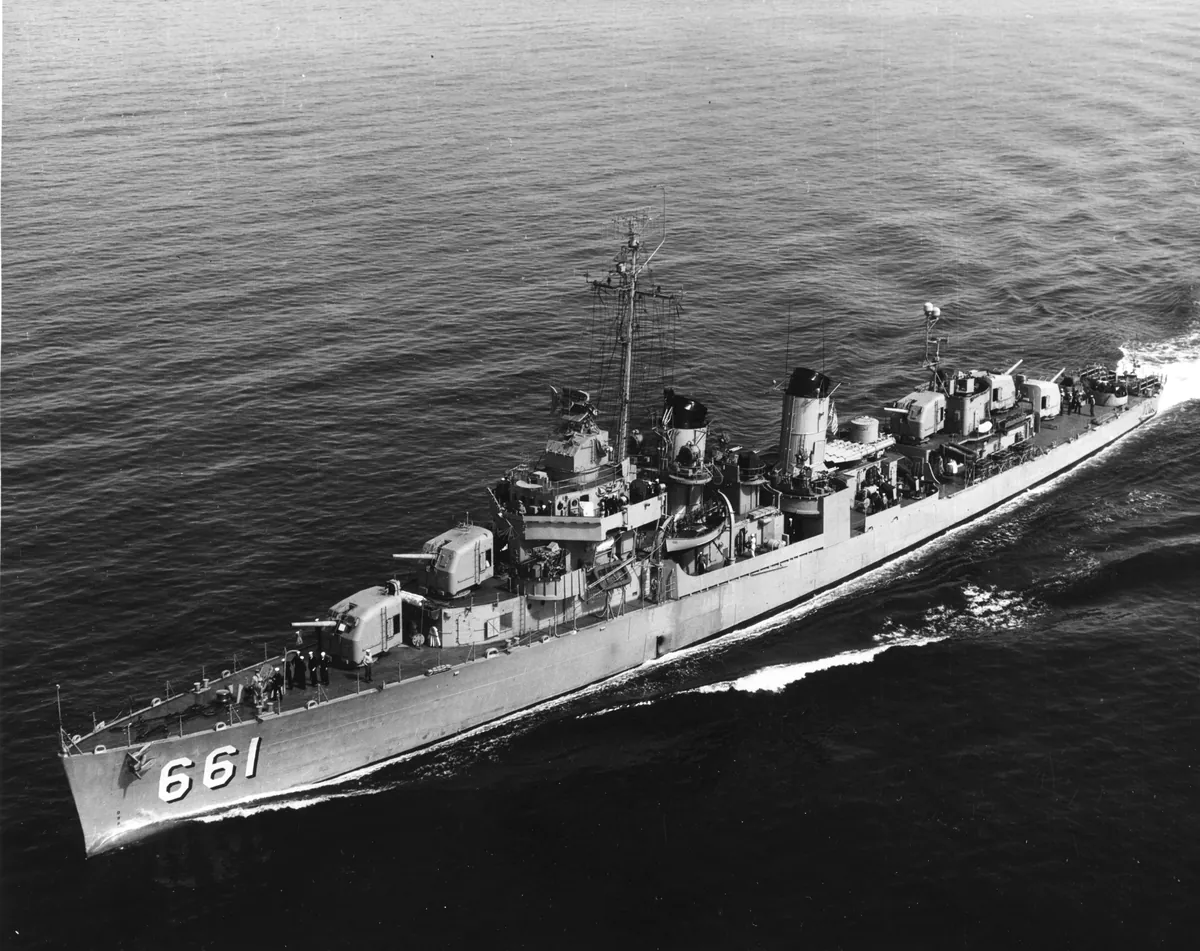
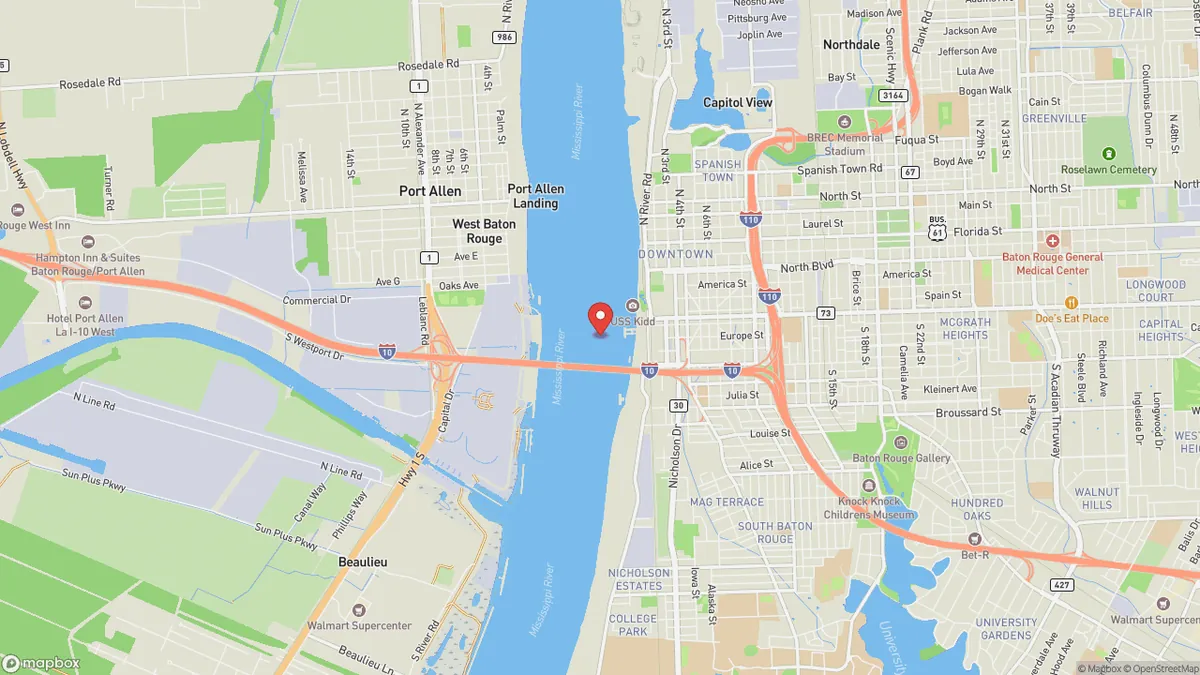
The Fletcher-class destroyer slid down the ways at Kearny, New Jersey on 28 February 1943, named for Rear Admiral Isaac C. Kidd, the first American flag officer killed in action—he died on the bridge of USS Arizona at Pearl Harbor. The widow sponsored the launch. But during the ship's initial cruise to the Brooklyn Navy Yard, she sailed across New York Harbor with the Jolly Roger flying from the foremast. The crew had adopted pirate captain William Kidd as their mascot and commissioned a local artist to paint a pirate on the forward smokestack. The skull-and-crossbones stayed. USS Kidd fought in virtually every major Pacific campaign from 1943 through the end of World War II. She screened carriers striking Wake Island in October 1943, rescued a downed Essex aircrew under Japanese attack off Rabaul in November while dodging torpedoes and bombs—shooting down three attackers—and bombarded Roi, Wotje, and Guam through the Gilbert and Marshall Islands campaigns. She entered Leyte Gulf on 20 October 1944 for the Philippines invasion, then joined Task Force 58 for Okinawa in early 1945. On picket station on 11 April 1945, a kamikaze crashed into Kidd, killing 38 men and wounding 55. Her fire drove off follow-up attackers as she limped south. She decommissioned in December 1946. Recommissioned in March 1951 for Korea, she bombarded targets from Wan-Do Island to south of Koesong through January 1952, then alternated West Pacific anti-Soviet submarine patrols with West Coast operations through 1959. After Atlantic Reserve training duty and a Caribbean "show of force" patrol during the 1961 Dominican crisis, she decommissioned for the last time on 19 June 1964. Kidd was never modernized. She is one of four remaining Fletcher-class destroyers in the world—the only one restored to her World War II configuration. Louisiana Congressman William Henson Moore selected her to serve as a memorial for Louisiana World War II veterans. She was towed from Philadelphia and arrived in Baton Rouge on 23 May 1982. She was designated a National Historic Landmark in 1986 as the best-preserved World War II destroyer of her class. Her special mooring in the Mississippi is designed to cope with the annual change in river depth, which can be up to 40 feet—half the year she floats as the river rises; the other half she sits on keel blocks, her entire hull visible when the water is low. In 2023, the Louisiana legislature approved approximately $10 million to fund drydocking after four small hull leaks appeared in September 2019—the ship had last been drydocked in Philadelphia in 1962. In 2025, the legislature approved an additional approximately $4 million to complete unanticipated repairs discoverable only after hull blasting. On 29 April 2024, Kidd began a three-day journey down the Mississippi, through the Gulf, and up the Houma Navigational Canal to Thoma-Sea Marine Constructors. She entered drydock on 13 August 2024. While there, the museum backfit two areas of the ship's interior, removing Cold War-era modifications to allow Kidd to become the only destroyer capable of presenting the segregated sleeping space for African American and other minority crew members that existed prior to 1948. She was repainted in her Measure 32/10D "dazzle" camouflage from 1944 as part of a limited-period rotating educational effort—she will ultimately return to her 1945 Measure 22 camouflage. Kidd left drydock on 11 November 2025 and was to remain in the shipyard until spring 2026, when the Mississippi rises high enough to allow her return to the mooring cradle in Baton Rouge. She is docked on the Mississippi in downtown Baton Rouge, accessible via River Road. Open daily 9:30am–3:30pm. Self-guided tours take visitors through berthing compartments, the bridge, engine rooms, and gun mounts. A P-40 Warhawk aircraft and Vietnam-era patrol boat are on display at the adjacent veterans memorial park. Admission charged.
 3Religious Site·1867·NRHPBaton Rouge National Cemetery
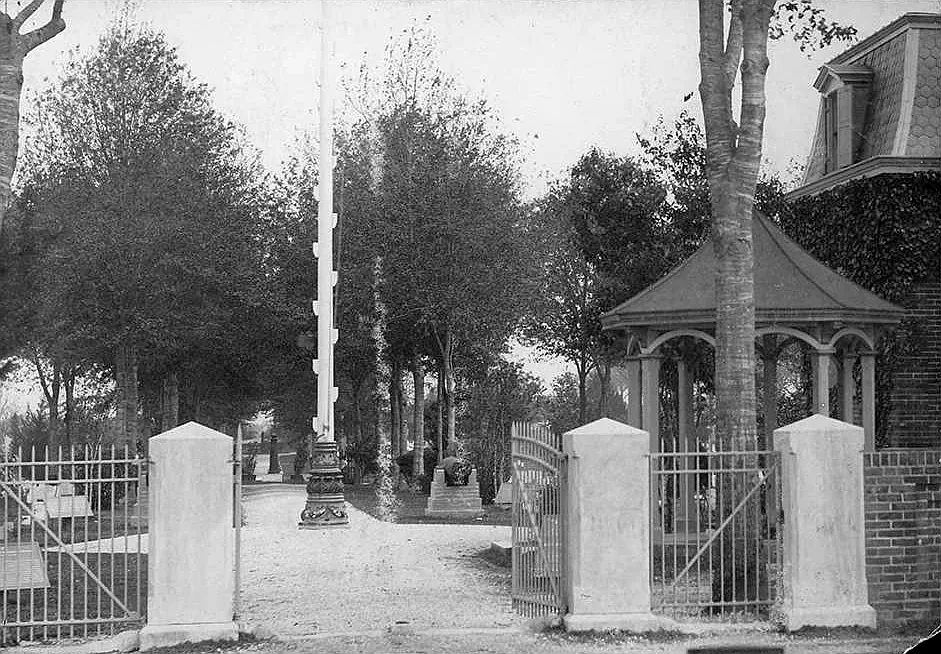
Burials started here in 1830, decades before there was a national cemetery, before there was a war that would make one necessary. The ground that would become Baton Rouge National Cemetery was already holding the dead when the war came to the river. During the Civil War, soldiers who died in Baton Rouge and at the battles of Plaquemine and Camden were buried here. In 1867, it became an official National Cemetery. The government offered rewards to anyone who could report the grave of a Union soldier so the remains could be moved to this ground. Over 3,500 Civil War dead are interred here, including hundreds of United States Colored Troops. Many have no names in the official records. In 1878, two men named Michael and Bernard Jodd were hired to build a brick wall around the cemetery, replacing the picket fence. Before they finished, both contracted yellow fever. They died in September 1878 and were buried here. Local laborers completed the wall. The cemetery sits adjacent to Magnolia Cemetery, the city's oldest burial ground — a continuous landscape of the dead from both sides of the war. As of 2020, more than 5,000 people were interred here across 7.7 acres. It is still an active national cemetery for veterans. New burials continue. General Philemon Thomas, who commanded the forces that captured the fort of Baton Rouge in 1810 and fought in both the Revolutionary War and the War of 1812, was reinterred here in 1886. Lieutenant General Troy Houston Middleton, a World War II veteran who became president of Louisiana State University, is buried here. In 1909, the Commonwealth of Massachusetts erected a monument honoring the officers of the 31st and 41st Infantry and the men from Massachusetts who died in the Department of the Gulf during the Civil War. The cemetery is maintained by the U.S. Department of Veterans Affairs. Open daily dawn to dusk. Free.
 4Cultural Heritage·1930sCapitol Lakes
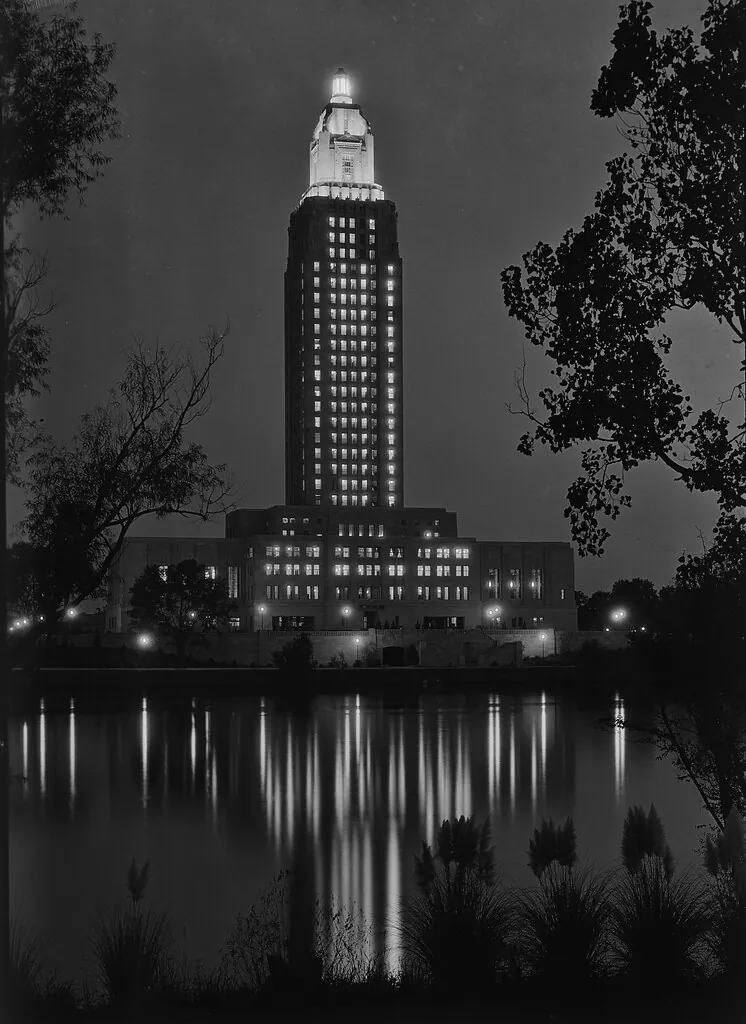
Three man-made lakes stretch south from the State Capitol through the center of the city, created as part of Huey Long's Capitol complex development in the 1930s. On clear mornings the Capitol building reflects in the water at the north end. Egrets and herons work the banks year-round. Joggers circle the perimeter at dawn, and the path stays popular all day. The lakes are free and open daily — Long built a monumental capital, and left the foreground accessible.
 5Nature & ParksLSU Center for River Studies — Water Campus
Twenty ceiling-mounted projectors light a 10,000-square-foot physical model of the Mississippi River Delta. Pumps push actual water and sediment through 179 miles of river recreated at exact scale. You watch storm surge, sediment flow, and coastal land loss play out in real time across the miniature coast. Louisiana loses roughly a football field of coastline every 100 minutes. This is the most tangible way to understand why. The model is the centerpiece of the LSU Center for River Studies, housed in the Water Campus — a $1.5 billion mixed-use research district on the downtown riverfront. The campus is anchored by LSU, the Coastal Protection and Restoration Authority, and The Water Institute of the Gulf. These are the institutions working out what the state plans to do about the disappearing coast, and this exhibit makes their work visible to anyone who walks in. Free admission. Guided presentations at 2pm and 4pm on First Free Sundays. Located at 1110 River Road South.