Vicksburg's mansions are not architecture, they are siege evidence. McRaven stacks 1797 frontier cottage, 1836 empire, and 1849 Greek Revival in one structure. Cedar Grove still has the Union cannonball lodged in its parlor wall. The Balfours hosted the Confederate Christmas ball on December 17, 1862 — a courier interrupted the dancing to announce Sherman's gunboats on the Yazoo. Duff Green served as a hospital for both armies. Anchuca housed Jefferson Davis's brother Joseph. The walls remember the 47 days.
The route
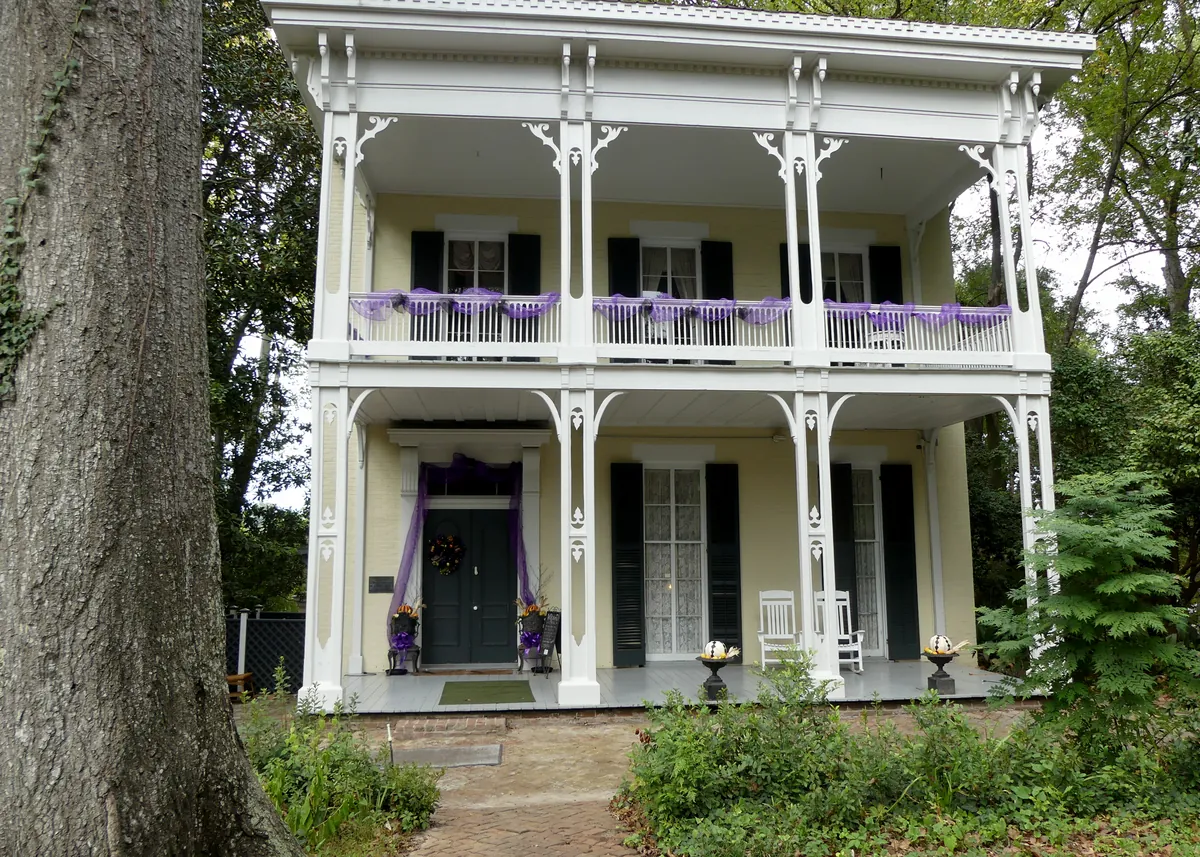 1Architecture·1797 / 1836 / 1849·NRHPMcRaven Tour Home
Andrew Glass built a kitchen with one room above it around 1797 in the town of Walnut Hills — what would become Vicksburg. The structure served as a way station for pioneers traveling the Natchez Trace to the Mississippi River, bound for Nashville. That first section still stands. In 1836, Sheriff Stephen Howard bought the house and added a middle dining room with a bedroom above it, built in Empire architectural style. His wife Mary Elizabeth Howard died during childbirth in late August 1836 in that middle bedroom. John H. Bobb purchased the house in 1849 and built the rest of it in Greek Revival style. Three owners across fifty-two years, each adding a section in the architectural vocabulary of his era. National Geographic Magazine featured the house in its July 1963 issue and called it the "Time Capsule of the South." During the 1863 Siege of Vicksburg — the campaign that broke Confederate control of the Mississippi River and marked the war's turning point — the house was used as a Confederate field hospital and camp site. It stood close to the railroad, a major point of battle, and was battered by cannon blasts from both Union and Confederate forces. On May 18, 1864, John Bobb threw a brick at soldiers from the 46th United States Colored Infantry marching back from picket duty. The brick hit U.S. Sgt. William Anderson in the head, fracturing his skull. Sgt. Anderson shot Bobb in the head and bowels, resulting in Bobb's death. A Court Martial investigation found Anderson not guilty of malice for shooting a citizen. Sgt. Anderson died in August while stationed at Milliken's Bend, leaving a widow and small child behind. Census records from 1860 show Bobb was a farmer who enslaved 22 African Americans on this parcel of property. William Murray purchased the house in 1882. Murray and his wife Ellen Flynn raised four daughters and three sons there. William Murray died at the house in 1911, his wife Ellen in 1921, their daughter Ida in 1946, and a son in 1950. Two of William's daughters, Annie and Ella Murray, both unmarried, lived alone in the house with no modern conveniences aside from a telephone. In 1960, Ella Murray died at the age of 81. The house was in such disrepair that neighbors had no idea it existed. The upper story was completely overgrown with vines, and the sisters had resorted to chopping up antique furniture for firewood. The house was placed on the National Register of Historic Places on January 8, 1979. It has been called the most haunted house in Mississippi. History tours run Friday through Saturday 10am–4pm, Sunday 1–4:30pm. Haunted tours run Friday through Sunday evenings. The house is at 1445 Harrison Street. Admission is charged.
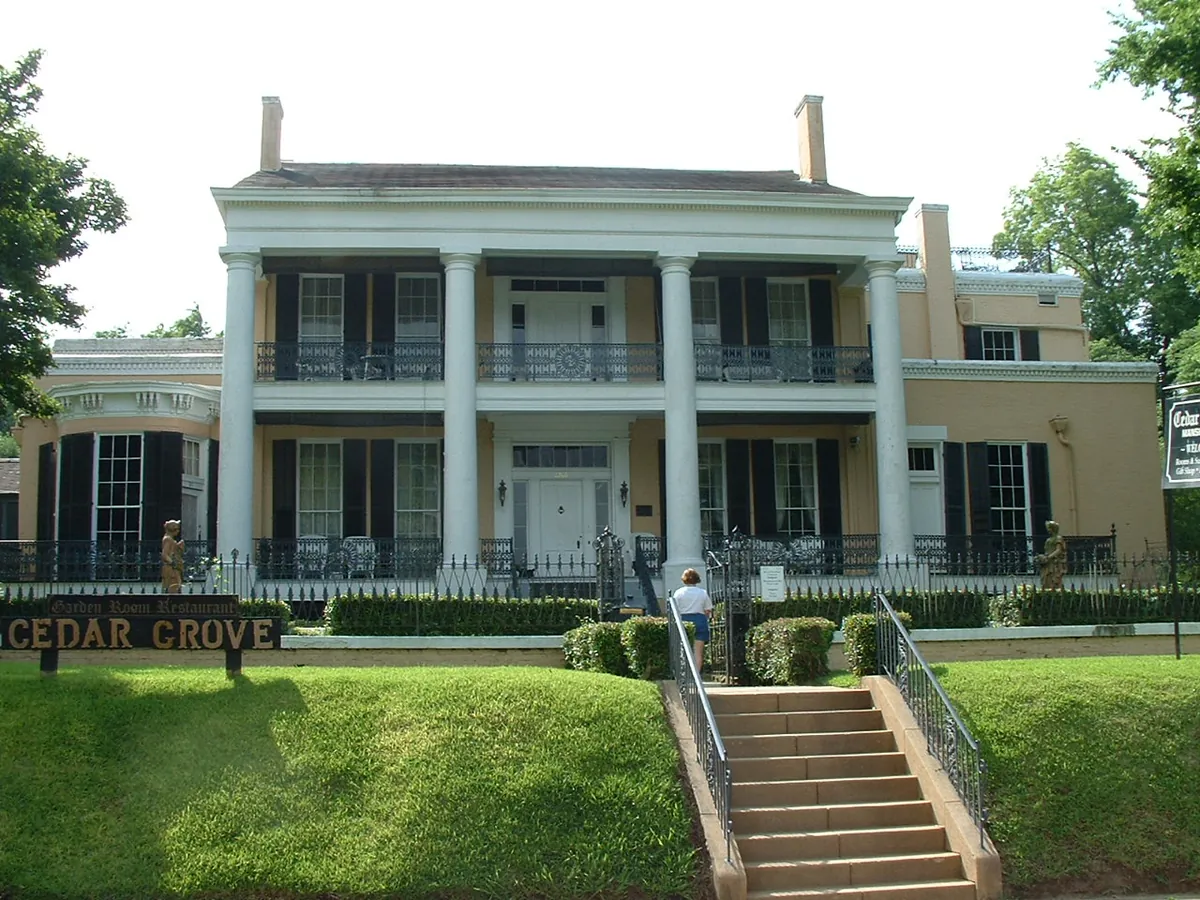 2Architecture·1840s·NRHPCedar Grove Mansion
A Union cannonball from 1863 sits embedded in the parlor wall, left exactly where it struck. The shell hit John Alexander Klein's Greek Revival mansion during the war that remade Vicksburg — the Confederate river-port whose July 1863 surrender, alongside Gettysburg, marked the conflict's turning point. Klein built the house in the 1840s with commanding views of the Mississippi, the water that made this city a strategic prize. The mansion is among the finest surviving examples of Greek Revival architecture in Vicksburg. Upper galleries overlook the river that drew French colonists to these bluffs in 1719, that made fortunes in the antebellum cotton years, that brought Union gunboats within range of parlor walls. The cannonball remains visible, a physical fact left unrepaired for more than a century and a half. Today Cedar Grove operates as The Inn at Cedar Grove — overnight stays, events, and tours. The mansion is at 2200 Oak Street. Check cedargrovemansion.com for tour and lodging information.
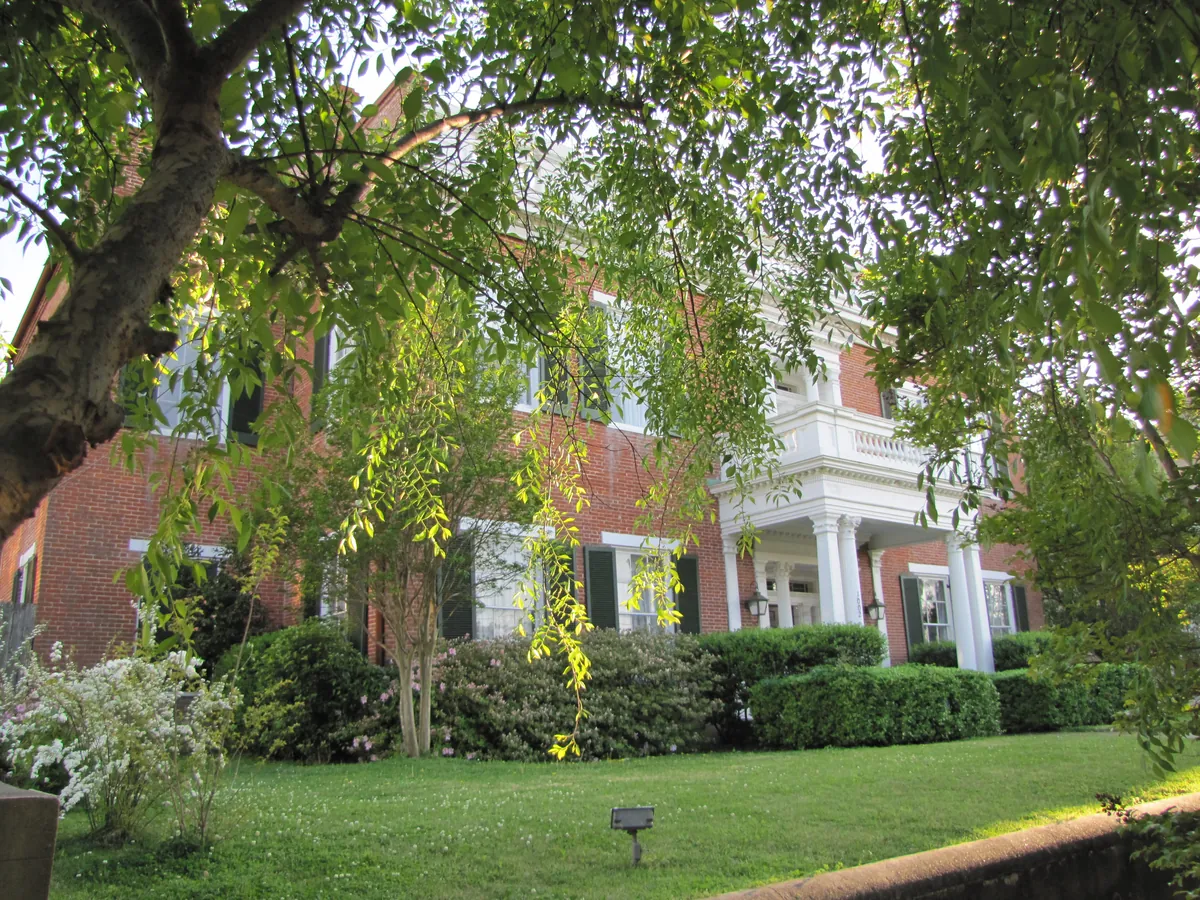 3Architecture·1835·NRHPBalfour House
Lincoln called Vicksburg "the key to the war," and on Christmas Eve 1862, that key nearly turned. William Balfour built this red-brick house in 1835, but it entered history three decades later when Emma Balfour — celebrated diarist of the Siege of Vicksburg — refused to abandon it. On the night of December 24, 1862, Confederate officers and their ladies filled the rooms for a grand Christmas Ball. Among them: Brig. Gen. Martin Luther Smith and Lt. Gen. Stephen D. Lee. Thirty-six miles north at Lake Providence, Major L.L. Daniel sent an urgent telegraph to the office across the Mississippi River in Louisiana. Philip H. Fall, a Western Union operator who had joined the Vicksburg Light Artillery, received it. The river was dangerously turbulent that night, the weather cold and stormy. The only transport across was a small skiff. Shortly after midnight, Fall — exhausted, covered in mud — burst through the door and waded into the crowd of dancers. He found General Smith and delivered the message. Smith announced loudly: "This ball is at an end! The enemy is coming down river. All non-combatants must leave the city!" On December 26 came the Battle of Chickasaw Bayou, the initial battle of the Vicksburg Campaign. During the siege that followed, most houses were abandoned for caves dug into hillsides for protection against mortar attacks. Emma Balfour stayed. She sheltered wounded Confederate soldiers and wrote: "What is to become of all the living things in this place when the boats commence shelling — God only knows — shut up as in a trap — no ingress or egress — and thousands of women and children..." After the Confederate surrender, the house served as headquarters of Union Maj. Gen. James B. McPherson. The elliptical spiral staircase with no center support remains among the finest in the South. Now a bed and breakfast offering tours. Check balfourhouse.com for hours.
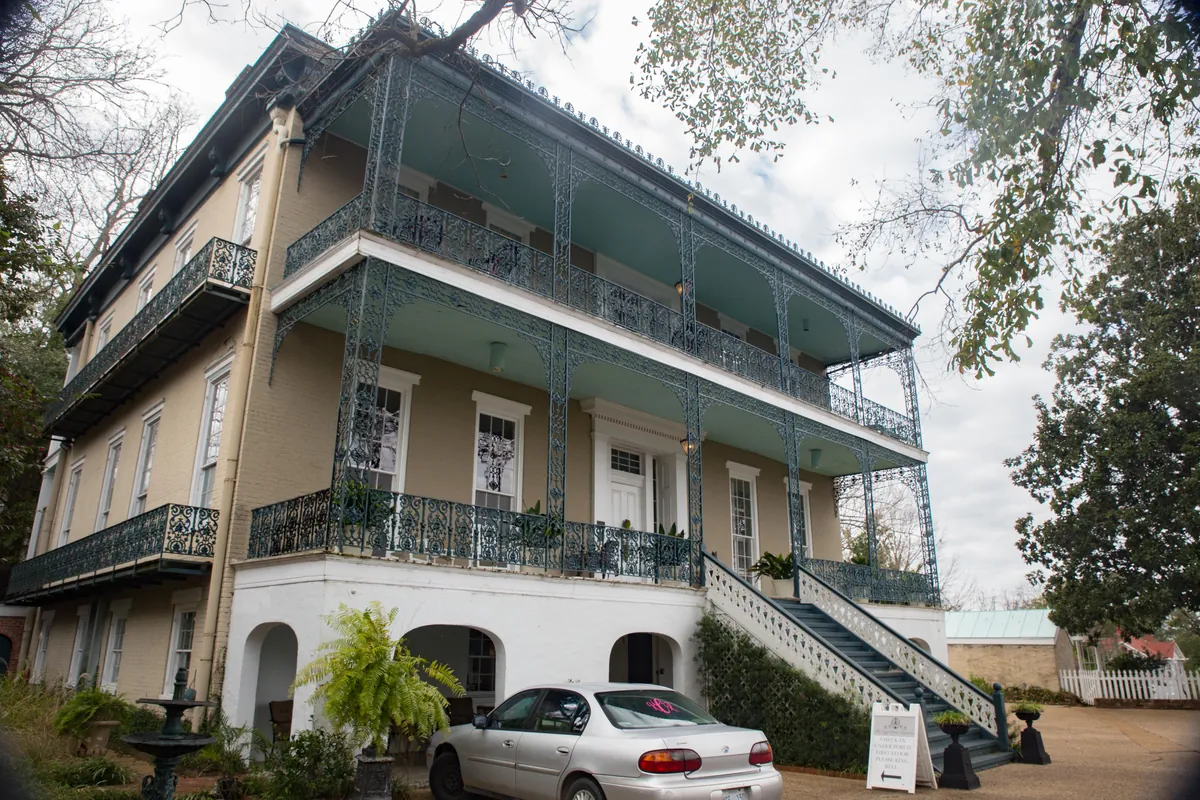 4Architecture·1856·NRHPDuff Green Mansion
When Duff Green built his Italianate mansion in 1856, Vicksburg was a river-port city whose bluff commanded the Mississippi. Seven years later, that elevation made it a Union target. The siege that broke the Confederacy in July 1863 also broke the mansion's peacetime purpose. It became a hospital for soldiers from both armies—wounded men stacked in rooms that shook with each bombardment from Grant's guns across the river. The shelling drove everyone underground. Behind the house was a cave, and into that cave went the patients, the surgeons, and the Green family. Mary Green gave birth there during the siege and named her son Siege Green, a name that carries the whole summer in two words. The siege ended when Vicksburg surrendered, a concurrent blow with Gettysburg that turned the war. The mansion survived. It stands now as a bed and breakfast at 1114 First East Street. You can tour it. What you're seeing is a house that held men from opposite armies while the city that controlled the Mississippi changed hands, and a cave where a child was born under fire and given a name no one would need explained.