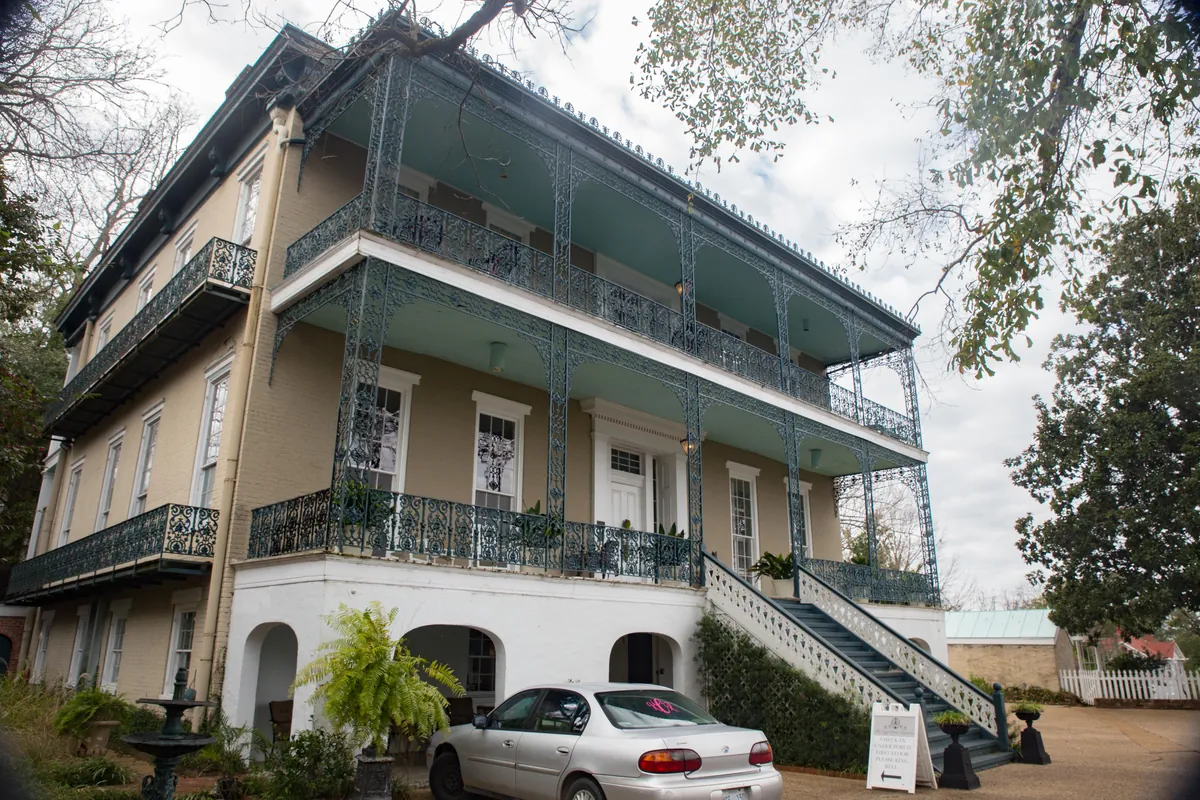
When Duff Green built his Italianate mansion in 1856, Vicksburg was a river-port city whose bluff commanded the Mississippi. Seven years later, that elevation made it a Union target. The siege that broke the Confederacy in July 1863 also broke the mansion's peacetime purpose. It became a hospital for soldiers from both armies—wounded men stacked in rooms that shook with each bombardment from Grant's guns across the river.
The shelling drove everyone underground. Behind the house was a cave, and into that cave went the patients, the surgeons, and the Green family. Mary Green gave birth there during the siege and named her son Siege Green, a name that carries the whole summer in two words. The siege ended when Vicksburg surrendered, a concurrent blow with Gettysburg that turned the war. The mansion survived.
It stands now as a bed and breakfast at 1114 First East Street. You can tour it. What you're seeing is a house that held men from opposite armies while the city that controlled the Mississippi changed hands, and a cave where a child was born under fire and given a name no one would need explained.
- ·Served as a hospital for both Confederate and Union soldiers during the 1863 siege.
- ·When shelling made the upper floors dangerous, patients and family moved to a cave behind the house.
- ·Mary Green gave birth to a son in the cave and named him Siege Green.
- ·Built 1856 in the Italianate style by Duff Green, a wealthy merchant.
- ·Now a bed and breakfast. Tours available.
- ·Located at 1114 First East Street.
Memories
Editorial content compiled with AI assistance. Place details verified against public records.