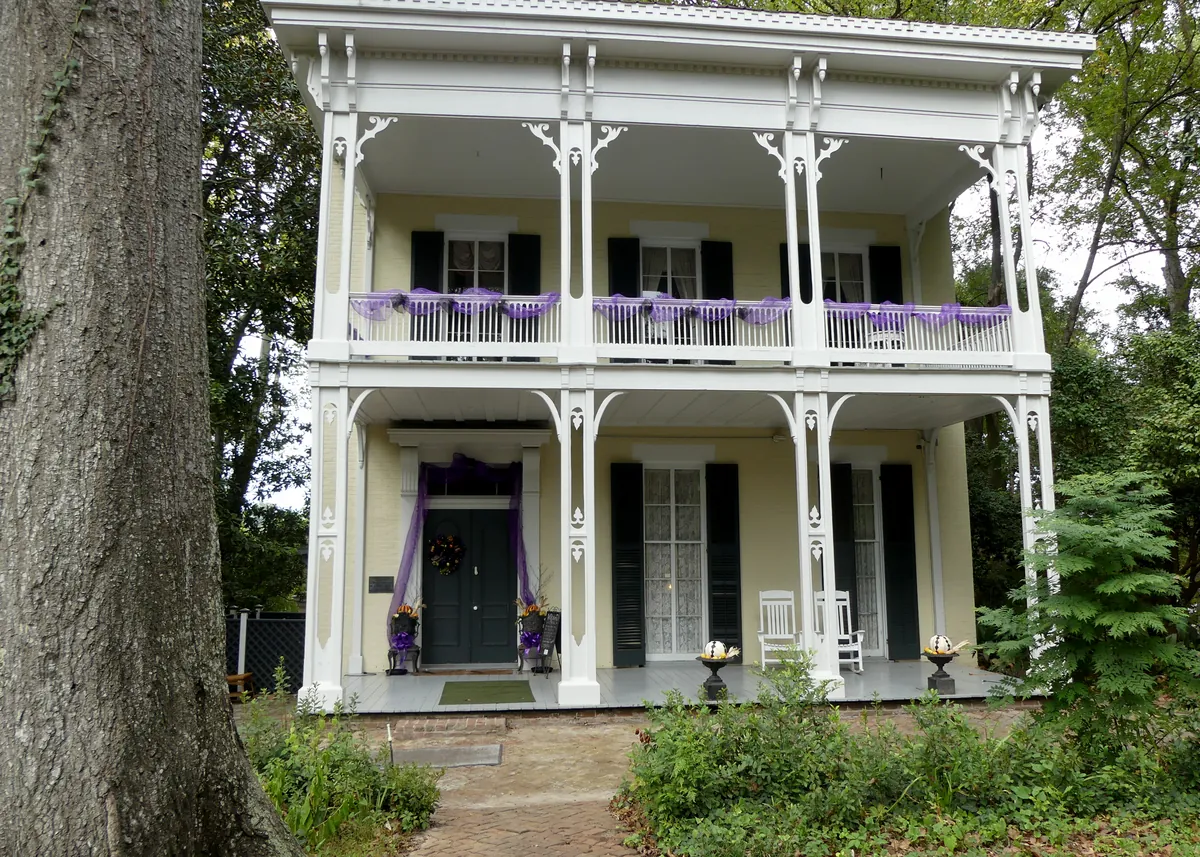
Andrew Glass built a kitchen with one room above it around 1797 in the town of Walnut Hills — what would become Vicksburg. The structure served as a way station for pioneers traveling the Natchez Trace to the Mississippi River, bound for Nashville. That first section still stands.
In 1836, Sheriff Stephen Howard bought the house and added a middle dining room with a bedroom above it, built in Empire architectural style. His wife Mary Elizabeth Howard died during childbirth in late August 1836 in that middle bedroom. John H. Bobb purchased the house in 1849 and built the rest of it in Greek Revival style. Three owners across fifty-two years, each adding a section in the architectural vocabulary of his era. National Geographic Magazine featured the house in its July 1963 issue and called it the "Time Capsule of the South."
During the 1863 Siege of Vicksburg — the campaign that broke Confederate control of the Mississippi River and marked the war's turning point — the house was used as a Confederate field hospital and camp site. It stood close to the railroad, a major point of battle, and was battered by cannon blasts from both Union and Confederate forces.
On May 18, 1864, John Bobb threw a brick at soldiers from the 46th United States Colored Infantry marching back from picket duty. The brick hit U.S. Sgt. William Anderson in the head, fracturing his skull. Sgt. Anderson shot Bobb in the head and bowels, resulting in Bobb's death. A Court Martial investigation found Anderson not guilty of malice for shooting a citizen. Sgt. Anderson died in August while stationed at Milliken's Bend, leaving a widow and small child behind. Census records from 1860 show Bobb was a farmer who enslaved 22 African Americans on this parcel of property.
William Murray purchased the house in 1882. Murray and his wife Ellen Flynn raised four daughters and three sons there. William Murray died at the house in 1911, his wife Ellen in 1921, their daughter Ida in 1946, and a son in 1950. Two of William's daughters, Annie and Ella Murray, both unmarried, lived alone in the house with no modern conveniences aside from a telephone. In 1960, Ella Murray died at the age of 81. The house was in such disrepair that neighbors had no idea it existed. The upper story was completely overgrown with vines, and the sisters had resorted to chopping up antique furniture for firewood.
The house was placed on the National Register of Historic Places on January 8, 1979. It has been called the most haunted house in Mississippi. History tours run Friday through Saturday 10am–4pm, Sunday 1–4:30pm. Haunted tours run Friday through Sunday evenings. The house is at 1445 Harrison Street. Admission is charged.
- ·Three distinct sections built in 1797, 1836, and 1849 — each in the architectural style of its era.
- ·National Geographic named it the 'time capsule of the South.'
- ·Widely considered the most haunted house in Mississippi.
- ·Owner John Bobb was killed by Union soldiers in the garden in 1864.
- ·History tours Fri–Sat 10am–4pm, Sun 1–4:30pm. Haunted tours Fri–Sun evenings.
- ·Located at 1445 Harrison Street. Admission charged.
Memories
Editorial content compiled with AI assistance. Place details verified against public records.