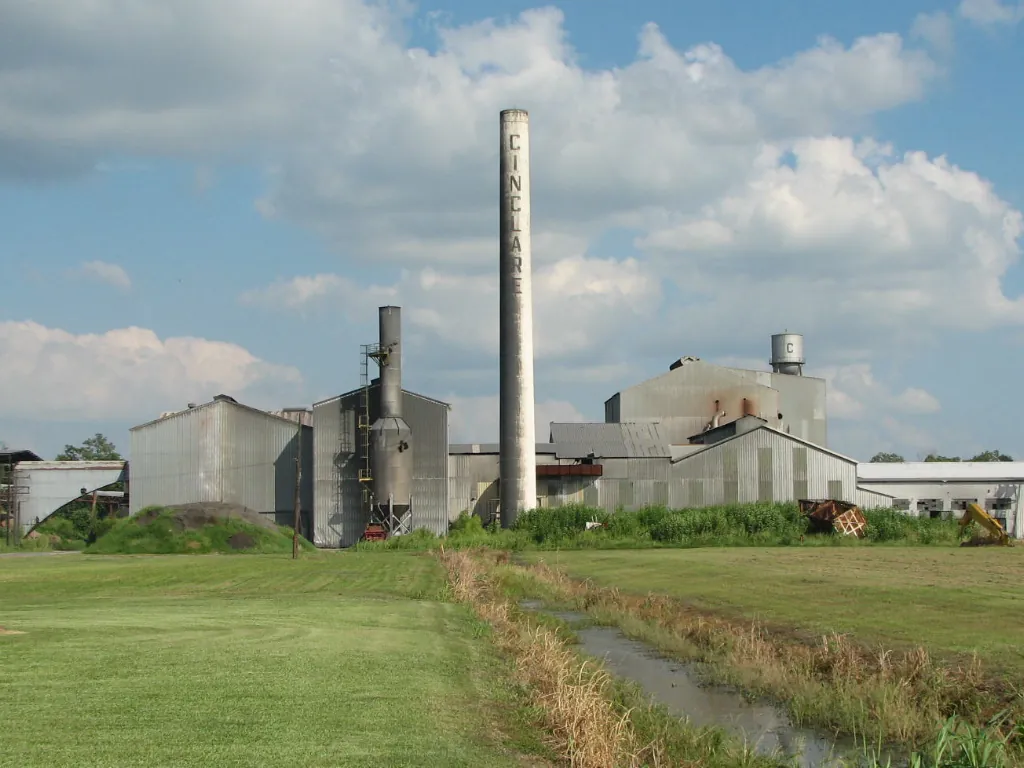
The 210-foot smokestack reading "CINCLARE" marks one of the last surviving 19th-century central sugar factories in Louisiana. From the 1890s through 2003, this west-bank mill ground cane for more than a century—a span that took it from mule power to mechanization, from forced labor to company scrip, from a single plantation to a consolidated industrial operation serving 13,000 acres across three parishes.
The Marengo Plantation was established in 1855 as a forced-labor operation with its own mule-driven sugar kiln. John H. Laws from Cincinnati bought the facility in 1878, renamed it Cinclare, and began expanding and automating at a time when smaller mills were failing. His son Langdon Laws, a director of the Texas and Pacific Railroad, had a spur line built to the mill in 1914. Seasonal workers augmented the year-round staff during the fall "cracking season." The company town ran on company scrip and a plantation store.
What survives is a 46-building industrial and residential complex listed on the National Register in 1998. The circa 1855 plantation house stands in the Greek Revival style. Manager houses form a row nearby. Several worker cottages built in 1913 are kit houses from Aladdin Homes, which listed Cinclare Central Factory as a client in their 1918 catalog of Industrial Housing. Earlier worker housing built in the traditional Creole cottage style can also be found. The nineteenth-century plantation mule barn is the only known surviving building of its type and is considered important at a state level—the sugar industry relied heavily on mules for power in mills, but similar structures were typically demolished after the introduction of tractors.
The mill closed in 2005. The smokestack was repaired and repainted in 2013. The West Baton Rouge Museum received donated machinery from Cinclare and incorporated it into exhibits—it was the last sugar mill in the parish. Visible from the levee road south of Port Allen, the complex is not a staffed visitor site, but the smokestack and water tower still anchor the west bank, marking where cane turned to sugar for more than a hundred harvests.
- ·One of the last surviving 19th-century central sugar factories in Louisiana.
- ·Operated continuously from the 1890s through 2003 — a full century of cane grinding on the west bank.
- ·The brick chimney stack and mill complex are on the National Register.
- ·Workers' quarters and company store buildings document the sharecropping economy that replaced slavery.
- ·Visible from the levee road south of Port Allen. Not a staffed visitor site.
Memories
Editorial content compiled with AI assistance. Place details verified against public records.