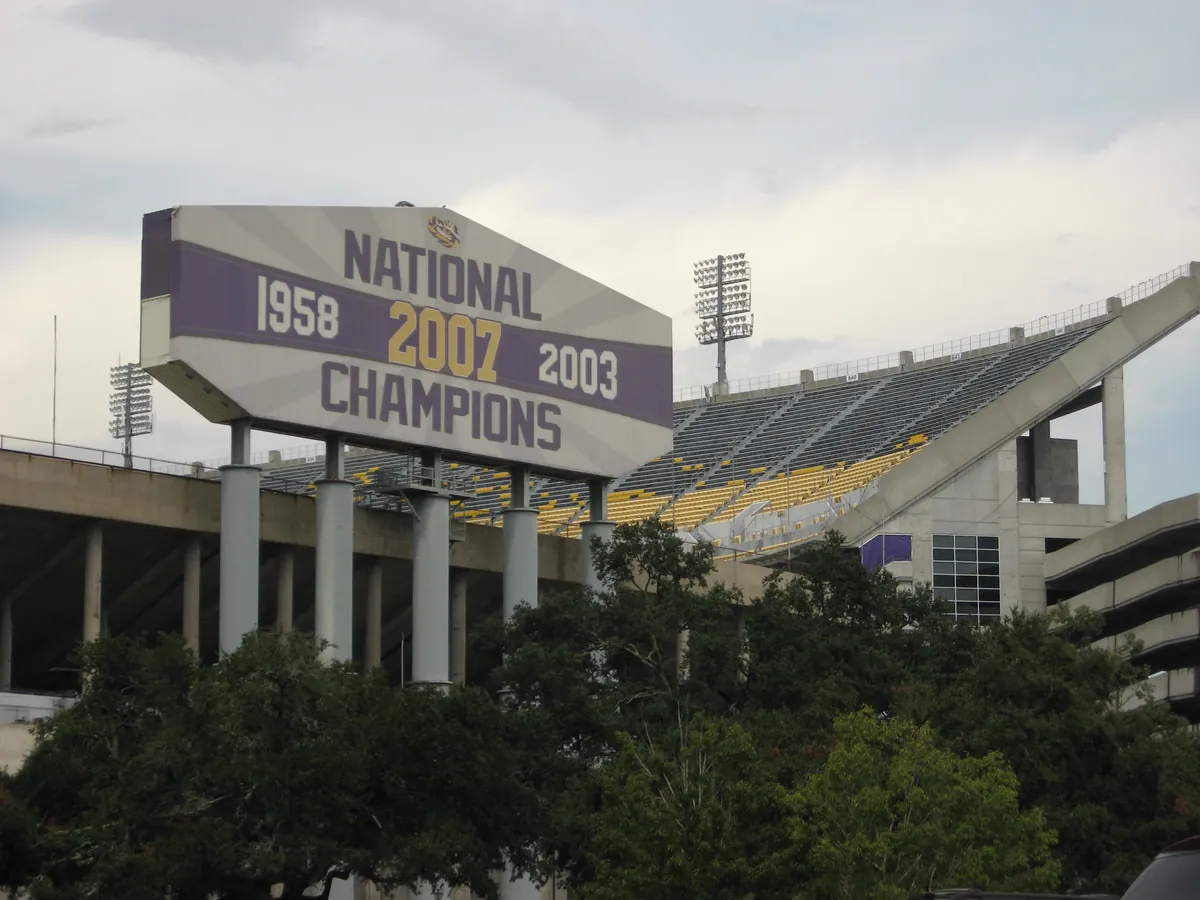
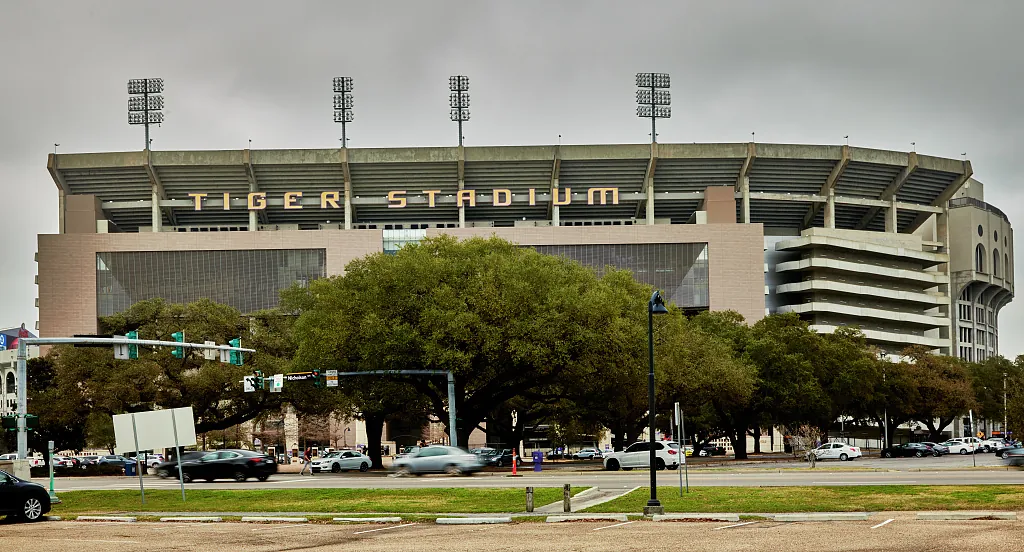
In 1924, LSU built a 12,000-seat football stadium on the south side of campus. A century later, that same structure holds 102,321, the seventh-largest stadium in the world and the fifth-largest in the NCAA. It was never demolished and rebuilt. Each expansion was added onto the existing bowl, decade by decade.
In 1931, 10,000 seats were added to the existing grandstands — and night games were introduced, a 35-0 victory over Spring Hill under the lights. In 1936, capacity more than doubled with 24,000 seats in the north end zone, turning the stadium into a horseshoe. According to local legend, Governor Huey P. Long ordered that dormitories be built in the stadium, with seating above the student living quarters. The idea actually came from athletic director T. P. "Skipper" Heard, though Long helped in other ways. The dormitories were inhabited until the early 1990s. In 1953, more than 21,000 seats were added in the south end zone, creating a 67,720-seat bowl. In 1978, the first of two upper decks was added to the west side, bringing capacity to approximately 78,000. The east upper deck, seating 11,600, was completed in 2000. In 2014, an $80 million south end-zone upper deck expansion added 70 Tiger Den suites, over 3,000 club seats, and 1,500 general public seats.
Since 1960, LSU is 201–59–3 at night in Tiger Stadium and 21–22–3 during the day. Bear Bryant once remarked that Baton Rouge is "the worst place in the world for a visiting team. It's like being inside a drum." In 2007, ESPN named it "the scariest place to play." In 2013, the NCAA ranked it the loudest stadium in all of college football. In 2024, ESPN.com polled 14 college football writers for the best stadiums in the sport; Tiger Stadium was awarded first place with a score of 247 points out of a possible 280.
In 1988, LSU played Auburn in what became known as the Earthquake Game. Quarterback Tommy Hodson completed a game-winning touchdown pass to running back Eddie Fuller in the waning seconds; LSU won 7–6. The crowd reaction registered as a legitimate earthquake on the seismograph in the Louisiana Geological Survey office on campus — the origin of the Death Valley nickname. LSU has won five national championships in football: 1958, 2003, 2007, 2011 (BCS), and 2019. Since the first game in 1924, LSU has posted a 439-154-18 record in Death Valley.
Tiger Stadium uniquely sports H-style goal posts, as opposed to the more modern Y-style used by other schools. This allows the team to run through the goal post in the north end zone when entering the field. Tiger Stadium is one of only three Division I FBS schools who still use H-style goal posts full-time. The goalposts at the north end were torn down by students in 1997 and twice in 2000. Fans rushed the field following victories in 2014, 2018, twice in 2022, and 2024.
Night games in Tiger Stadium are considered among the most hostile environments in all of college football. Tailgating begins Friday night before Saturday home games. Tours are available on non-game days.
- ·The original structure opened in 1924 with 12,000 seats; it now holds 102,321, making it the fifth-largest stadium in the world.
- ·LSU has won five national championships in football: 1958, 2003, 2007, 2011 (BCS), and 2019.
- ·A 1988 touchdown against Auburn registered on a seismograph in the geology building across campus — the origin of the Death Valley nickname.
- ·The stadium was never demolished and rebuilt; each expansion was added onto the existing bowl, decade by decade.
- ·Night games in Tiger Stadium are considered among the most hostile environments in all of college football.
- ·Located on North Stadium Drive. Tailgating begins Friday night before Saturday home games. Tours available on non-game days.
More archive

Memories
Editorial content compiled with AI assistance. Place details verified against public records.