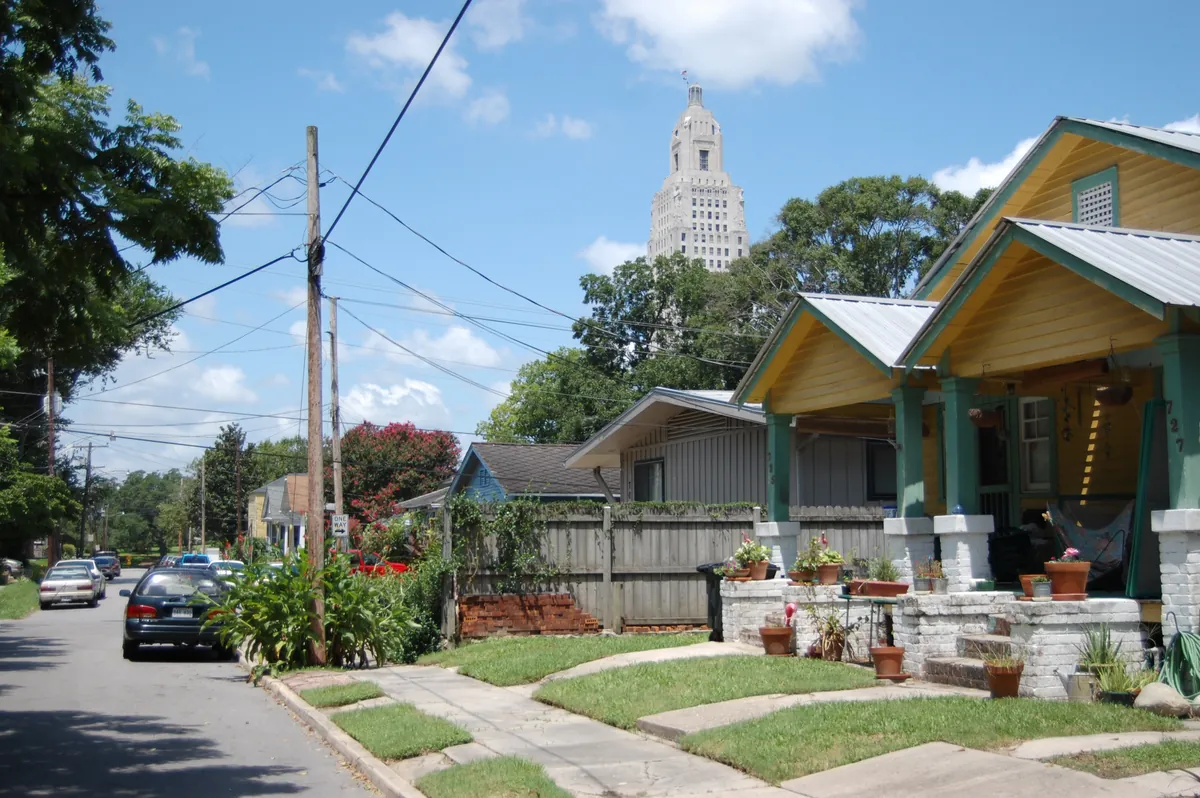
When the Louisiana Purchase delivered Galvez Town to the United States in 1803, the Canary Islanders who'd settled there twenty miles southeast of Baton Rouge asked permission to move — they wanted to stay on Spanish soil. In 1805, Don Carlos de Grand Pré, administrator of the Baton Rouge District, laid out a grid east of the fort, far enough to be "out of cannon shot." The neighborhood became Spanish Town, a place where Spanish culture and language could persist in what was otherwise a mainly Anglo city.
The Civil War left only a few structures standing. In the years afterward, freed African Americans looking for work in Baton Rouge rebuilt the neighborhood. Between 1890 and 1920, the founding of Louisiana State University brought students and faculty, and Spanish Town grew to serve them.
The district today covers 49.4 acres, with 258 contributing properties dating from 1823 to 1975. The oldest is the Pino House, built in 1823. It was added to the National Register of Historic Places on August 31, 1978.
The neighborhood's largest claim now is the parade. The first Spanish Town Mardi Gras took place in 1981, a way for residents to "celebrate their difference" — a few children on foot with instruments and trinkets. It has since become the largest Mardi Gras parade in Baton Rouge, held the Saturday before Mardi Gras. The tone is sarcastic and raunchy, emphatically not family-friendly. Floats deliver crude political commentary on local and national figures. Krewes carry names like "Krewe of Roadkill" and "Wasted Krewe." The unofficial mascot is the pink flamingo, said to represent the mantra "poor taste is better than no taste at all." Around the beginning of Mardi Gras season, large plywood flamingos appear in the LSU Lakes to announce the date of the annual ball — and there is a tradition of "kidnapping" one by boat, a yard ornament earned with unique pride. Walk Spanish Town Road and Convention Street to see the oldest neighborhood in Baton Rouge meet the most irreverent parade in Louisiana.
- ·The oldest intact residential neighborhood in Baton Rouge — settled by Spanish Canary Islanders (Isleños) in 1779.
- ·The grid of low Creole cottages between the Capitol and the river predates the American period entirely.
- ·Listed on the National Register of Historic Places.
- ·Hosts the most irreverent Mardi Gras parade in Louisiana every year — flamingos, sequins, and a float-riding queen.
- ·Walk the neighborhood along Spanish Town Road and Convention Street.
Memories
Editorial content compiled with AI assistance. Place details verified against public records.