Natchez was among the wealthiest cities in the United States before 1860, built on cotton plantation wealth, and the cotton planters spent the money where everyone could see it. Auburn went up first in 1812 — Lyman Harding's prototype with the freestanding spiral staircase that every later mansion copied. Rosalie followed in 1823, on the bluff where the French built Fort Rosalie in 1716. Dunleith wrapped 26 Tuscan columns around all four sides in 1856. Stanton Hall took a full city block in 1857 with materials shipped from Europe. Magnolia Hall finished in 1858. Three years later everything stopped.
The route
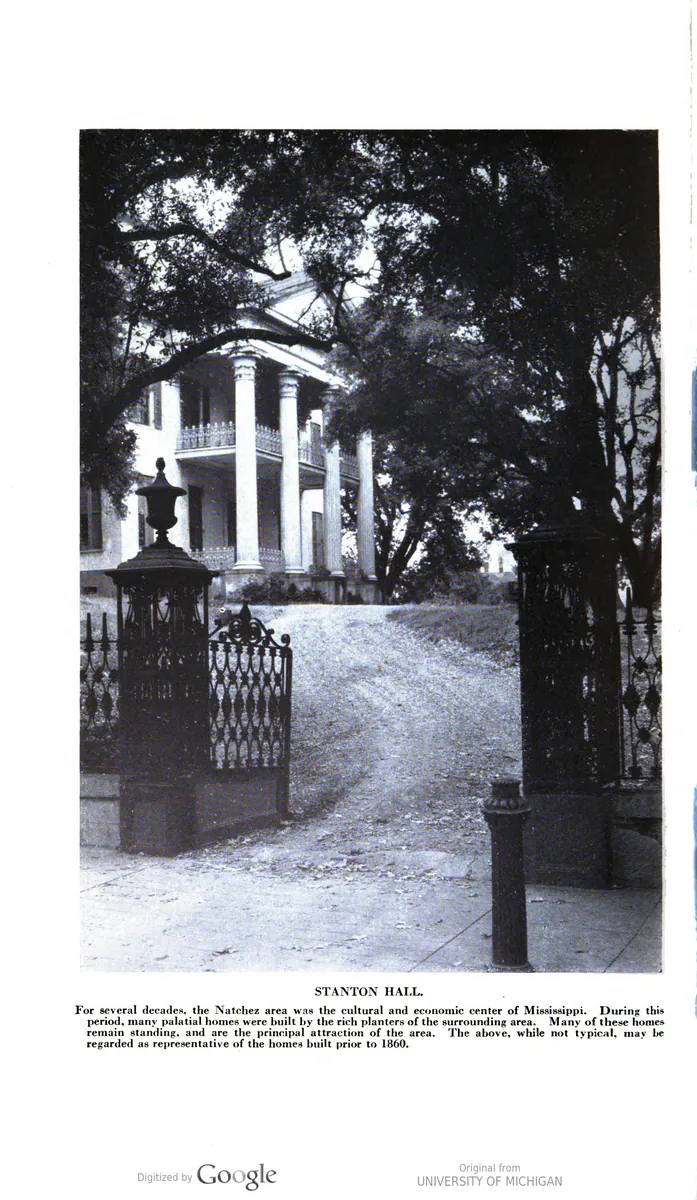 1Architecture·1857·NHLStanton Hall
Frederick Stanton built the largest antebellum mansion in Natchez on an entire city block between 1851 and 1857. He was a cotton broker. The architect was Thomas Rose, a local builder and English immigrant, who designed a three-story brick structure plastered white with a two-story Greek temple portico — four fluted cast-iron Corinthian columns supporting an entablature and gabled pediment. The interior used imported Italian marble, textiles from Paris, and chandeliers made of glass and bronze. Stanton named it Belfast. He lived in it nine months before he died of yellow fever. The house survived the Civil War. In 1890 it became home to Stanton College for Young Ladies. In 1940 the Pilgrimage Garden Club acquired it and still operates it as headquarters, museum, and event venue. It was declared a National Historic Landmark in 1974 — one of the most opulent antebellum mansions to survive in the southeastern United States. The Carriage House Restaurant serves lunch on the grounds. Tours run daily. The property occupies two acres, ringed by wrought iron fencing with elaborate gate posts. A large cupola sits at the center of the hipped roof. The front entrance has decorative iron railings between the columns and a second-floor balcony railing set under the portico.
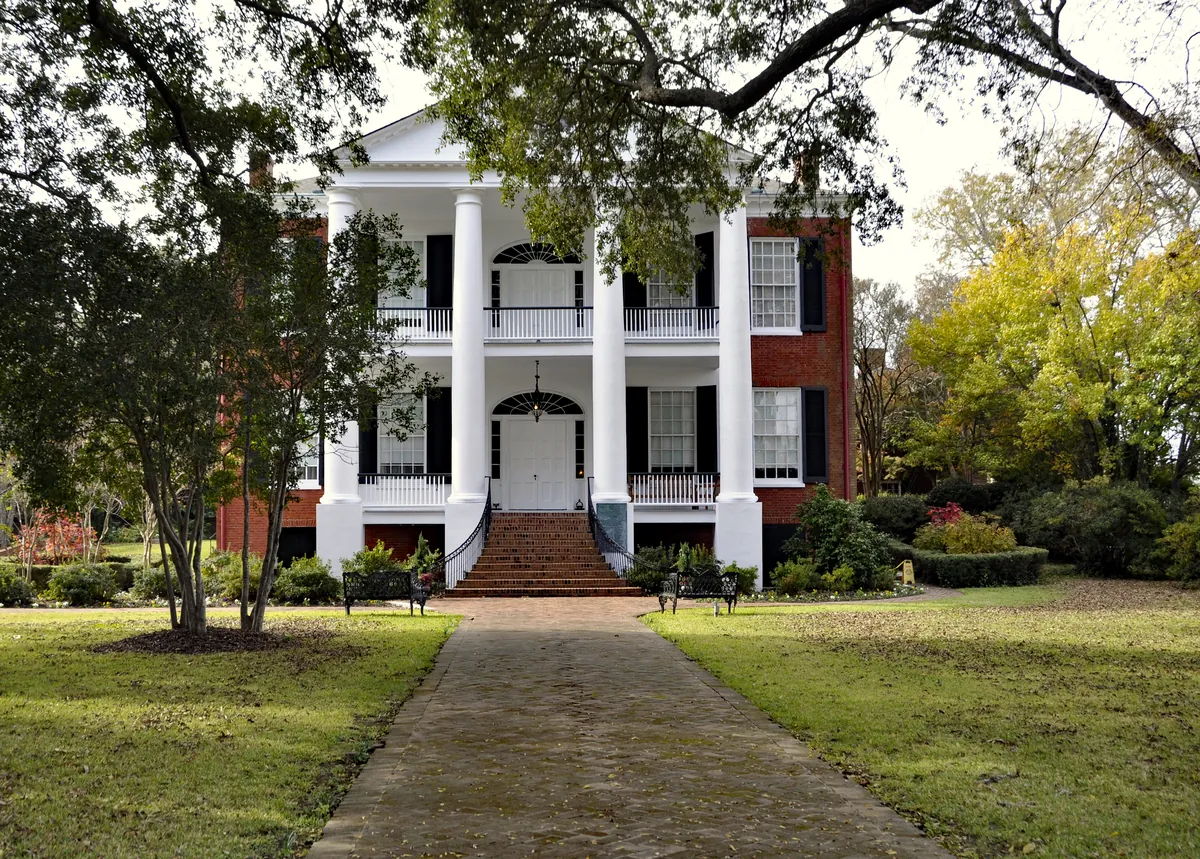 2Architecture·1823·NHLRosalie Mansion
Peter Little, a cotton broker, built Rosalie in 1823 on a portion of the site of the 1729 Natchez revolt at Fort Rosalie. The mansion rises three stories of brick with a four-column Tuscan portico, commanding views over the Mississippi from the bluff. It became a major influence on Antebellum architecture in the greater region, inspiring many of Natchez's grand Greek Revival mansions. On July 13, 1863, a week after the Siege of Vicksburg, Major General Ulysses S. Grant took possession of the mansion for use as Union headquarters. General Walter Q. Gresham assumed command of U.S. troops at Natchez on August 26, and his headquarters remained at Rosalie. Gresham had much of the owner's furnishings stored in the attic and put under guard to prevent theft or destruction. Army tents covered the grounds surrounding the mansion. Soldiers took positions in the widow's walk on the roof. The Mississippi State Society Daughters of the American Revolution has owned, operated, and maintained Rosalie as a historic house museum for more than seventy years. It was designated a National Historic Landmark in 1989. The mansion is open for tours daily — check visitnatchez.org for seasonal hours and admission.
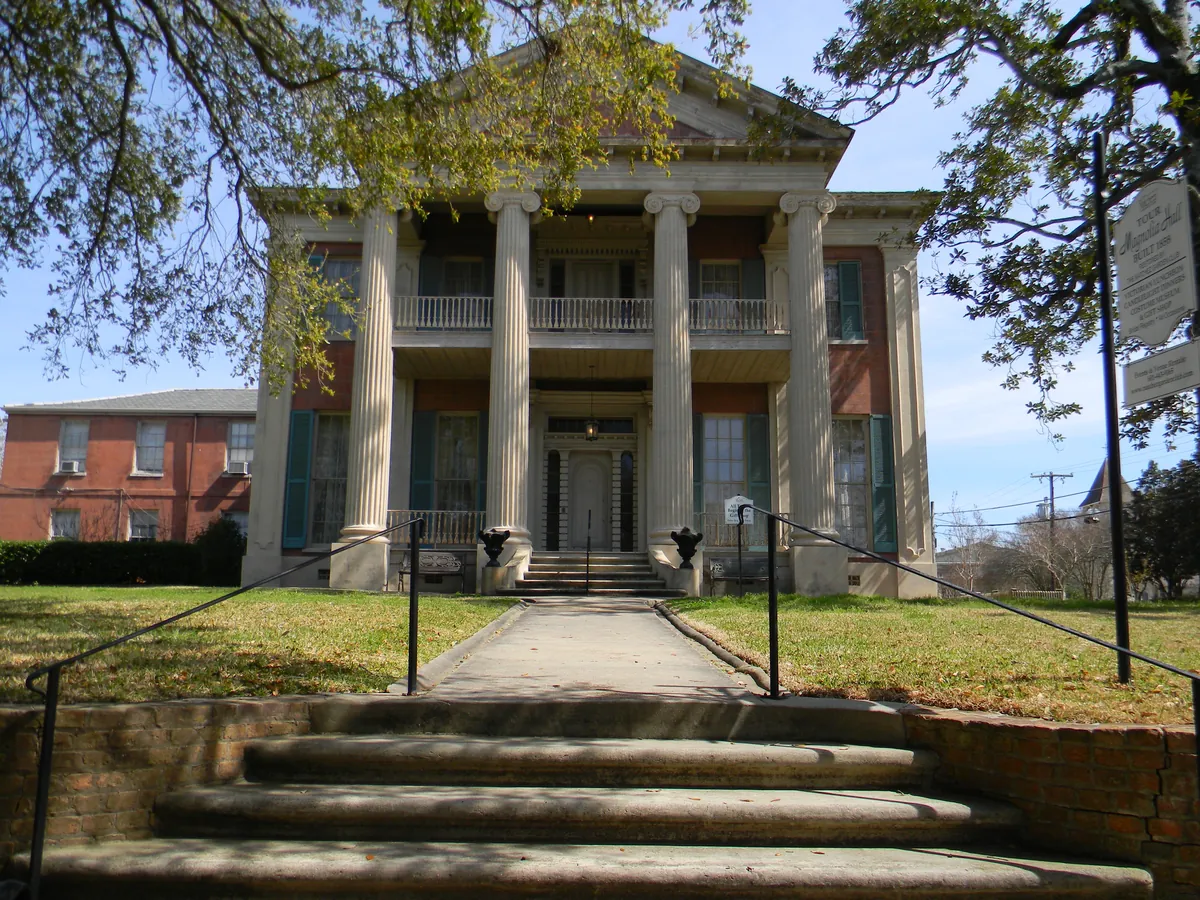 3Architecture·1858·NRHPMagnolia Hall
Thomas Henderson built the last great mansion Natchez would see before the Civil War. Completed in 1858, the house marked him as one of the wealthiest men in antebellum Mississippi — merchant, planter, cotton broker. Greek Revival was the standard in Natchez, but Henderson fronted his in brownstone, unusual here. During a bombardment by the Union gunboat Essex, a shell hit the soup tureen in the kitchen. The house survived. The Natchez Garden Club restored Magnolia Hall and has operated it since 1977. The main floor holds mid-nineteenth century antiques. Upper floors contain a costume collection. Tours run during Pilgrimage season and by appointment.
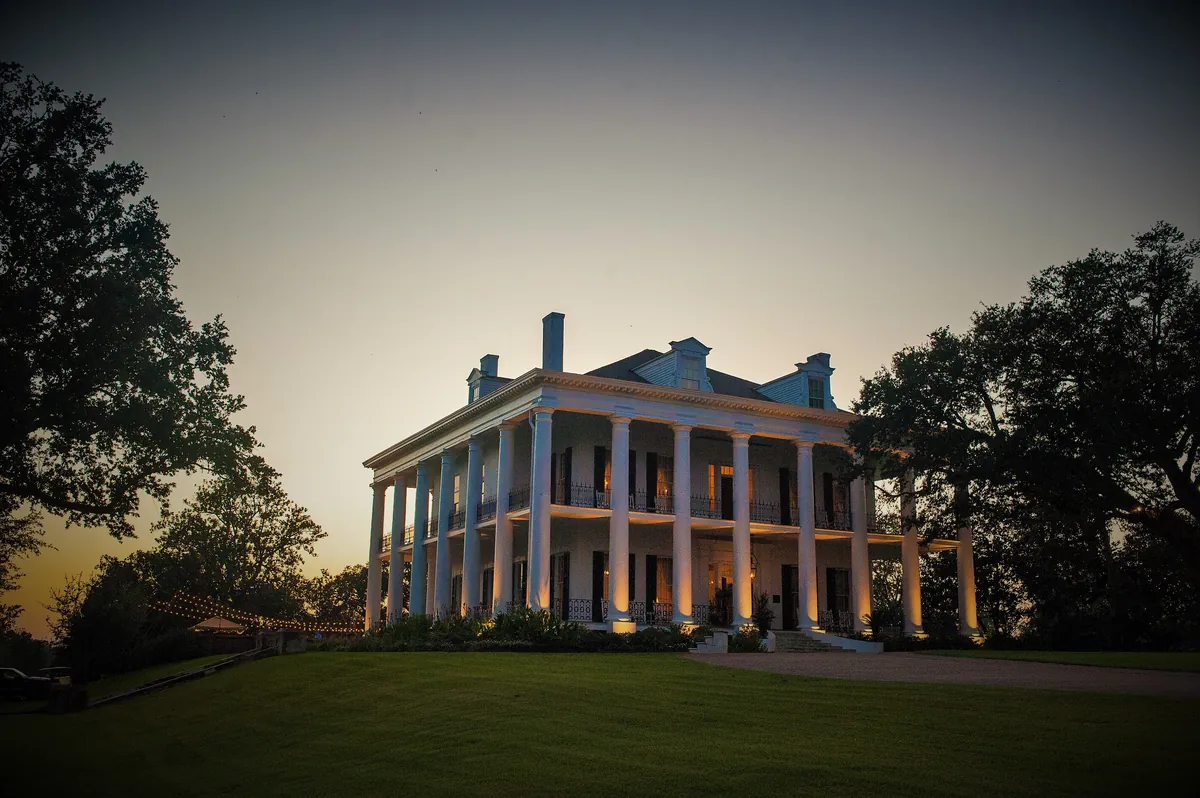 4Architecture·1856·NHLDunleith Historic Inn
Built about 1855, Dunleith is Mississippi's only surviving example of a plantation house with a fully encircling colonnade of Greek Revival columns. The colonnade consists of 26 Tuscan columns built of brick and stucco. Porches with wrought iron railings wrap the entire building on the first and second floor. First-floor windows roll up to become doorways, similar to those at Monticello. The 12-room main house sits on 40 acres. Outbuildings include a carriage house, a dairy barn, a poultry house, and a three-story brick courtyard building that historically housed the kitchen, laundry and slave quarters. The previous building, called Routhland, had been built by Job Routh in the 1790s and passed to his daughter Mary Routh. When lightning struck and burned it down in 1855, Mary's husband, General Charles G. Dahlgren, rebuilt. It was sold in 1858 for $30,000 to Alfred Vidal Davis, who renamed it Dunleith. Among its occupants was John Roy Lynch, born enslaved at Tacony Plantation in Louisiana. Lynch became the first African-American Speaker of the House in the Mississippi State Legislature and one of the first African-American U.S. Congressmen. He studied law, authored articles and books, and served in appointed political and military positions. After his death in Chicago in 1939 at age 92, Lynch was buried with military honors in Arlington National Cemetery. Dunleith was designated a National Historic Landmark in 1974. It has operated as a historic inn since 1976. The historic inn has 22 guest rooms divided among the main house, courtyard and dairy barn buildings. The Castle Restaurant & Pub occupies the former carriage house, constructed circa 1790.
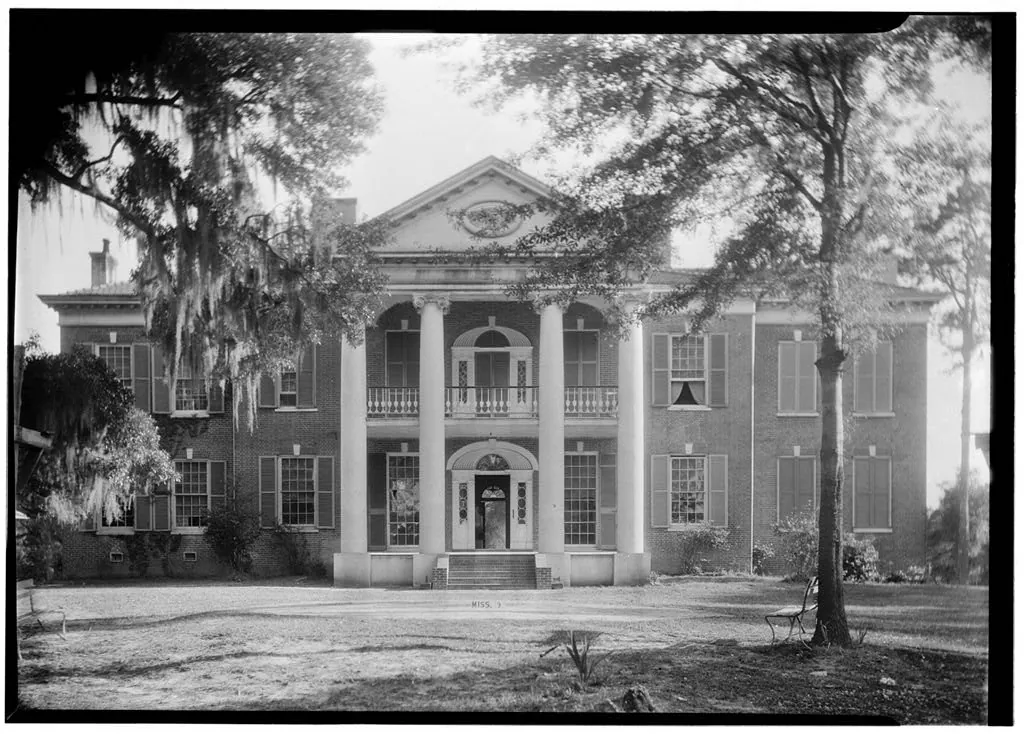 5Architecture·1812·NHLAuburn — The First Grand Mansion
Lyman Harding built this house in 1812, and it set the template. Mississippi's first Attorney General commissioned what became the first grand mansion in Natchez—the architectural prototype for those that followed. A freestanding spiral staircase rises two stories without center support, engineering that still draws visitors two centuries later. The site matters. By the late seventeenth century, the Natchez people occupied this area as their major ceremonial center, adding to mounds their Plaquemine ancestors had begun building around 1200. French colonists founded Fort Rosalie in 1716 to protect a trading post, settling too close to Natchez land. In November 1729, the Natchez and their allies killed 229 French colonists—138 men, 35 women, and 56 children—and took most of the women and children captive. It remains the largest death toll by an Indian attack in Mississippi's history. The French and their Indian allies retaliated over two years, and by 1731 most of the Natchez had been killed, enslaved, or driven out as refugees. Survivors were sold as slaves and shipped to Saint-Domingue. Harding built Auburn on land that had seen all of that. The house now sits inside Duncan Park, the oldest public park in Mississippi. It is a National Historic Landmark, open for seasonal tours—check with the Natchez Convention & Visitors Bureau for hours.