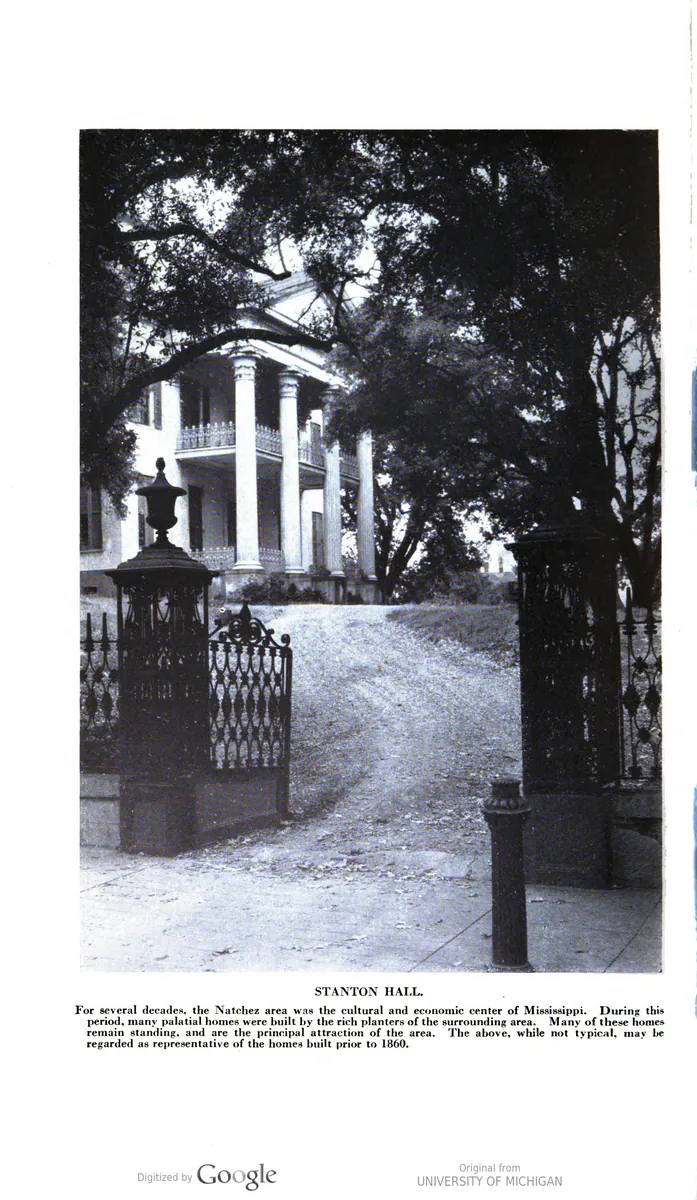
Frederick Stanton built the largest antebellum mansion in Natchez on an entire city block between 1851 and 1857. He was a cotton broker. The architect was Thomas Rose, a local builder and English immigrant, who designed a three-story brick structure plastered white with a two-story Greek temple portico — four fluted cast-iron Corinthian columns supporting an entablature and gabled pediment. The interior used imported Italian marble, textiles from Paris, and chandeliers made of glass and bronze. Stanton named it Belfast. He lived in it nine months before he died of yellow fever.
The house survived the Civil War. In 1890 it became home to Stanton College for Young Ladies. In 1940 the Pilgrimage Garden Club acquired it and still operates it as headquarters, museum, and event venue. It was declared a National Historic Landmark in 1974 — one of the most opulent antebellum mansions to survive in the southeastern United States.
The Carriage House Restaurant serves lunch on the grounds. Tours run daily. The property occupies two acres, ringed by wrought iron fencing with elaborate gate posts. A large cupola sits at the center of the hipped roof. The front entrance has decorative iron railings between the columns and a second-floor balcony railing set under the portico.
- ·Occupies an entire city block in downtown Natchez — the largest antebellum mansion in the city.
- ·Built 1857 by Irish immigrant Frederick Stanton, who died one year after completion.
- ·Carrara marble mantels, Sheffield silver hardware, French mirrors — all imported from Europe.
- ·National Historic Landmark. Considered the most opulent surviving antebellum home in the Southeast.
- ·Operated by the Pilgrimage Garden Club since 1938.
- ·Tours available daily. Carriage House Restaurant serves lunch on the grounds.
Memories
Editorial content compiled with AI assistance. Place details verified against public records.