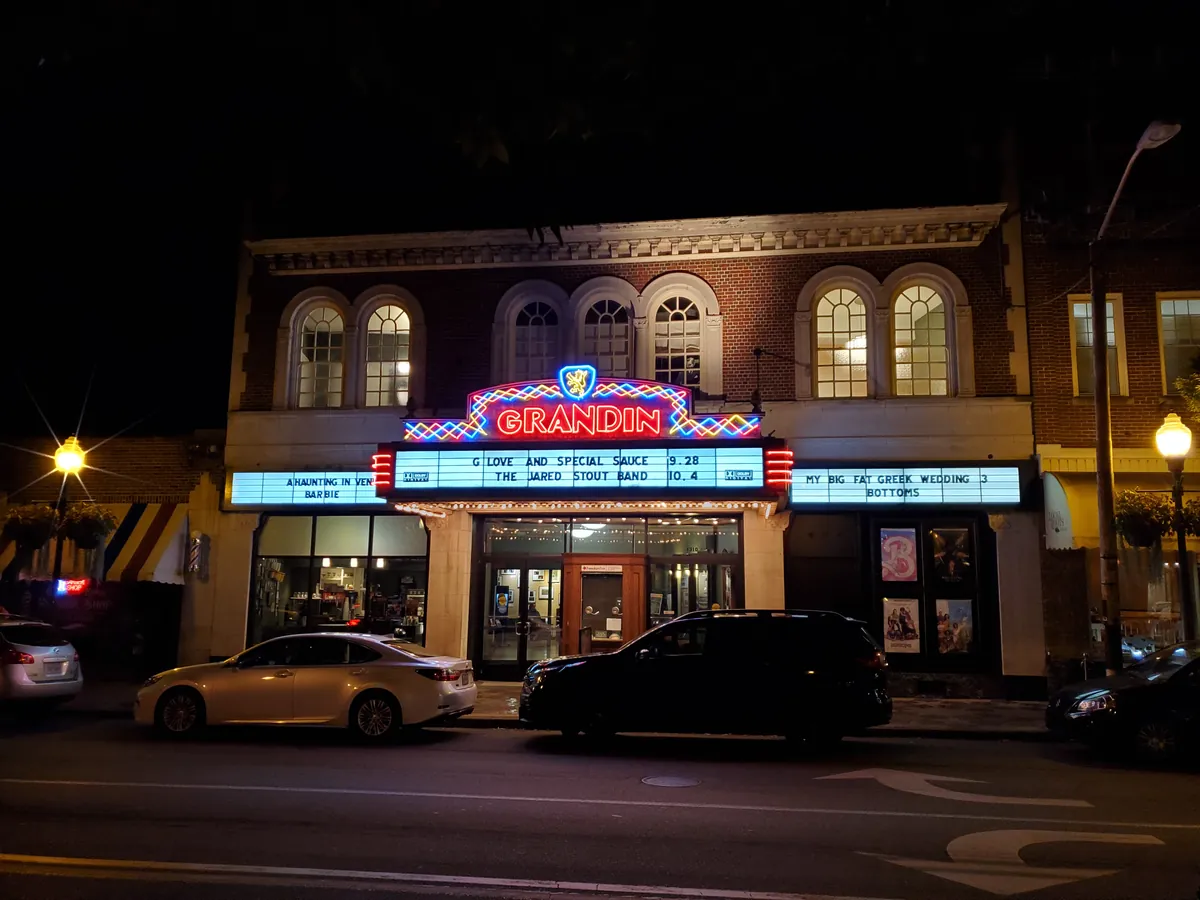
The Grandin opened in 1932 — Roanoke's first suburban movie house, designed by Eubank & Caldwell in an eclectic mix of revival styles. The Depression was on, but the theater held. It ran continuously until November 11, 2001, when deterioration forced it to close. The Grandin Theatre Foundation raised enough money to renovate and reopen it on October 20, 2002. It survives as the only historic movie theater left in the Roanoke Valley.
The interior retains original detailing from the Depression era. Now run as a nonprofit, it shows independent and classic films, plus live music events. Tickets are affordable. The theater anchors Grandin Village, a three-block stretch of independently owned bookstores, coffee shops, and restaurants at the intersection of Grandin Road and Memorial Avenue — one of Roanoke's best examples of a mixed-use urban village. The district traces its origin to 1906 with the establishment of the Virginia Heights Land Corporation, developed after the opening of Memorial Bridge connected southwest Roanoke to downtown. A streetcar line arrived in 1911 and accelerated the commercial build-out; most of what you see went up between 1917 and 1945. Streetcar service ended on July 31, 1948 — the last day of streetcar transit in Roanoke altogether. After mid-century decline, the area rebounded and now functions like a small town inside the city. Check the marquee or the website for showtimes.
- ·A 1932 Art Deco movie palace saved from demolition in the 1990s by the neighborhood.
- ·Now a nonprofit community cinema showing independent and classic films, plus live music events.
- ·Anchors a three-block Grandin Village of coffee shops, bookstores, and restaurants.
- ·The interior retains original Art Deco detailing from the Depression era.
- ·Check the marquee or website for showtimes. Tickets are affordable.
Memories
Editorial content compiled with AI assistance. Place details verified against public records.