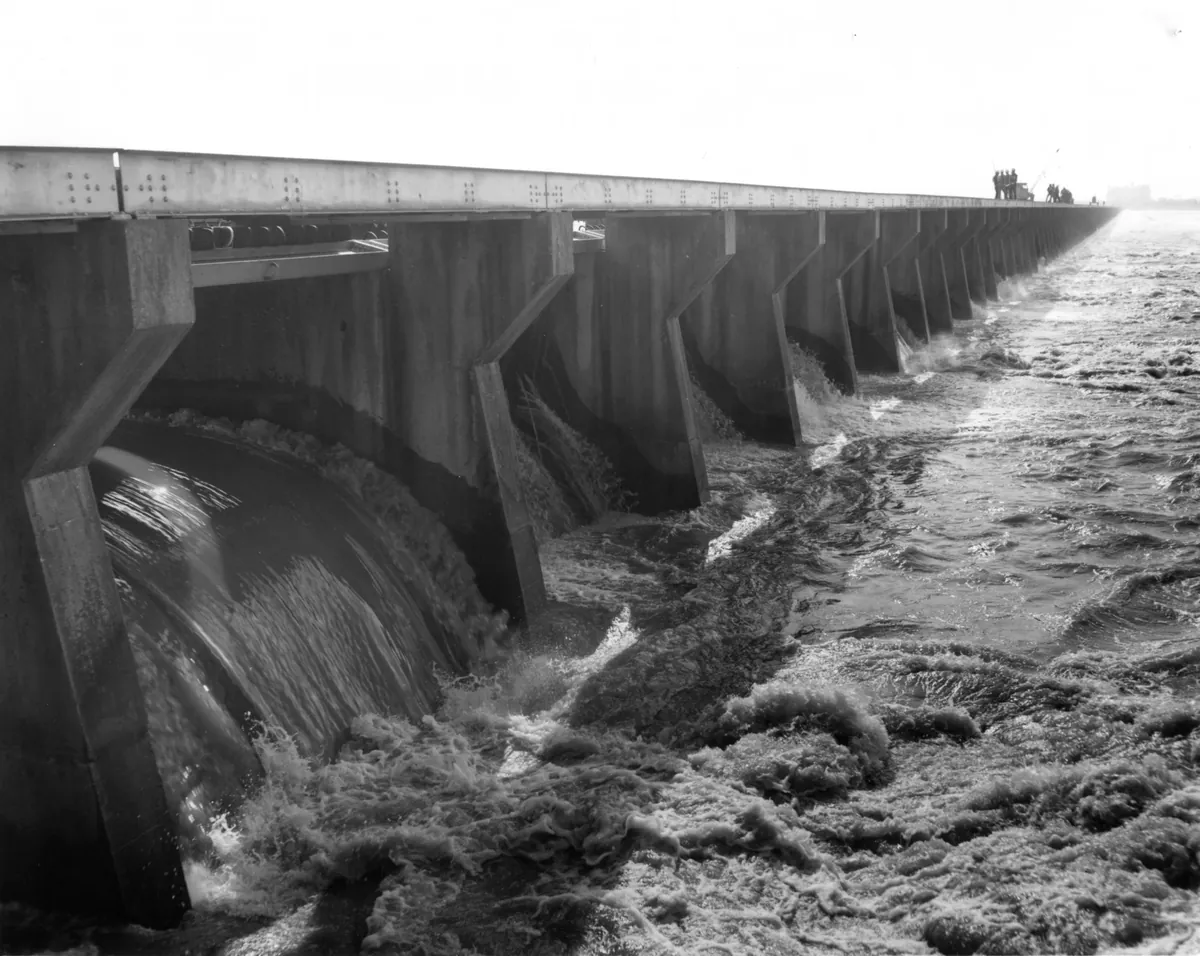
The Mississippi has breached its banks in the Bonnet Carré area for at least two centuries. After the Great Mississippi Flood of 1927 inundated much of the river basin, the Army Corps of Engineers built a spillway here between 1929 and 1931 to divert floodwater into Lake Pontchartrain before it could reach New Orleans. The control structure extends over a mile and a half along the east bank between Montz and Norco. When flood stage comes, two rail-mounted gantry cranes lift out wooden needles—8-by-12-inch beams arranged in 350 bays—to let the river through. All 7,000 needles can be removed in 36 hours, though the Corps usually does it over several days. The floodway stretches nearly six miles to the lake, with a design capacity of 250,000 cubic feet per second.
It was first opened during the 1937 flood. In 2019 it opened February 27, closed April 11, then reopened May 10—the first time it was opened twice in one year. The American Society of Civil Engineers designated it a National Historic Civil Engineering Landmark.
Between openings, the spillway is a wildlife management area used for off-road vehicles, biking, boating, hiking, hunting, and fishing. Clay extraction pits on the property have been stocked with bluegill and largemouth bass.
Two cemeteries lie within the floodway. The Kenner and Kugler cemeteries contain the remains of enslaved persons and free African Americans from the early 1800s through 1929, buried in the cane fields of the Roseland and Hermitage plantations. Several African American Civil War veterans were moved to Chalmette National Cemetery in 1930. When the spillway opens, the cemeteries flood. The sites were placed on the National Register of Historic Places in 1987. Young live oak trees now mark where the graves lie under several feet of sediment.
Interstate 10 crosses the spillway. You can see it from the highway any day it isn't actively saving the city.
- ·When the Mississippi threatens New Orleans, the Army Corps opens 350 bays of concrete and steel to divert floodwater into Lake Pontchartrain.
- ·Completed in 1931. Opened 14 times since.
- ·Between openings, it's a 7,700-acre wildlife preserve drawing 400,000 visitors a year.
- ·Birders, fishermen, and families use it for camping, hiking, and hunting warblers and raptors.
- ·The single most important piece of infrastructure keeping New Orleans dry.
- ·Visible from I-10. Open to the public every day it isn't actively saving the city.
Memories
Editorial content compiled with AI assistance. Place details verified against public records.