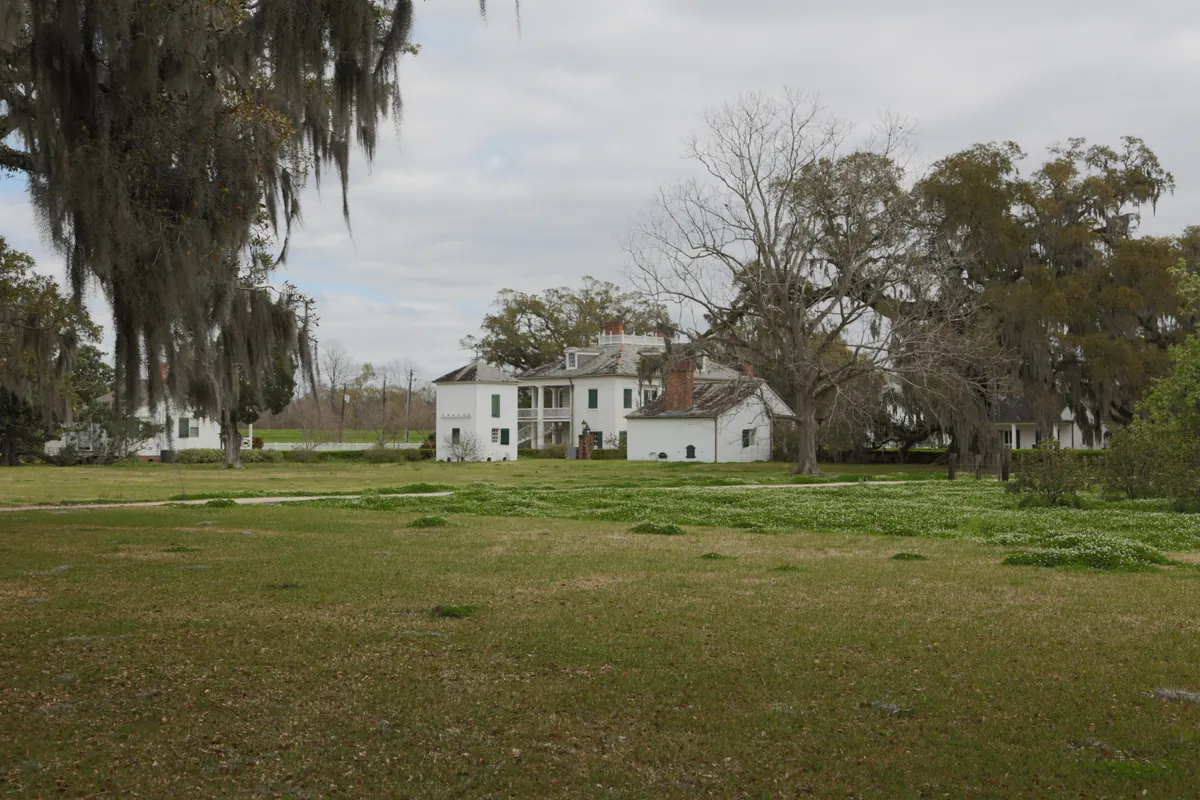
Twenty-two slave cabins stand in their original double-row configuration along an oak allée at Evergreen, exactly as they were arranged in 1860. No other site in Louisiana — possibly in the country — preserves the physical reality of enslaved quarters at this scale. The plantation complex includes 37 buildings on the National Register, all but eight built before the Civil War, making it one of the most complete plantation complexes in the South.
The main house was built mostly in 1790 and renovated to its current Greek Revival form in 1832. The crop was sugarcane, cultivated by enslaved African Americans until emancipation. The plantation operated until about 1930, when the Depression caused the owners to abandon the house. A bank took over, kept the cane operation running, and it remains a working sugarcane plantation today where people live. Heiress Matilda Geddings Gray sponsored restoration in the 1940s, using 300,000 bricks from the demolished Uncle Sam Plantation.
Among the outbuildings: a garconnière for young bachelors of the family or male guests, a pigeonnier for keeping pigeons — a status marker among planters — an overseer's cottage, and late 19th-century barns. The site was designated a National Historic Landmark in 1992 and included among the first 26 sites on the Louisiana African American Heritage Trail.
The house is not open for tours. A "No Trespassing" sign marks the dirt road entrance. Access policies change; tours by appointment only at (985) 497-3837. It's been used as a production site for films including Django Unchained and Antebellum. You reach it down Louisiana Highway 18 on the west bank, off the tourist circuit entirely.
- ·The most intact plantation complex in the American South — 37 buildings on the National Register of Historic Places.
- ·22 original slave cabins arranged in their double-row configuration exactly as they stood in 1860.
- ·No other site in Louisiana — possibly the country — preserves the full physical reality of enslaved quarters at this scale.
- ·Still a working sugarcane plantation where people live. Not on the tourist circuit.
- ·Located on the west bank, down a state highway.
- ·Tours by appointment only. Access policies change. Call ahead: (985) 497-3837.
Memories
Editorial content compiled with AI assistance. Place details verified against public records.