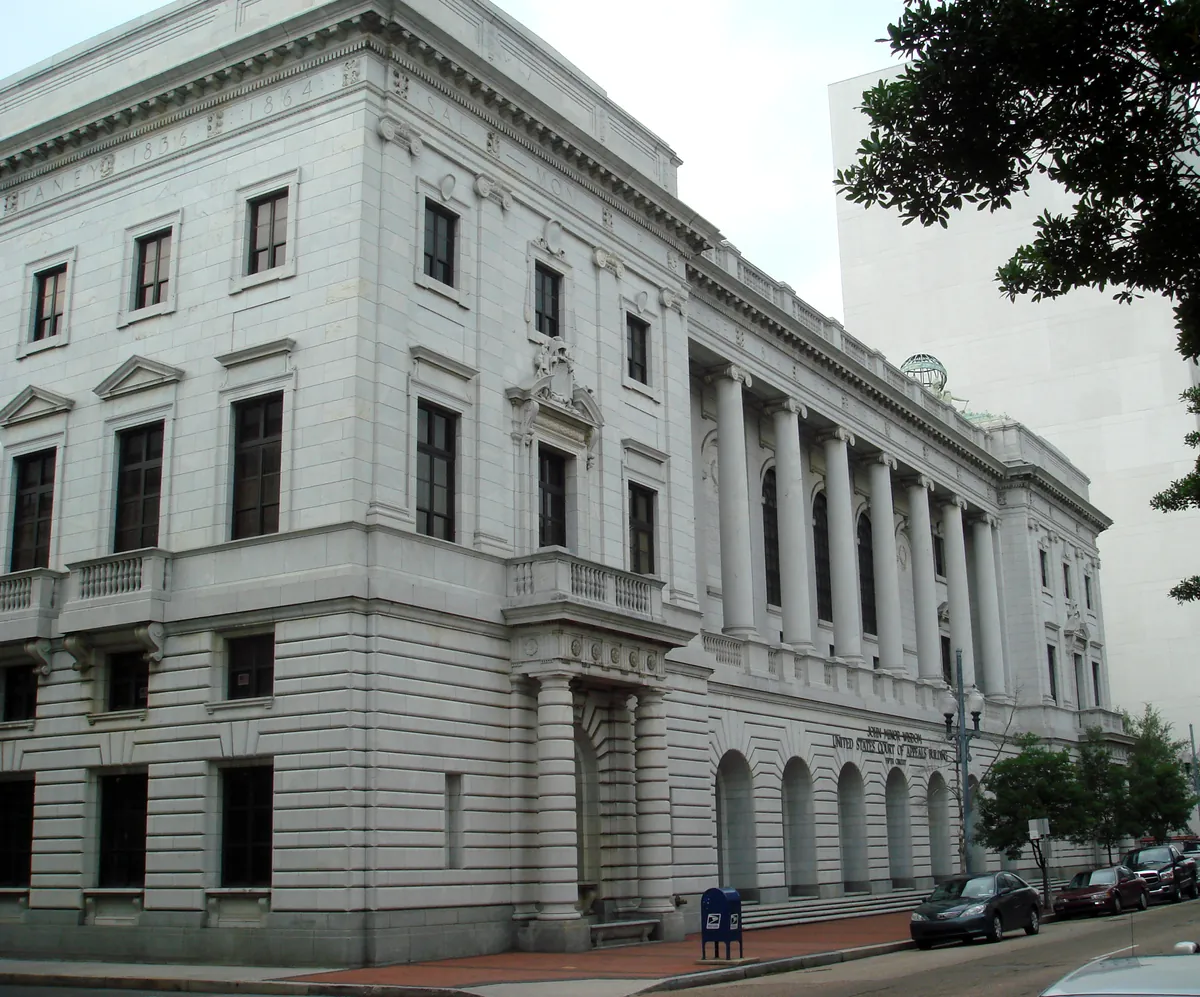
The Fifth Circuit Court of Appeals, housed at 600 Camp Street in an Italian Renaissance Revival building completed in 1915, is where Judge John Minor Wisdom wrote landmark desegregation opinions that reshaped American law. In *U.S. v. Jefferson County Board of Education* (1966), his majority opinion established the legal framework for affirmative integration, articulating a principle that would echo through decades of jurisprudence: "The Constitution is both color blind and color conscious. To avoid conflict with the equal protection clause, a classification that denies a benefit, causes harm, or imposes a burden must not be based on race. But the Constitution is color conscious to prevent discrimination being perpetuated and to undo the effects of past discrimination."
Wisdom was a Tulane-educated Republican from New Orleans who had left the Democratic Party in reaction to what he perceived as the corrupt administration of Governor Huey Long. He became instrumental in securing Dwight Eisenhower's nomination at the 1952 Republican National Convention, and helped Eisenhower win Louisiana in 1956 -- the first time the state had voted Republican in eighty years. Eisenhower appointed him to the Fifth Circuit in 1957.
During Wisdom's tenure, the Fifth Circuit's jurisdiction stretched across Louisiana, Mississippi, Texas, Alabama, Georgia, Florida, and the Canal Zone. Wisdom was one of the "Fifth Circuit Four," judges who advanced the goals of the Civil Rights Movement through a series of crucial decisions in the 1950s and 1960s. The court became one of the most consequential federal courts for civil rights law.
President Bill Clinton awarded Wisdom the Presidential Medal of Freedom in 1993. The building was renamed in 1994 for the judge who served on the court until his death in 1999. It is a National Register property and a National Historic Landmark -- and it remains a working courthouse.
- ·Houses the U.S. Fifth Circuit Court of Appeals — one of the most consequential federal courts for civil rights law.
- ·Renamed in 2000 for Judge John Minor Wisdom, a Tulane-educated Republican who wrote landmark desegregation opinions.
- ·Wisdom's opinion in U.S. v. Jefferson County Board of Education (1966) established the legal framework for affirmative integration.
- ·The 1914 Beaux-Arts building at 600 Camp Street is a National Register property and a working courthouse.
Memories
Editorial content compiled with AI assistance. Place details verified against public records.