The summer of 1853 killed a tenth of New Orleans — roughly 10,000 people — in a single season of yellow fever. Families shuttered their houses and fled the city. Mass graves opened at Lafayette Cemetery.
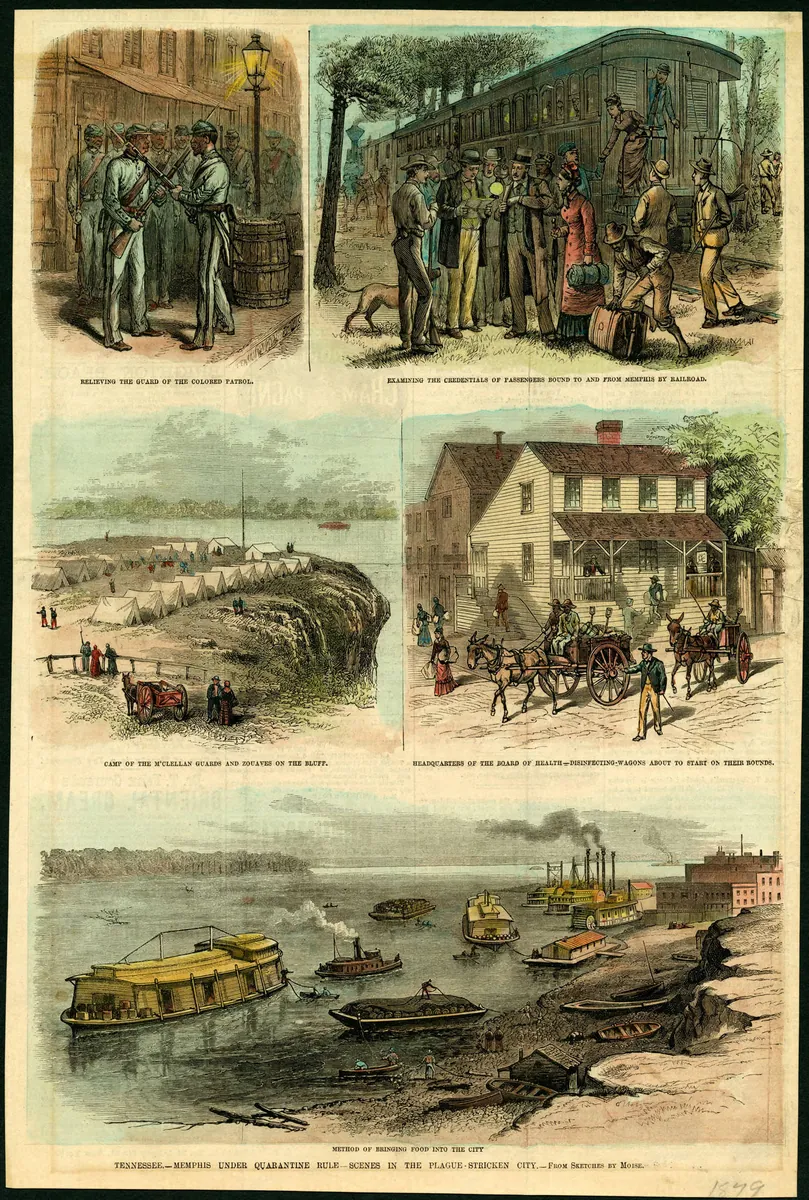
The fever did not leave. It returned through the rest of the century, carried by mosquitoes no one yet understood. In 1878, the worst outbreak since 1853 swept the Lower Mississippi Valley from St. Louis south, killing nearly 16,000 people across Alabama, Kentucky, Louisiana, Mississippi, and Tennessee. New Orleans saw 20,000 infections and 5,000 deaths. Memphis lost more than 5,000. Entire families died. Confederate General John Bell Hood and his wife died in New Orleans. The town of Beechland, near Vicksburg, became a ghost town.
During the Civil War, Union troops occupying New Orleans had enforced strict sanitation and quarantine procedures, fearing the fever. When federal troops withdrew in 1877, those measures relaxed. By March 1878, a virulent strain of yellow fever had arrived from Havana, possibly carried by refugees fleeing the Ten Years' War in Cuba. Investigators traced the New Orleans outbreak to the steamer *Emily B. Souder* on May 22, 1878. Roughly 40,000 residents — a fifth of the city's population — fled via the new railroad systems constructed during Reconstruction, further spreading the virus across the Lower Mississippi Valley. Memphis quarantined itself, but the virus had already arrived. An estimated 25,000 residents fled Memphis in four days.
The epidemic halted all trade. Steamboats were tied up along the Mississippi River. Railroad lines stopped running. In New Orleans, an estimated 15,000 heads of households were unemployed — more than 100,000 people in dire need across the Valley. New Orleans lost more than $15 million to the disruption. Memphis lost upward of $15 million. The Lower Mississippi Valley experienced roughly $30 million in economic losses.
The epidemic ended in late October when lower temperatures drove off the mosquitoes. It was not declared officially over until November 19. According to estimates, there were around 120,000 cases of yellow fever and approximately 20,000 deaths. Mosquitoes were finally identified as the vector in 1901.
Lafayette Cemetery No. 1 tells this story on its headstones. Look for repeated 1853 and 1878 death dates.
- ·The 1853 yellow fever epidemic killed roughly 10,000 New Orleanians — a tenth of the city — in a single summer.
- ·Families shut their houses and fled; mass graves opened at Lafayette Cemetery.
- ·The fever kept returning through the 19th century; 1878 was nearly as bad.
- ·Mosquitoes were finally identified as the vector in 1901.
- ·Visitor tip: Lafayette Cemetery No. 1 tells this story on its headstones — look for repeated 1853 and 1878 death dates.
Memories
Editorial content compiled with AI assistance. Place details verified against public records.