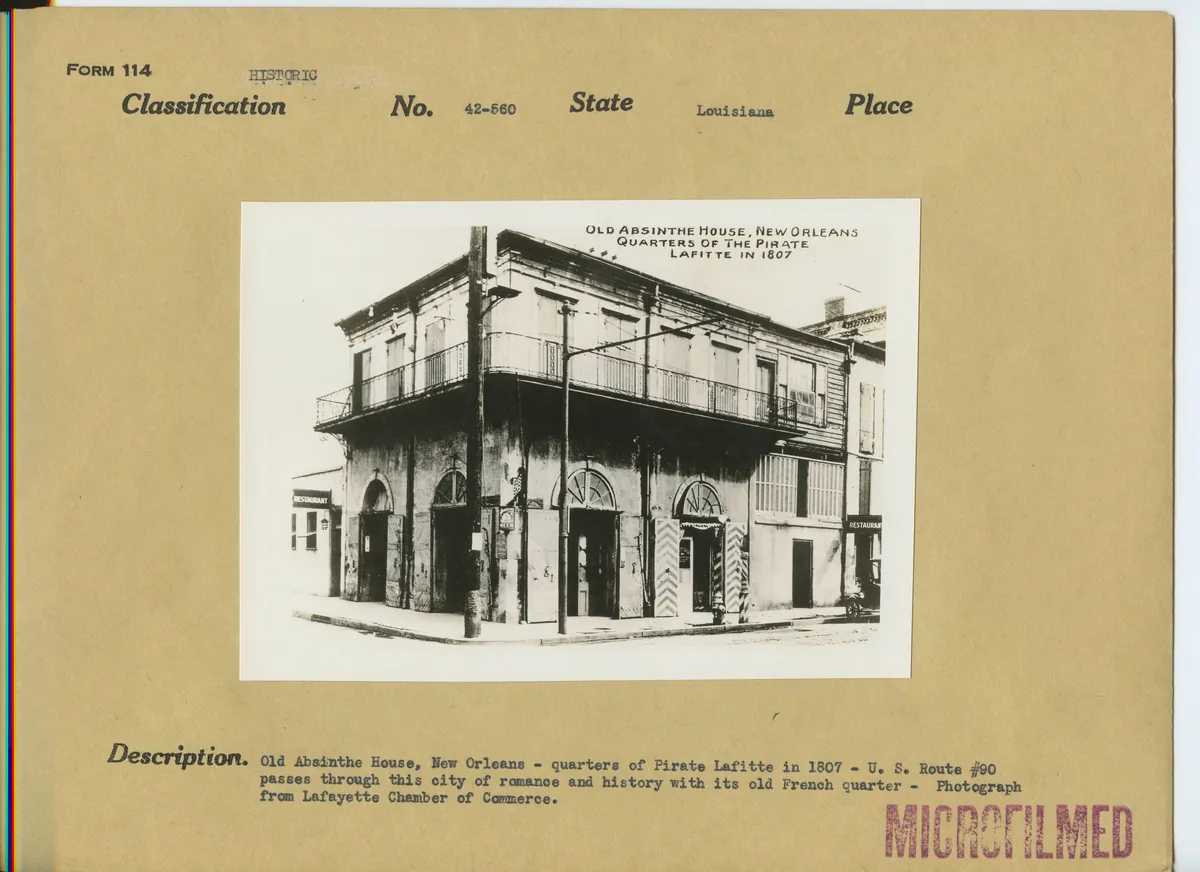
The building was completed in 1806 as a grocery. Around 1836, the first floor became a bar. By 1842, the Aleix family—Catalonian immigrants, like the building's owners—took over management. By 1869, it began advertising as "the Absinthe House."
Around 1870, Aleix hired Cayetano Ferrer, a bartender highly regarded for his work at the French Opera House. Ferrer took over management three years later and helped build the bar's reputation. The signature ritual: absinthe dripped over a sugar cube through a slotted spoon into ice water. When the U.S. banned absinthe in 1912, the bar outlasted it—the ban lifted in 2007. During Prohibition, the owners hid the original marble absinthe fountain and copper fixtures from federal agents.
Owen Brennan bought the bar in 1943. Business cards tacked to every surface are a tradition dating back over a century. The building has two stories with an entresol—an intermediate service floor—and a wrought-iron balcony railing. It's used for commercial and residential purposes.
Go for the ritual if absinthe is legal again. Go for the cards if you want to leave your mark in a room that's been collecting them for a hundred years.
- ·The building has been pouring drinks since 1807, originally as a coffeehouse and importing firm.
- ·The signature ritual: absinthe dripped over a sugar cube through a slotted spoon into ice water.
- ·During Prohibition, the owners hid the original marble absinthe fountain and copper fixtures from federal agents.
- ·Business cards tacked to every surface are a tradition dating back over a century.
- ·Absinthe was banned in the U.S. from 1912 to 2007 — the bar outlasted the ban.
- ·Located at the corner of Bourbon and Bienville. Open daily.
Memories
Editorial content compiled with AI assistance. Place details verified against public records.