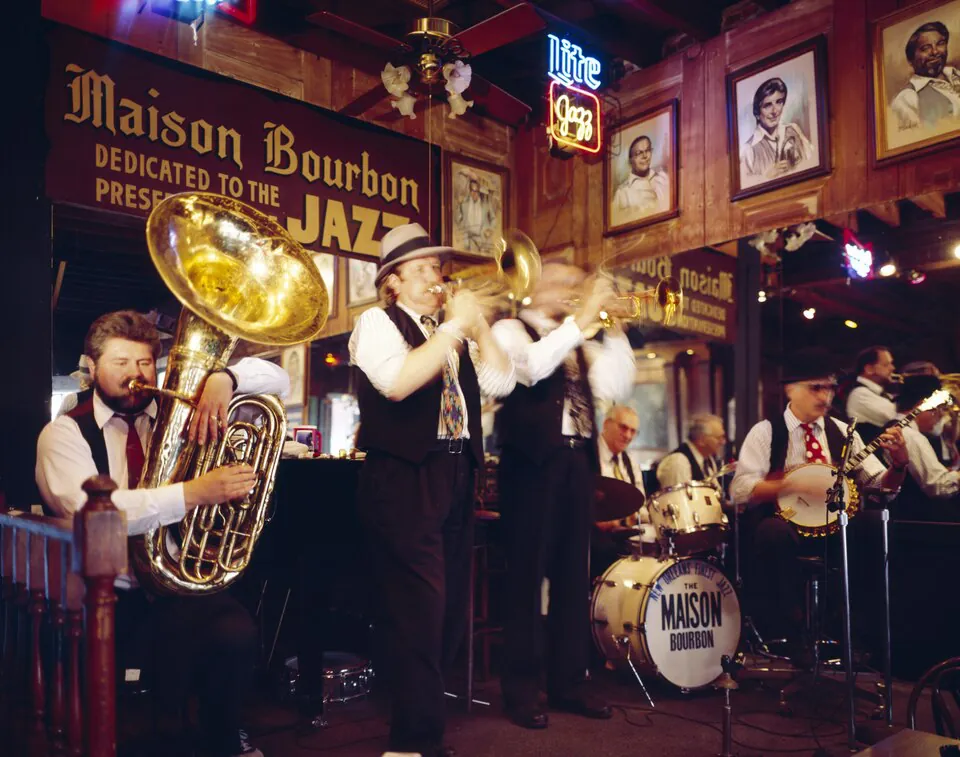
The doors stay open and the music spills onto the sidewalk. Maison Bourbon has been booking Dixieland and traditional New Orleans jazz since 1955. The sign reads "Dedicated to the Preservation of Jazz," and that's what happens here — clarinet, trumpet, trombone, the rhythm section working through standards in a shotgun-shaped room where the band plays at street level.
New Orleans was founded by the French in 1718 as a strategic colonial city, positioned to control the Mississippi River Valley trade. Throughout the nineteenth century it became the largest port in the Southern United States, exporting cotton and farm products to Western Europe and New England. The city passed through French and Spanish control before the Louisiana Purchase in 1803. That colonial and port history created a population mix — French, Spanish, African, Caribbean — and New Orleans developed what the city still calls its unique cultural heritage. Jazz came out of that.
Most of Bourbon Street converted. This one didn't. The musicians are professionals who play this style because it's their music, not a novelty act. No cover charge, two-drink minimum. Open nightly. You go because the form is still alive here, played by people who carry it, and you can hear it from the street before you decide to walk in.
- ·One of the last traditional jazz clubs on Bourbon Street — the sign reads 'Dedicated to the Preservation of Jazz.'
- ·Booking Dixieland and traditional New Orleans jazz since 1955.
- ·A shotgun-shaped room where the band plays at street level and the doors stay open so the music spills onto the sidewalk.
- ·No cover charge, two-drink minimum.
- ·The musicians are professionals who play this style because it's their music, not a novelty act.
- ·Located at 641 Bourbon St, French Quarter. Open nightly.
Memories
Editorial content compiled with AI assistance. Place details verified against public records.