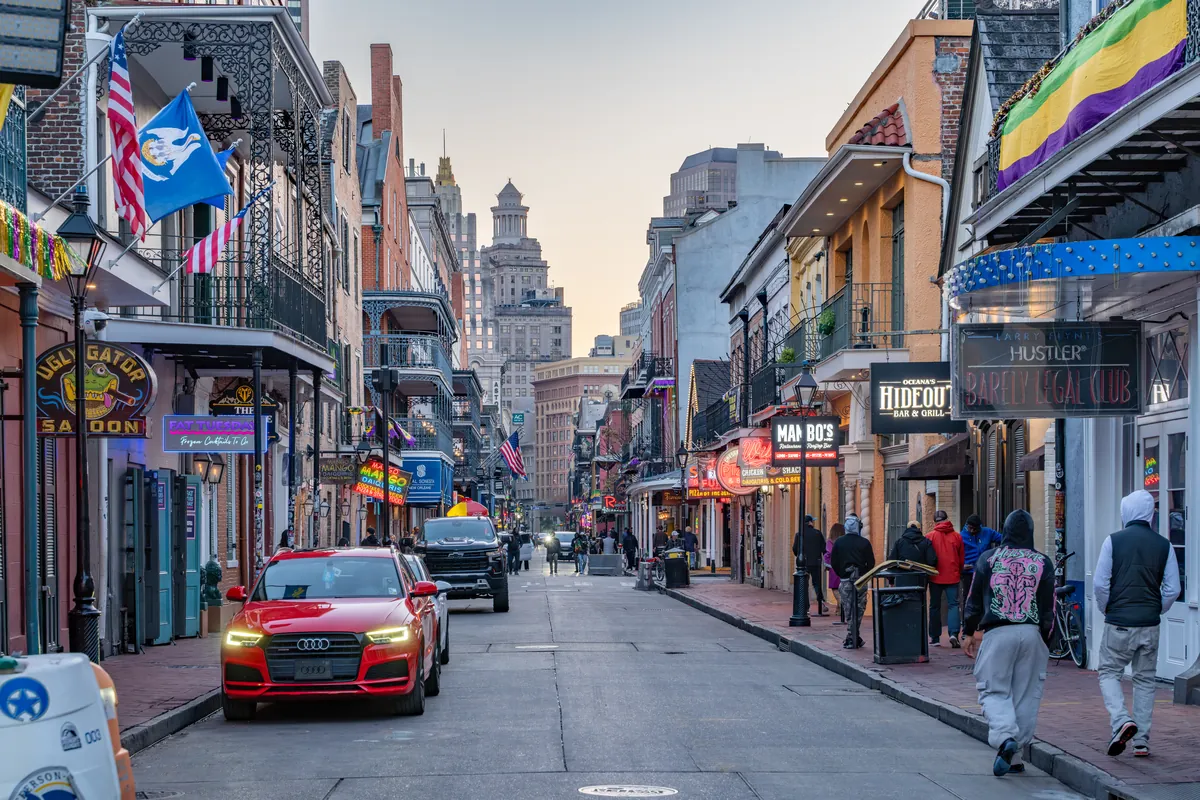
The street was named in 1721 by French engineer Adrien de Pauger, who designed the city's layout and honored France's ruling family, the House of Bourbon — not the whiskey. The Great New Orleans Fire of 1788 destroyed 80 percent of the city's buildings, and the Spanish rebuilt much of what stands today. Bourbon Street and the French Quarter display more Spanish than French architectural influence because of that rebuilding.
Before about 1900, Bourbon Street was a desirable residential area. That changed when the Storyville red-light district was constructed on Basin Street adjacent to the French Quarter in the late 1800s and early 1900s. Jazz is said to have developed in Storyville, with King Oliver and Jelly Roll Morton providing musical entertainment at the brothels. When the U.S. Navy forced the red-light district to close in 1917, jazz musicians and other businesses migrated into the French Quarter, more specifically to Bourbon Street. Galatoire's, at 209 Bourbon Street, was established by Jean Galatoire in 1905.
After World War II, Bourbon Street became the new Storyville in terms of reputation. During the 1940s and 1950s, the street was known for burlesque and striptease venues. One local historical account states that more than fifty acts could be seen along a five-block stretch on a given night.
In August 1962, District Attorney Jim Garrison began raiding adult entertainment establishments on Bourbon. He forced closure on a dozen nightclubs convicted of prostitution and selling overpriced alcohol. Following this campaign, Bourbon Street became populated by peep shows and sidewalk beer stands. When Mayor Moon Landrieu came into office in 1970, he made Bourbon Street a pedestrian mall to stimulate tourism. The 1980s and 1990s were characterized by a Disneyfication of Bourbon Street, with critics saying the street's authenticity had been lost to souvenir shops and corporate ventures.
Bourbon Street's high-ground location in the French Quarter left it mostly intact following Hurricane Katrina in 2005. The city had 10.1 million visitors in 2004, the year before Katrina. The year after the storm, that number was 3.7 million. New Orleans attracted 10.5 million visitors in 2016.
The street extends twelve blocks from Canal Street to Esplanade Avenue. The most-visited section is upper Bourbon Street toward Canal, an eight-block section of bars, restaurants, souvenir shops and strip clubs. Local open container laws allow drinking alcoholic beverages on the Quarter's streets. Lower Bourbon Street, from the intersection of St. Ann Street, caters to New Orleans' thriving gay community. Cafe-Lafitte-in-Exile is the oldest gay bar in the nation. Lafitte's Blacksmith Shop, on the corner of Bourbon Street and St. Phillip, is considered one of the oldest still-operating buildings in New Orleans and the oldest operating bar in the United States.
- ·Named for the French royal House of Bourbon, not the whiskey.
- ·The lower blocks nearest Canal are the neon-lit strip tourists expect; the upper blocks past St. Ann are quiet and residential.
- ·Before it became a tourist corridor, Bourbon was a residential street with Creole cottages and neighborhood bars.
- ·Real music venues remain: Fritzel's European Jazz Pub (oldest on the street), Maison Bourbon, the Funky Pirate.
- ·The street is closed to vehicle traffic nightly from Canal to St. Ann.
- ·Some of the oldest buildings in the Quarter are on the upper blocks of Bourbon.
Memories
Editorial content compiled with AI assistance. Place details verified against public records.