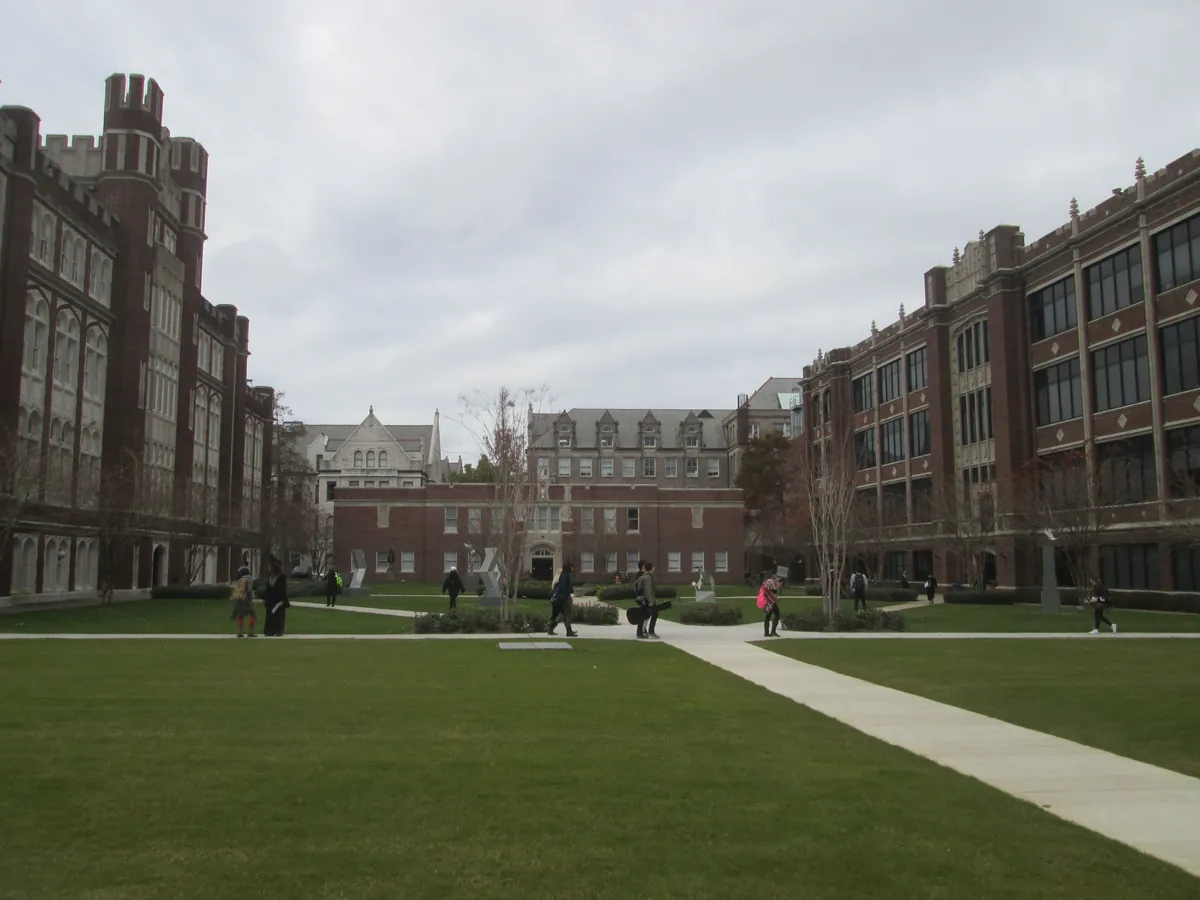
A young Jesuit was handed a nickel for streetcar fare in 1904 and told to ride the St. Charles line uptown and found a university. Fr. Albert Biever held the first classes in a residence behind Most Holy Name of Jesus Church — the Gothic-spired church still anchoring the campus corner on St. Charles Avenue. On July 10, 1912, the institution that began as Loyola College was chartered as Loyola University New Orleans.
Marquette Hall, completed in 1910 and named for the Jesuit explorer Fr. Jacques Marquette, is one of the handsomest Tudor Gothic buildings on any American campus. The 19-acre main campus shares a fence line with Tulane and fronts St. Charles Avenue across from Audubon Park; the streetcar passes both institutions. By the end of its first decade, Loyola included a College of Arts and Sciences, a School of Law, a School of Dentistry, and a College of Pharmacy. On March 31, 1922, the university transmitted the first radio broadcast in the Deep South when WWL began operation as a laboratory experiment.
In 1932, the New Orleans Conservatory of Music and Dramatic Art was incorporated into the university, becoming the College of Music — the only Jesuit college of music in the United States. The jazz studies program puts students in direct contact with the New Orleans music scene. In April 2007, the Thelonious Monk Institute of Jazz Performance relocated here from the University of Southern California. Norman Francis entered the Law School in 1952, becoming the first African-American admitted to the university.
Hurricane Katrina closed the campus in August 2005. The university sustained minimal wind damage but no floodwater breached any buildings. Despite the displacement of the entire student body during the fall 2005 semester, 91 percent of Loyola's undergraduates returned for the spring 2006 semester. On April 28–29, 2006, Loyola held commencement for the Class of 2006, becoming the first New Orleans college to do so post-Katrina — a signal the city read clearly.
The university enrolls 5,000 students. Take the St. Charles streetcar and walk the campus for Marquette Hall and the Gothic spire at the corner. The jazz program alone is reason enough to visit.
- ·A Jesuit university on St. Charles Avenue, sharing a fence line with Tulane.
- ·Founded in 1912; Marquette Hall's Tudor Gothic design is one of the handsomest on any American campus.
- ·The College of Music's jazz studies program puts students in direct contact with the New Orleans music scene.
- ·Holy Name of Jesus Church at the campus corner anchors the St. Charles Avenue skyline with its Gothic spire.
- ·Walkable from the St. Charles streetcar.
Memories
Editorial content compiled with AI assistance. Place details verified against public records.