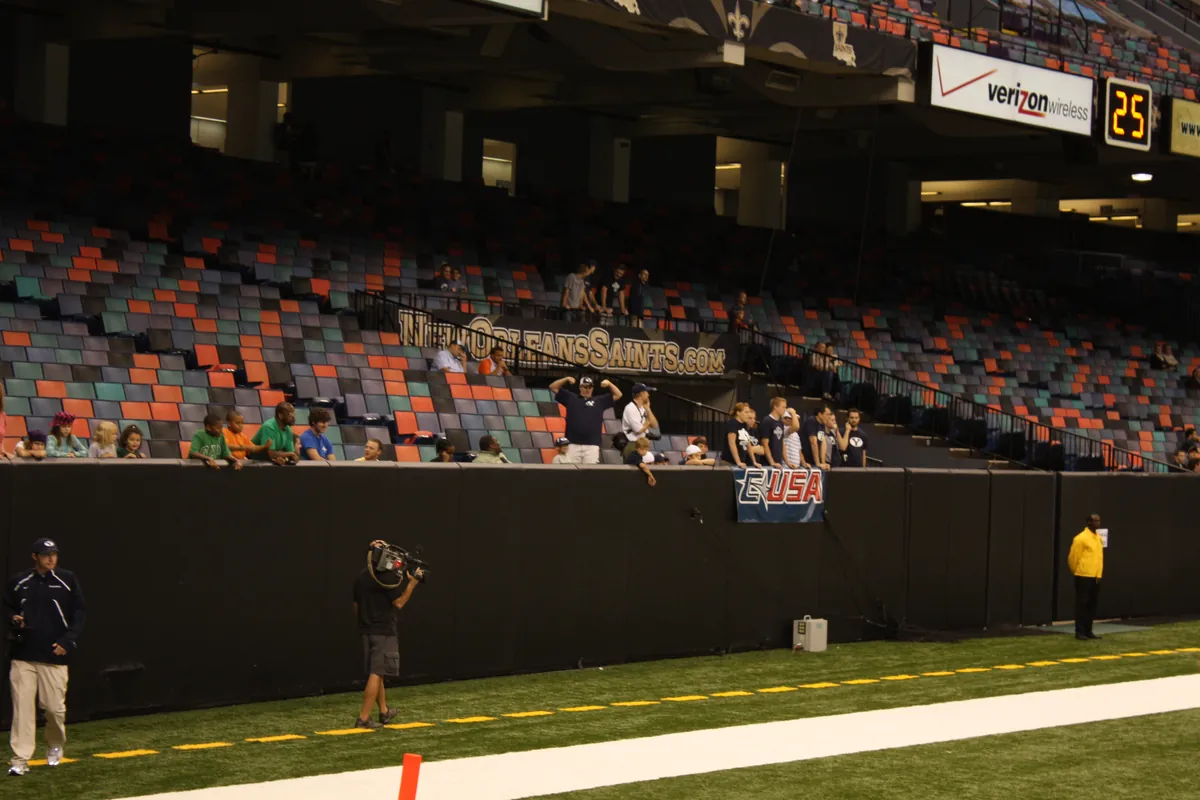
Tom Dempsey kicked a 63-yard field goal on November 8, 1970, with the goal posts on the goal line instead of the end line, and the ball cleared with feet to spare. The Saints beat Detroit 19-17. It was one of only two games New Orleans won that year. The record stood alone for 28 years before Jason Elam tied it, then Sebastian Janikowski, then David Akers. Matt Prater broke it in 2013 with 64 yards. Justin Tucker reset the mark at 66 yards in 2021. In 2025, Cam Little kicked 68. The kick happened at Tulane Stadium, which opened in 1926 on the Tulane campus in Uptown New Orleans. The original structure seated roughly 35,000 and was mostly brick and concrete. It was billed as "The Queen of Southern Stadiums."
The first Sugar Bowl was played there on January 1, 1935: Tulane against Temple. Fred Digby, sports editor of the New Orleans Item, had coined the term and had been pushing for an annual New Year's Day football game since 1927. The Sugar Bowl proved popular. The north end was enclosed in 1937, creating a 49,000-seat horseshoe. In 1939, the north end and sides were double-decked, expanding capacity to 69,000. The south end was enclosed in 1947, bringing capacity to 80,735. A seating adjustment in 1955 brought the stadium to its final capacity of 80,985. Lights were installed in 1957. The stadium hosted the Sugar Bowl through December 1974.
The New Orleans Saints played their first seven seasons there, 1967 through 1974. John Gilliam returned the opening kickoff 94 yards for a touchdown in the franchise's first home game, a 27-13 loss to the Los Angeles Rams on September 17, 1967. The Saints won their last game in the stadium, 14-0 over St. Louis on December 8, 1974.
Tulane Stadium hosted three Super Bowls: IV, VI, and IX. Super Bowl IV was held on January 11, 1970—Kansas City 23, Minnesota 7. Super Bowl VI was played on January 16, 1972, at 39°F. Super Bowl IX was played on January 12, 1975, at 46°F, and had originally been scheduled for the Superdome, which was unfinished. Super Bowl IX was the final professional league game ever played at the stadium.
On August 4, 1975, the day after the Superdome opened, Tulane Stadium was condemned. The older concrete-and-brick section was deemed fit to use on appeal, but the newer metal upper deck was declared unsafe, having rusted badly after 36 years of exposure to New Orleans' humid climate. The stadium continued in limited use for five years with the smaller seating area. Tulane hosted its final Green Wave game on November 30, 1974, a 26-10 loss to Ole Miss. One month later, Nebraska won the final college game in the stadium, defeating Florida 13-10 in the Sugar Bowl on December 31. The last game played before demolition was between Chalmette High School and Jesuit High School on November 3, 1979. The final touchdown was a 9-yard pass from Keith Mason to Craig Stieber with 4:08 remaining. Chalmette won 23-9.
Demolition started on November 18, 1979 and ended in June 1980. While storage areas underneath the seating were being emptied, an Ancient Egyptian mummy couple was rediscovered. The Reily Student Recreation Center now occupies the site. Nothing physical remains.
- ·Tulane Stadium opened in 1926 with a capacity of 80,735 — the largest in the South at the time.
- ·Super Bowl IV, the first ever played, was held here on January 11, 1970: Kansas City 23, Minnesota 7.
- ·The stadium also hosted Super Bowls VI and IX before the Superdome replaced it.
- ·Demolished in 1980; the Reily Student Recreation Center now occupies the site on the Tulane campus.
- ·Nothing physical remains — only its legacy as the venue that brought professional football's biggest game to New Orleans.
Memories
Editorial content compiled with AI assistance. Place details verified against public records.