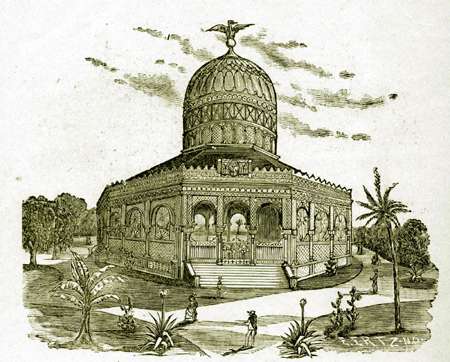
Throughout the 19th century, New Orleans exported most of the nation's cotton output to Western Europe and New England, the largest port in the South and the largest city in the South at the start of the Civil War. By 1884, nearly one third of all cotton produced in the United States was handled here. The Cotton Planters Association proposed a World's Fair to mark the occasion — a century since the earliest-surviving record of export of a shipment of cotton from the U.S. to England in 1784.
Congress lent $1 million to the fair's directors and gave $300,000 for a U.S. Government & State Exhibits Hall. Then state treasurer Edward A. Burke absconded abroad with some $1,777,000 of state money including most of the fair's budget. The planning and construction was marked by corruption and scandals, but the thing opened anyway. The Centennial covered 249 acres stretching from St. Charles Avenue to the Mississippi River. The main building enclosed 33 acres and was the largest roofed structure constructed up to that time. It was illuminated with 5,000 electric lights — still a novelty, said to be ten times the number then existing in New Orleans outside the fairgrounds. There was a Horticultural Hall, an observation tower with electric elevators, working examples of multiple designs of experimental electric street-cars, and a Mexican exhibit with a huge brass band that was a great hit locally.
President Chester Arthur opened the fair via telegraph on December 16, 1884, two weeks behind schedule. It closed on June 2, 1885. The grounds and structures were reused for the North Central & South American Exposition from November 10, 1885, to March 31, 1886, in an unsuccessful attempt to recover financial losses. After this the structures were publicly auctioned off, most going only for their worth in scrap.
The 249 acres of swampy Uptown land became Audubon Park — one of the finest urban green spaces in the South, the legacy of a spectacular failure.
- ·The World's Industrial and Cotton Centennial Exposition ran for six months in 1884 on 249 acres of swampy Uptown land.
- ·Drew 1.5 million visitors to what was briefly the largest building ever constructed.
- ·Ran $1 million over budget and ended in bankruptcy — the second of New Orleans' two spectacular World's Fair failures.
- ·The fairgrounds were landscaped over the following decades and became Audubon Park.
- ·The legacy of a failed fair is now one of the finest urban green spaces in the South.
Memories
Editorial content compiled with AI assistance. Place details verified against public records.