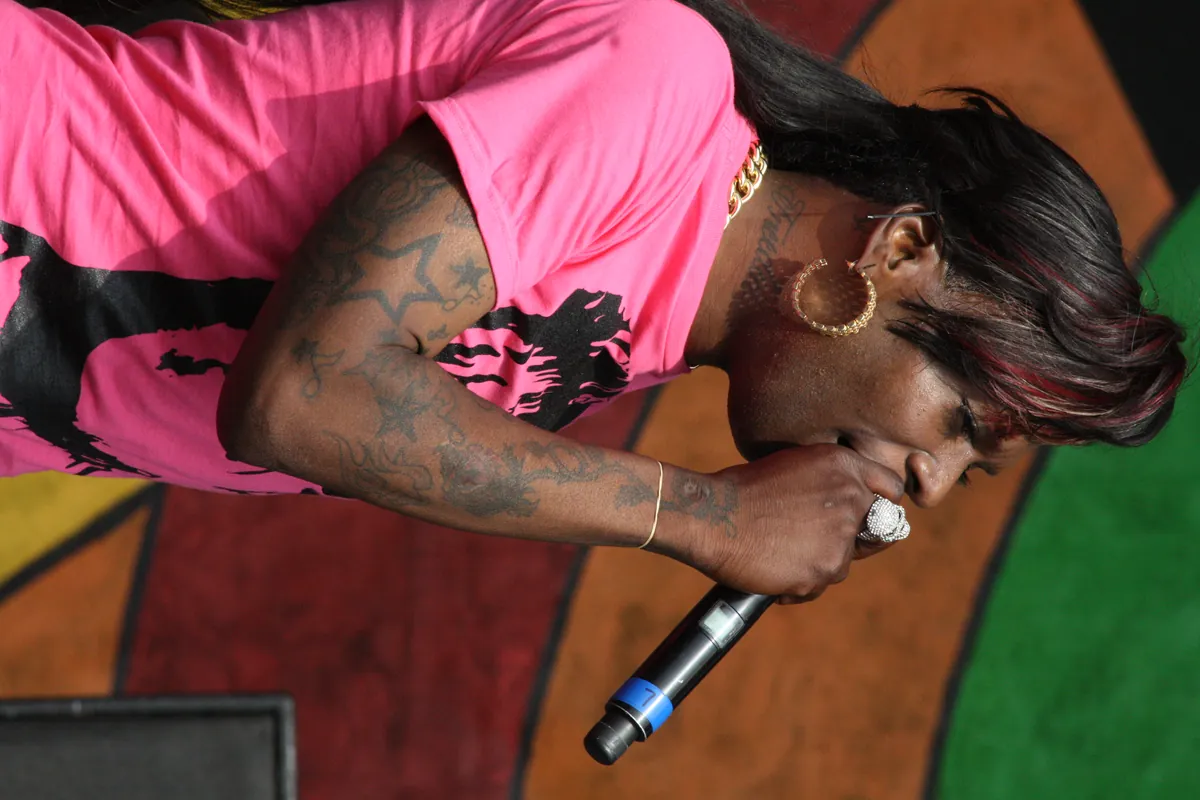
MC T. Tucker's "Where Dey At" was blowing out of Ghost Town, an Uptown Hollygrove club, in 1991. The track — performed over a DJ Irv backing sampled from a New York group called The Showboys — built on something older than hip-hop itself: call-and-response rooted in Mardi Gras Indian chants and second-line parades, now driven by an 808 drum machine. What came next was bounce, New Orleans' homegrown subgenre, intensely percussive and dance-centric, defined by "roll calls" of wards and neighborhoods chanted back by the crowd.
The city had been doing this for generations — the sousaphone-driven bass line on Gregory D and DJ Mannie Fresh's "Buck Jump Time (Project Rapp)" in 1989 made the link explicit. When Da Sha Ra sampled the Rebirth Brass Band's "I Feel Like Funkin' It Up" for "I Feel Like Bootin' Up" in 1993, it wasn't fusion. It was continuation.
DJ Jubilee's 1993 single "Do The Jubilee All" contains the first recorded use of the word "twerk." In 2013, he headlined the first bounce show at Preservation Hall, a venue built for jazz. The projects where bounce was born — Central City, Magnolia, Calliope — have mostly been demolished. But Take Fo' Records, founded in 1992 as the first independent label to specialize in bounce, launched DJ Jubilee, Big Freedia, and Katey Red, the first queer bounce rapper. Cash Money Records, founded the same year by brothers Bryan "Birdman" Williams and Ronald "Slim" Williams, initially functioned as a bounce label. With Mannie Fresh as sole in-house producer for more than a decade, Cash Money secured a distribution deal with Universal in 1998 that sent Juvenile's "400 Degreez" and "Back That Azz Up" — certified classics — national. Lil Wayne, B.G., and the Hot Boys followed. Master P's No Limit Records, established in the same era, built an empire and launched Mystikal and Silkk the Shocker.
After Katrina, when the city's poor Black residents were left behind by federal agencies, bounce artists were among the first to demand action. Big Freedia, the undisputed queen of bounce music, brought the genre global through collaborations with Beyoncé on "Formation." The music survived because it was never just music — it was how the city named itself, ward by ward, second line by second line, 300 years deep.
- ·Bounce music — New Orleans' homegrown hip-hop subgenre — emerged from the housing projects of Central City in the early 1990s.
- ·DJ Jubilee's 'Get Ready Ready' (1991) is widely credited as the track that launched bounce as a citywide phenomenon.
- ·Built on call-and-response chants, triggerman beats, and fierce neighborhood identity.
- ·Cash Money Records (Lil Wayne, Birdman) grew out of the same ecosystem in the Magnolia and Calliope projects.
- ·The Uptown housing projects where bounce was born have mostly been demolished, but the music thrives.
- ·Bounce draws a direct line from second line culture to contemporary hip-hop — the newest chapter in a 300-year music tradition.
Memories
Editorial content compiled with AI assistance. Place details verified against public records.