John L. Metoyer and members of a New York mutual aid society called "The Tramps" attended a vaudeville show in 1908 at the Pythian Temple Theater. The Smart Set's musical comedy *There Never Was and Never Will Be a King Like Me* included a skit where characters wore grass skirts and dressed in black makeup. Metoyer reorganized his marching troupe. In 1909, he and the first Zulu king, William Story, paraded — Story wore a lard-can crown and carried a banana stalk as a scepter. The Zulu Social Aid & Pleasure Club incorporated in 1916.
The hand-painted coconuts became the most coveted throw in Carnival. In the early twentieth century, other krewes threw glass necklaces, often hand-made and expensive. The working men of Zulu purchased coconuts from the French Market — unusual and cheap. Painted and adorned coconuts became popular starting in the late 1940s. In 1987, lawsuits stemming from coconut-related injuries forced a halt. In 1988, Governor Edwin W. Edwards signed the Coconut Bill into law, removing liability and enabling the tradition to resume.
Louis Armstrong reigned as King Zulu in 1949. In 1948, Edwina Robertson became the first Queen of Zulu, making the club the first to feature a queen in a parade. Zulu is the only New Orleans Mardi Gras krewe that selects their king through an election voting process — potential kings campaign for the job, including throwing parties for other krewe members to solicit votes.
In the 1960s, membership dwindled to fifteen as civil rights activists protested the parade. The induction of local civil rights leaders Ernest J. Wright and Morris F.X. Jeff Sr. as Zulu members eventually lifted tensions. Unlike the other old-line Carnival krewes, Zulu never had a policy of racial discrimination. In 1973, Zulu President Roy E. "Glap" Glapion Jr. started actively recruiting professionals, educators, and prominent businessmen from all racial and ethnic backgrounds, making Zulu the first parading organization to actually parade racially integrated.
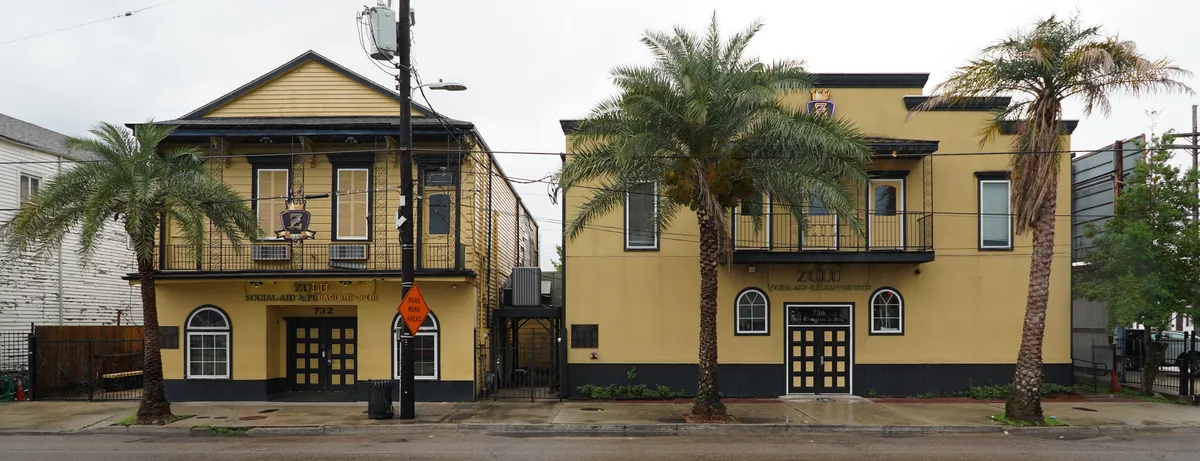
The krewe parades on Mardi Gras morning along Jackson Avenue and St. Charles Avenue. The parade route is announced each Carnival season at zulu.com. The clubhouse is on Broad Street.
- ·Founded in 1909 as a Black Carnival krewe in response to Rex's exclusion of African Americans from Mardi Gras.
- ·Hand-painted coconuts — the most coveted throw in all of Carnival — started as a satire of Rex's glass bead trinkets.
- ·Louis Armstrong reigned as King Zulu in 1949.
- ·Parades on Mardi Gras morning along Jackson Avenue and St. Charles Avenue.
- ·The krewe's membership includes generations of New Orleans musicians, politicians, and community leaders.
- ·The clubhouse is on Broad Street. The parade route is announced each Carnival season — check zulu.com.
Memories
Editorial content compiled with AI assistance. Place details verified against public records.