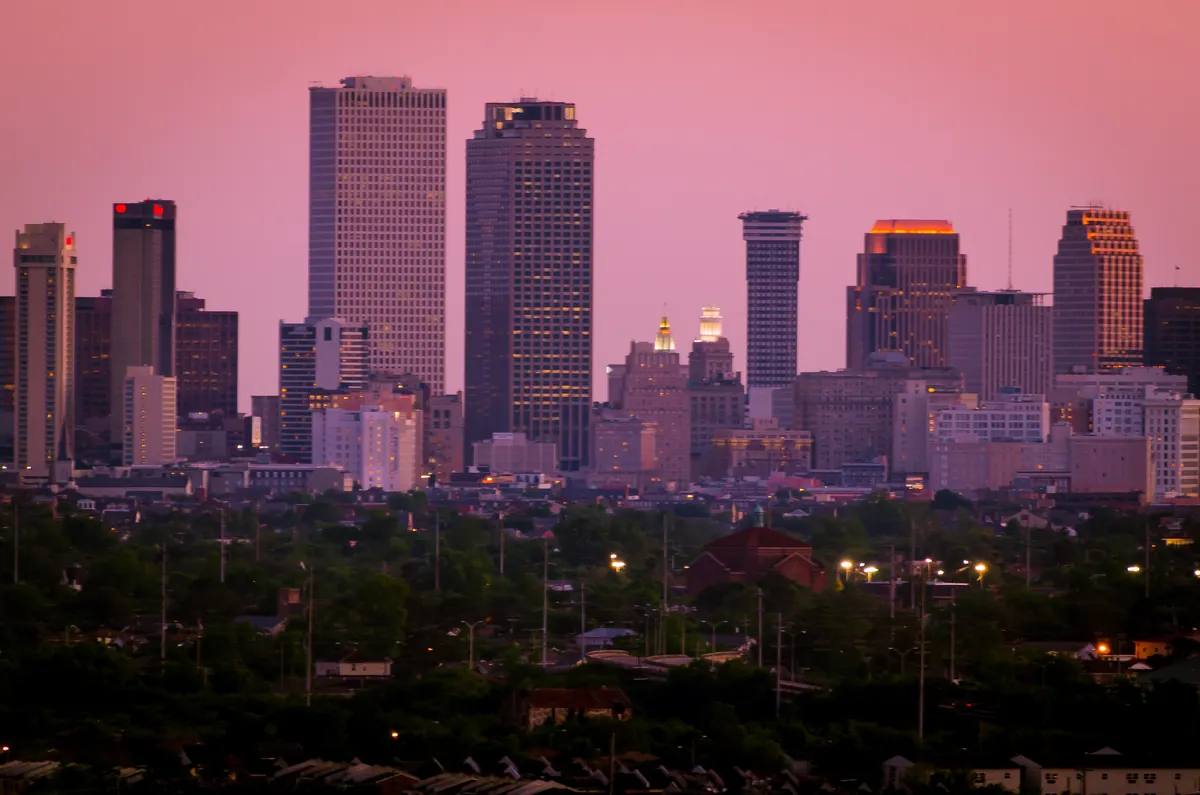
Below sea level, surrounded by water, following a street grid that bends with the river instead of the compass — New Orleans has been French, then Spanish, then French again, then American, all within eighty-five years. Four flags before most American cities had one. The only American city where slaves were allowed to gather in public and play their native music, which is why jazz was born here in the early twentieth century and not somewhere else. The only city where nearly all the surviving eighteenth-century architecture of the French Quarter dates from the Spanish period, not the French one whose name the neighborhood still carries.
In 1718, Jean-Baptiste Le Moyne de Bienville chose a site on a bend in the Mississippi River, 105 miles upriver from the Gulf, and named it for Philippe II, Duke of Orléans. The Choctaw had called it Bulbancha — land of many tongues. By 1840 it was the wealthiest and third-most populous city in the nation. The city's population has spoken French, Spanish, English, Creole, Vietnamese, and a dozen other languages in ordinary daily intercourse, producing dialects that exist nowhere else and a cuisine that belongs only to itself.
On August 29, 2005, the federal levee system failed during Hurricane Katrina. Eighty percent of the city flooded. More than fifteen hundred people died in Louisiana, most in New Orleans. The population fell by more than half. Ten years later, it had recovered to eighty percent of what it was in 2000. The city kept getting back up.
You go to New Orleans because it is the most culturally distinct city in the United States, and because every other American city is some version of the same story, and this one is not.
- ·The most culturally distinct city in the United States — the only American city that was French, then Spanish, then French again, then American, all within 85 years.
- ·Below sea level, surrounded by water, governed by a street grid that follows river bends instead of compass points.
- ·Home to a population that speaks, cooks, dances, and mourns in ways that exist nowhere else in the country.
- ·Every other American city is some version of the same story. New Orleans is a different story entirely.
- ·The city has been underwater, on fire, under four flags, and flattened by hurricanes — it keeps getting back up.
Memories
Editorial content compiled with AI assistance. Place details verified against public records.