New Orleans sits in a bowl below sea level, on land the Mississippi River deposited as silt over millennia. For two centuries after its 1718 founding, the city occupied a narrow crescent of relatively high ground along the river's natural levee. The rest was swamp.
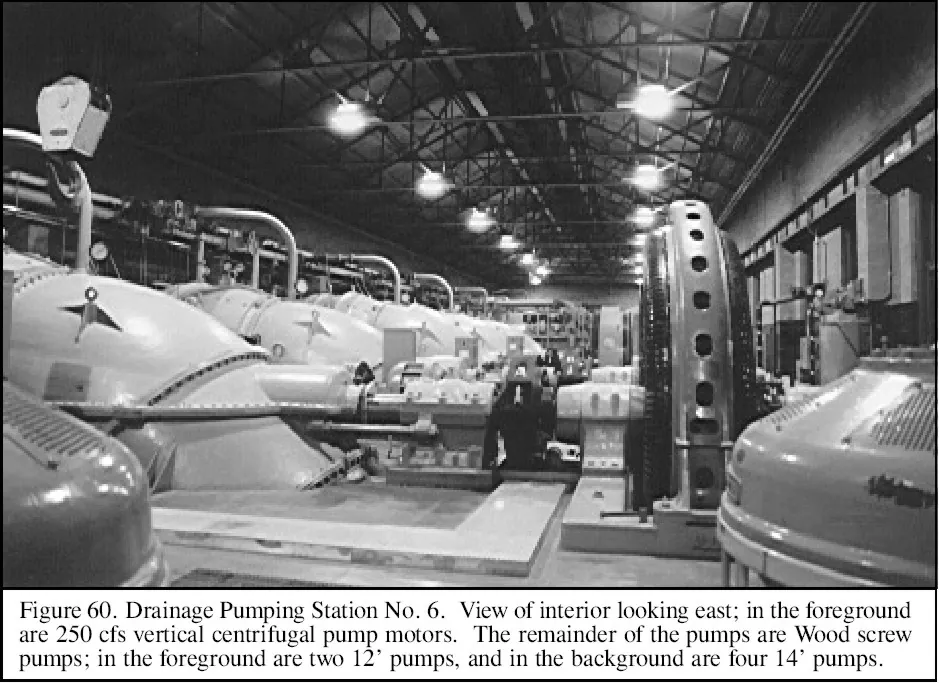
Albert Baldwin Wood graduated from Tulane in 1899 with a degree in engineering. The Sewerage & Water Board hired him that same year to solve the drainage problem. He invented the Wood Screw Pump in 1913—a massive horizontal Archimedes screw that moves up to 9 million gallons per minute from below-sea-level streets into outfall canals. He followed it with the Wood Trash Pump in 1915. He spearheaded the swampland reclamation that made much of the present city possible.
Some of Wood's pumps have run almost continuously for over eighty years without repairs. New pumps are still built from his designs. The American Society of Mechanical Engineers named them a civil engineering landmark. Wood also consulted on drainage systems for Chicago, Milwaukee, Baltimore, San Francisco, and cities in Canada, Egypt, China, and India. His work was especially helpful in the Zuiderzee Works, which reclaimed large areas of land from the Zuider Zee in the Netherlands.
The original 1913 pumps are still operating a century later. They're hidden in plain sight at drainage pumping stations across the city. Pumping Station 6 on Metairie Road is the most visible; tours are by appointment. You're looking at the machines that let New Orleans expand past its original crescent and survive the rain.
- ·Albert Baldwin Wood's 1913 screw pumps are why New Orleans can drain itself.
- ·Horizontal Archimedes screws move up to 9 million gallons per minute into outfall canals.
- ·The original 1913 pumps are still operating a century later.
- ·They're an ASME civil engineering landmark hidden in plain sight.
- ·Visitor tip: the Drainage Pumping Station 6 (Metairie Road) is the most visible; tours by appointment.
Memories
Editorial content compiled with AI assistance. Place details verified against public records.