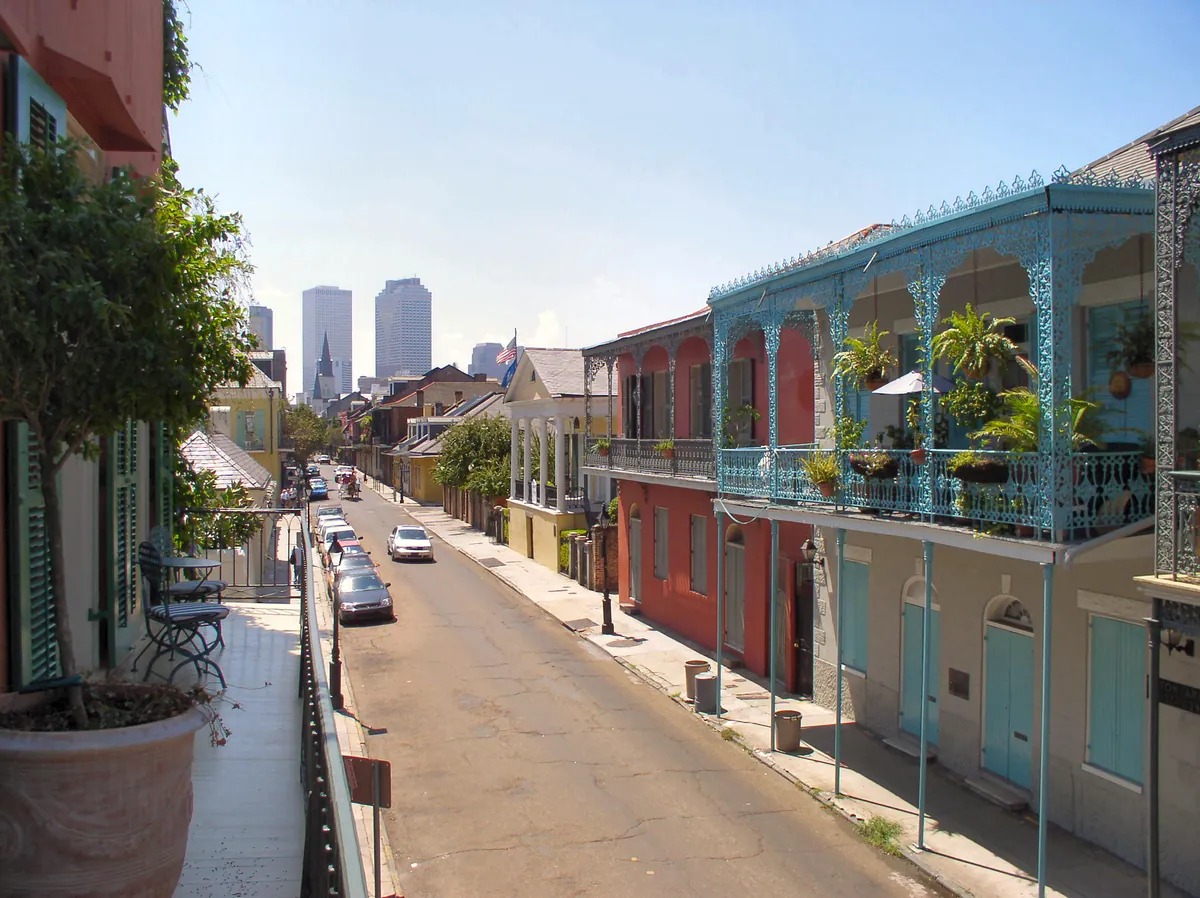
The daughter of Don Andres Almonaster y Rojas — the Spanish colonial landowner appointed to the Cabildo for life, who built the Cathedral and Presbytère — Micaela Almonester became Baroness de Pontalba and reshaped the edges of Jackson Square. Inspired by the imposing Parisian architecture she favored, she built the Upper and Lower Pontalba Buildings, row houses that would become the oldest apartment buildings in the United States. She convinced authorities to renovate the Square itself, the Cabildo, and the Presbytère, and persuaded church officials to enlarge the Cathedral. She hired architect James Gallier, Sr., then dismissed him before construction began, employing Samuel Stewart as builder instead. The buildings were completed in 1849 and 1851, each containing sixteen separate houses on the upper floors and self-contained shops on the ground. Cast-iron railings bear the "A and P" monograms for Almonaster and Pontalba.
City directories and the 1860 census show that merchants wealthy enough to afford one of New Orleans's most fashionable addresses rented these units. An average of nine residents occupied each dwelling — parents, children, slaves, and servants. William G. Hewes lived here with his two daughters and five slaves; he was president of both a bank and the New Orleans, Opelousas and Great Western Railroad. Members of the Soria family, merchants who came from New York, owned between five and eight slaves. Widow Amelia Zacharie Saul Cammack lived here with her son and three daughters and owned between three and seven slaves during their residency from 1853 to 1856.
The Louisiana State Museum took possession of the building in 1927 and opened the 1850 House to the public in 1948. One unit is furnished with domestic goods, decorative arts, and furniture of the period to show what middle-class family life looked like during the most prosperous period in New Orleans's history. Because residents were tenants who lived here for a few years at a time, the house does not represent a single family. It reflects mid-nineteenth-century prosperity, taste, and daily life. The furniture spans rococo revival, Gothic revival, and classical revival styles popular in the 1850s. Some pieces have a history of ownership in Louisiana; local furniture shops made or sold others. Old Paris porcelain sits alongside New Orleans silver. A six-piece bedroom suite attributed to the warerooms of Prudent Mallard — a large half-tester bed, a duchesse, two mirror-faced armoires, a washstand, and a nightstand — was made for Mrs. Magin Puig of 624 Royal. Paintings by French-trained artists Jacques Amans, Jean Joseph Vaudechamp, Aimable Desire Lansot, and François Bernard hang on the walls.
The first floor housed businesses including dry goods stores, clothing stores, law offices, a bank, and a railroad company. Upstairs are the parlor, dining room, and three bedrooms. A back wing, called the "kitchen building" in the builder's contract, served for storage, additional workspace, and housing for slaves or servants. The Cammack family's arrangement roughly corresponds to the way the living quarters are furnished. Docent- and curator-led tours are available, as is self-directed viewing. Open Thursday through Tuesday, 10am to 4:30pm. Admission charged. 523 St. Ann Street, directly adjacent to the Cabildo and Presbytère on Jackson Square.
- ·Inside the Pontalba Buildings — the oldest apartment buildings in the United States (1849).
- ·Louisiana State Museum site showing furnished rooms as an upper-middle-class Creole family would have lived in the 1850s.
- ·Commissioned by Baroness Micaela Almonester de Pontalba, one of the most powerful women in 19th-century New Orleans.
- ·Period furniture, domestic goods, and household arrangements are all authentic to the era.
- ·Flanks Jackson Square directly adjacent to the Cabildo and Presbytère.
- ·Open Thu–Tue 10am–4:30pm. Admission charged. 523 St. Ann Street.
Memories
Editorial content compiled with AI assistance. Place details verified against public records.