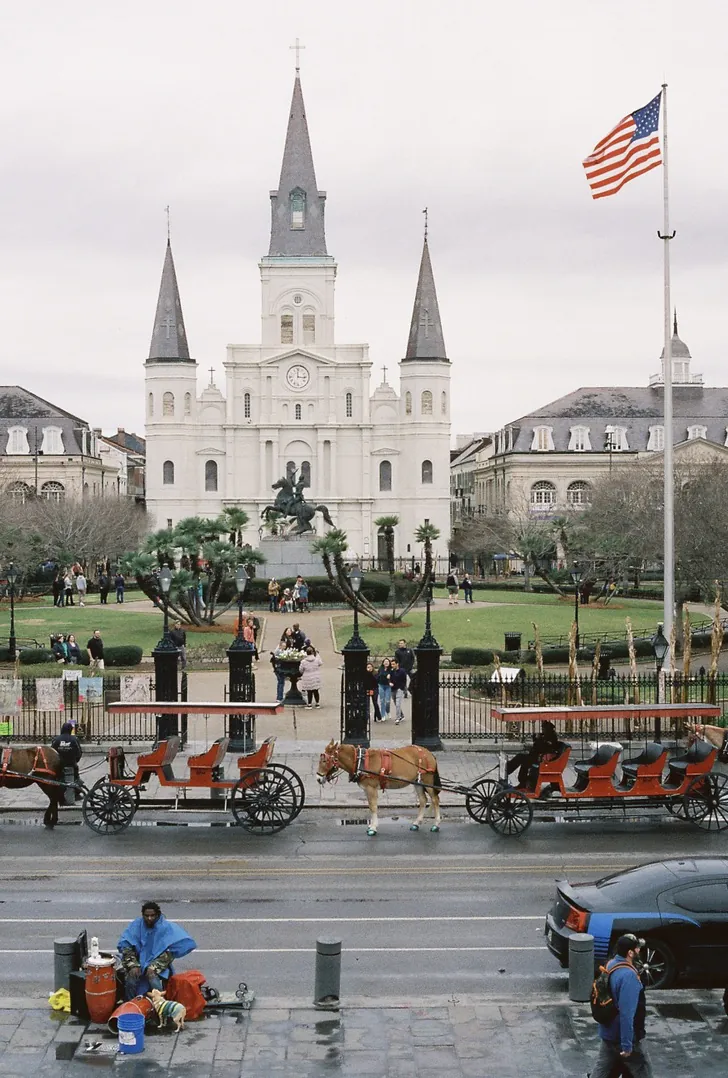
Three years after New Orleans was founded, the French laid out the Place d'Armes in 1721 — the oldest designed public space in America. Early French colonial New Orleans centered on this military parade ground. Under Spanish colonial administration in the second half of the 18th century, it became Plaza de Armas. After the Great New Orleans Fire of 1788, Spanish officials rebuilt the St. Louis Church in 1789 and the town hall — the Cabildo — in 1795. In 1803, Louisiana became United States territory here pursuant to the Louisiana Purchase; the final version of the treaty was signed in the Cabildo. Following the 1815 Battle of New Orleans, the former military plaza was renamed Jackson Square for the battle's victorious General Jackson.
Clark Mills' equestrian statue of Andrew Jackson — one of four identical statues in the U.S. by the sculptor — was erected in 1856. The statue was dedicated in a grand ceremony on Saturday, February 9, 1856. Baroness Pontalba commissioned the iron fence, walkways, benches, and Parisian-style landscaping in 1851. She also built the Pontalba Buildings, matching red-brick, block-long, four-story buildings from the 1840s that flank the old square. The ground floors house shops and restaurants; the upper floors are the oldest continuously rented apartments in North America. Four slightly older neoclassical statues representing the four seasons stand near each corner of the square.
On the north side are three 18th-century historic buildings: St. Louis Cathedral at center — designated a minor basilica by Pope Paul VI — the Cabildo to its left, and the Presbytère to its right, built to match the Cabildo. The Presbytère was initially planned for housing the city's Roman Catholic priests and other church officials, adapted as a courthouse at the start of the 19th century, and became a museum in the 20th century. Together, the ensemble is the most intact colonial civic square in North America. It was declared a National Historic Landmark in 1960. In 2012 the American Planning Association designated Jackson Square as one of the Great Public Spaces in the United States.
From the 1920s through the 1980s the square was famous as a gathering place of painters — proficient professionals, talented young art students, amateurs, and caricaturists. The 1960s and 1970s saw the beginnings of the square as a place of business for New Age and pagan devotees telling fortunes and reading palms and tarot cards on St. Ann or St. Peter street, alongside the park. Street musicians, artists, jugglers, and magicians work the section of Chartres Street comprising the parvis of the cathedral, the Presbytère, and the Cabildo, generally working for tips.
The Place d'Armes was the site for public execution of criminals and rebellious slaves during the 18th and early 19th centuries. After the 1811 German Coast Uprising, three slaves were hanged here. The heads of some executed rebels were put on the city's gates.
During the 1930s, the Works Progress Administration repainted façades, renovated buildings, and improved landscaping in and around the park. In 1971, the pedestrian zone was created when three surrounding streets were closed to vehicular traffic — Chartres, St. Peter, and St. Ann. The square is open daily, no admission. It closes at dusk; the surrounding sidewalks do not.
- ·Laid out as the Place d'Armes in 1721, two years after the city's founding — the oldest designed public space in America.
- ·Renamed Jackson Square in 1856 when the Andrew Jackson equestrian statue by Clark Mills was installed at center.
- ·The surrounding ensemble — Cathedral, Cabildo, Presbytere, Pontalba Buildings — is the most intact colonial civic square in North America.
- ·The iron fence surrounding the square dates to 1851, commissioned by Baroness Pontalba.
- ·Street musicians must hold a permit from the city; artists along the fence line have staked out the same spots for decades.
- ·Andrew Jackson's statue was one of the first equestrian statues in the U.S. to show a rearing horse.
- ·Open daily, no admission. The square closes at dusk; the surrounding sidewalks do not.
Memories
Editorial content compiled with AI assistance. Place details verified against public records.