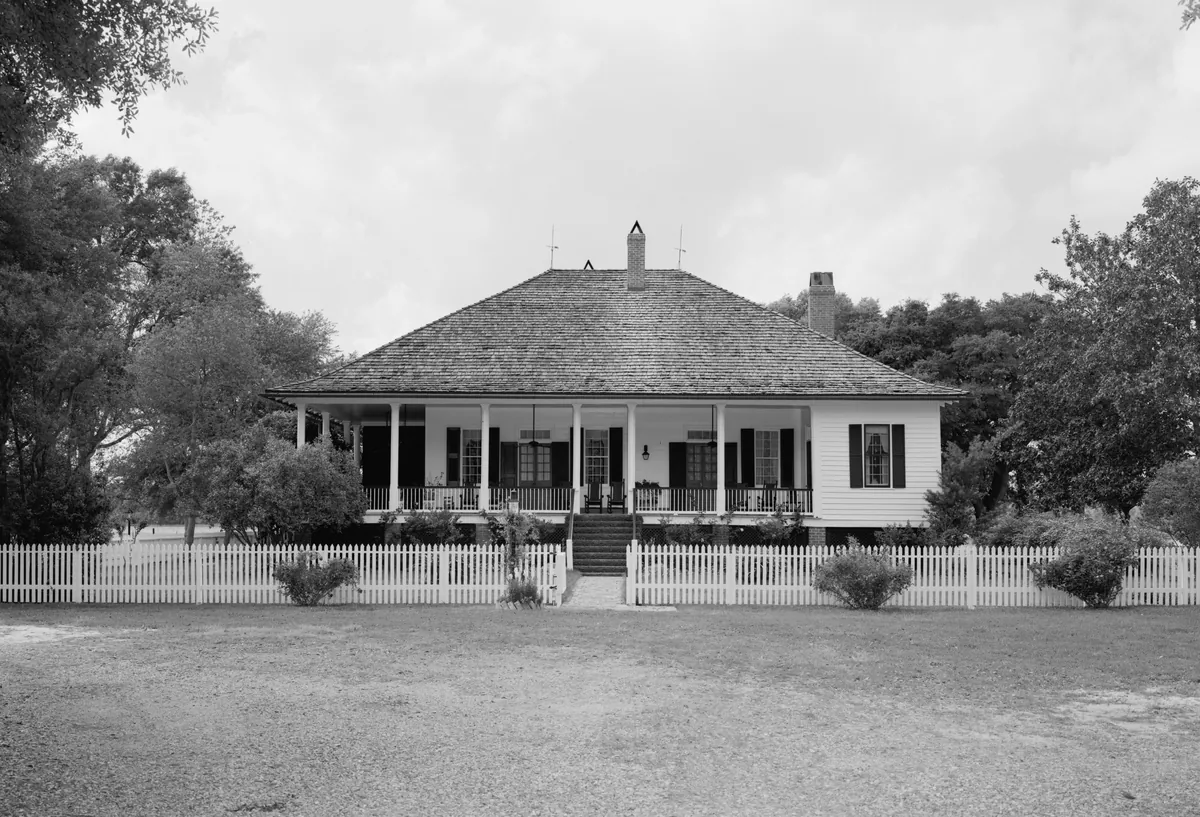
Eighteen hand-hewn cypress timbers frame the house — skilled joinery executed by enslaved African Americans who worked this 1,133-acre tract after Charles Emile Sompayrac purchased it on December 19, 1839. The name came from them, too: Cherokee, for the hedges of Cherokee roses surrounding the property. By 1860, Sompayrac owned 65 enslaved people. They worked cotton primarily, along with indigo, sugarcane, corn, and tobacco.
The house itself — built sometime between 1825 and 1849, most likely 1839 — exemplifies French Colonial and Creole architecture: three surrounding patios, six fireplaces, bousillage walls, hand-blown window glass, wide-planked floors. The designer and builder are unknown. The complex included three barns, a slave cabin, and a log crib. The house survived the Civil War undamaged, even as Union and Confederate troops destroyed plantations up and down the Cane River.
In the autumn of 1839, a political argument between adjutant-general François Gaiennie and State Senator Pierre E. Bossier ended in a duel on the grounds. Gaiennie fired first and missed. Bossier hit Gaiennie in the heart, killing him instantly. Eleven more men died in the aftermath as animosities continued to play out.
After Sompayrac's death in 1878, his widow sold parcels until the whole property went to Robert Calvert Murphy in 1891. Murphy's granddaughter and her husband bought it back in 1972 and began restoration. It was designated a National Historic Landmark in 1973 — one of the most architecturally intact Creole plantations in Louisiana. It remains private property, visible from the road but not regularly open for tours. Part of the Cane River National Heritage Area, it stands as evidence of what enslaved hands built and what wealth extracted from their labor purchased.
- ·Designated a National Historic Landmark in 1973.
- ·Built 1839 in the French Creole raised-plantation style along the Cane River.
- ·One of the most architecturally intact Creole plantations in Louisiana.
- ·Private property — not regularly open for tours. Visible from the road.
- ·Part of the broader Cane River National Heritage Area landscape.
Memories
Editorial content compiled with AI assistance. Place details verified against public records.