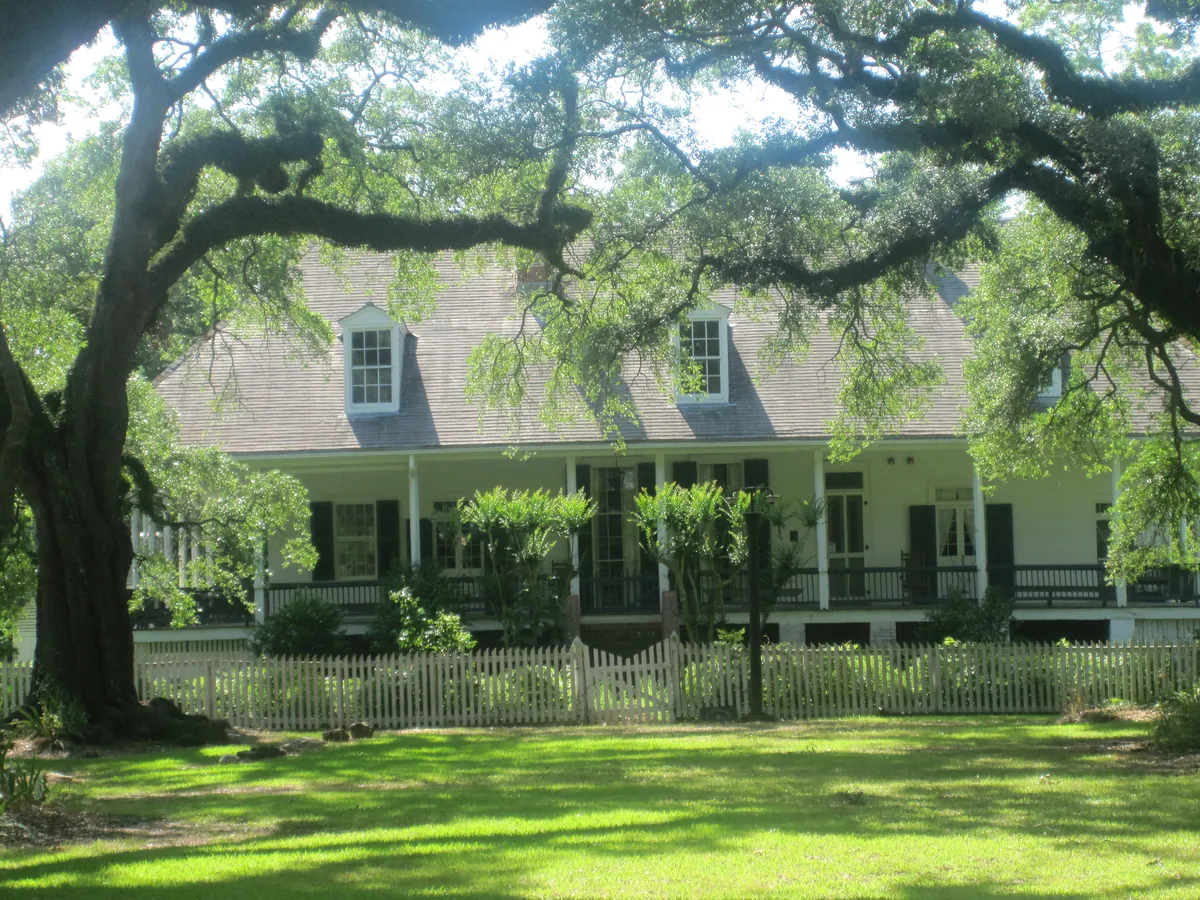
The Prud'homme family held Oakland for 177 years — one family, one place, 1821 to 1998 — and seventeen original outbuildings still stand. That completeness is what makes Oakland matter. Most Southern plantation complexes were dismantled, burned, or sold off in pieces. Oakland survived intact: the main house Jean-Pierre Emanuel Prud'homme finished in 1821, the cabins where enslaved people lived, the mule barn, the pigeonniers, the dipping vat, the plantation store that doubled as the Bermuda post office. Walk the grounds and you see the entire working infrastructure of a French Creole cotton plantation, not a curated fragment.
By 1860, 160 enslaved African Americans worked Oakland — harvesting cotton, laboring in the house, crafting tools and furniture. After the Civil War, sharecroppers — primarily descendants of those enslaved workers — continued to work the land until mechanization ended the arrangement in the 1960s. The National Park Service acquired Oakland in 1997 as part of the Cane River Creole National Historical Park, authorized by Congress in 1994.
The NPS interpretation centers enslaved workers' lives: their cabins, work routines, and resistance strategies. This is not a planter-family shrine. The park's program includes the history of emancipation, of freedmen and Creoles of color who remained on Oakland for nearly a century after the war. In 2018, the NPS created five documentary films with Traditionally Associated People from Oakland and nearby Magnolia Plantation — voices of descendants still living in the area.
Oakland was designated a National Historic Landmark in 2001 and added to Louisiana's African American Heritage Trail. The grounds are open daily 9am–3:30pm. Main house self-guided tours run Saturdays and Sundays, 10am–2pm. Free admission. You're standing where cotton was cultivated on a forced-labor farm, where people endured and resisted, where sharecropping families raised children long after slavery ended. The reason to go is that the full record survived.
- ·17 original outbuildings survive — one of the most complete plantation complexes in the South.
- ·Built 1821 by Pierre Emmanuel Prud'homme; the family held it until the National Park Service acquired it in 1998.
- ·NPS interpretation centers enslaved workers' lives: their cabins, work routines, and resistance strategies.
- ·Part of the Cane River Creole National Historical Park, est. 1994 by Congress.
- ·Grounds open daily 9am–3:30pm. Main house self-guided tours Sat–Sun 10am–2pm. Free.
Memories
Editorial content compiled with AI assistance. Place details verified against public records.