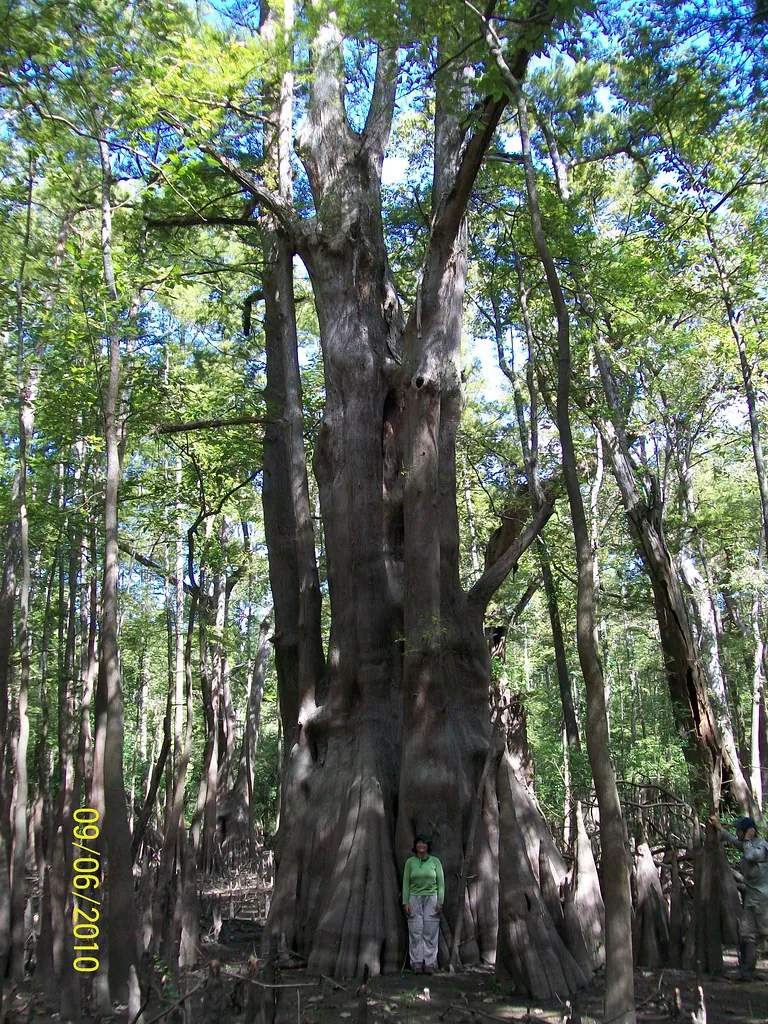
The National Champion baldcypress grows in Cat Island National Wildlife Refuge, thirty miles north of Baton Rouge. It is the largest tree of any species east of the Sierra Nevada — a buttressed trunk that splits into two canopies, the buttresses deep enough for a human being to hide inside. Many of the baldcypress in the refuge are estimated to be 500 to 1,000 years old.
The refuge itself was established in 2000 along the southernmost portion of the lower Mississippi River that has no levees. The river floods most years, and the refuge is inundated to varying degrees, generally between January and June. The champion tree is about 4.8 miles from the entrance gate. Access ends when the Mississippi River gauge in Baton Rouge reaches 26 feet — which means the walk-in season is late summer and fall, when the water drops and the ground reappears.
The refuge is home to the Louisiana black bear and lies within a major bird migration corridor for neotropical migrants, including the swallow-tailed kite. The habitat includes old growth baldcypress-tupelo, overcup oak-bitter pecan, hackberry-elm-ash, and nuttall oak-ash-sweetgum. Species present include white-tailed deer, bobcat, mink, river otter, wild turkey, wood duck, prothonotary warbler, and pileated woodpecker.
The refuge was created to conserve native forested wetland habitats for migratory birds, aquatic resources, and endangered and threatened plants and animals. It was also created to encourage partnerships among the U.S. Fish and Wildlife Service, local communities, and conservation organizations. That partnership model began with The Nature Conservancy of Louisiana, which purchased the original land in 2000. The U.S. Fish and Wildlife Service acquired it in stages; by 2003, the refuge reached its current size of 9,623 acres.
You go when the river allows, and you walk to a tree that was already centuries old before there was a refuge around it.
Memories
Editorial content compiled with AI assistance. Place details verified against public records.