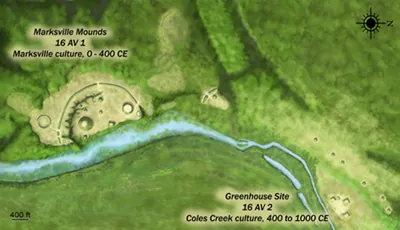
Two thousand years ago, the Marksville people raised earth into geometric forms that still stand — among the oldest intact earthworks in Louisiana. They worked within the Hopewell cultural tradition, a network of Indigenous societies that stretched across eastern North America between roughly 100 BCE and 400 CE, building ceremonial centers connected by exchange routes that moved copper, mica, and carved stone across a continent.
The federal government recognized the site as a National Historic Landmark in 1964, a designation reserved for places that possess exceptional value in illustrating American history. But the most important recognition came later: the Tunica-Biloxi Tribe of Louisiana, on whose ancestral territory the earthworks stand, now stewards the site.
Visit with the Tunica-Biloxi cultural center. The interpretation is Indigenous-led, which means the story of what was built here — and why it endures — is told by the people whose ancestors shaped this ground.
- ·The Marksville people — part of the Hopewell cultural tradition — built this earthwork complex 2,000 years ago.
- ·The site was designated a National Historic Landmark in 1964.
- ·The Tunica-Biloxi Tribe of Louisiana now stewards the site, whose ancestral territory this is.
- ·The mounds are among the oldest intact earthworks in the state.
- ·Visitor tip: visit with the Tunica-Biloxi cultural center for the Indigenous-led interpretation.
Memories
Editorial content compiled with AI assistance. Place details verified against public records.