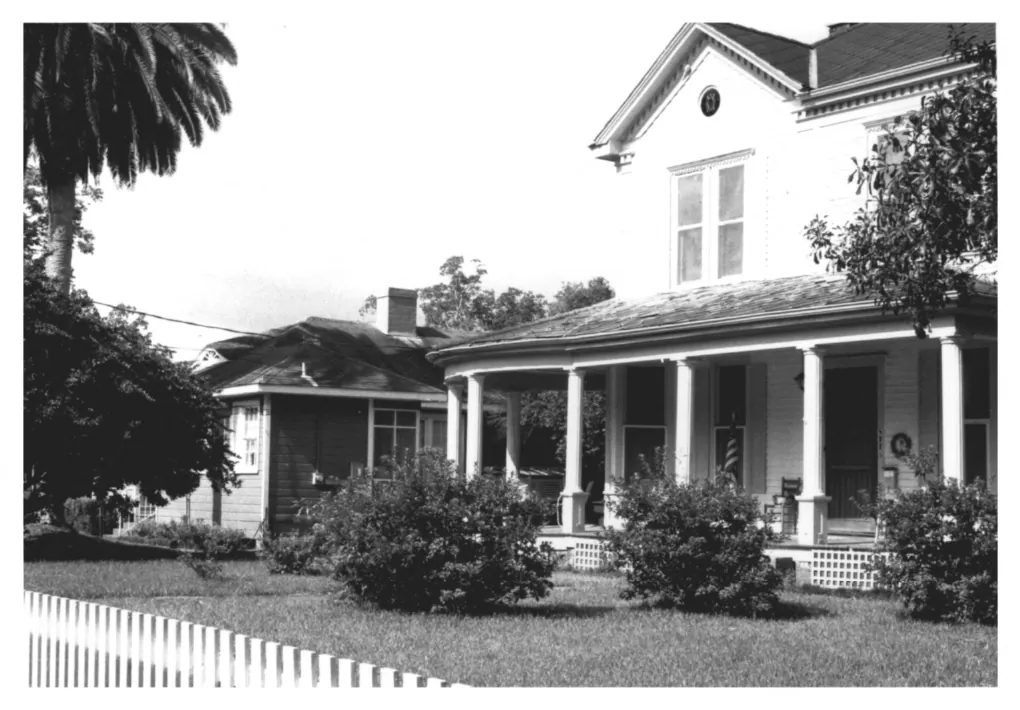
Charpentier means carpenter, and that's the joke: forty blocks of Queen Anne and Eastlake mansions designed by the same men who framed the houses, because the lumber-baron clients couldn't be bothered to hire architects. Turrets and fretwork and stained glass compete house by house. The 1900 Waters Pierce stable predates the pipelines that replaced timber. The 1929 Charleston Hotel rises nine stories on the next economy. The 1910 courthouse closes the walk: Favrot & Livaudais designed the lumber money's confidence into stone before the trees ran out.
The route
 1Architecture·1880s–1920s·NRHPCharpentier Historic District
Lake Charles got rich cutting longleaf pine and Louisiana cypress during the lumber boom of the 1880s through 1920s, but the new money arrived before the architects did. The carpenters who framed the sawmill owners' houses competed block by block, each building a one-of-a-kind design in whatever style caught his eye — Queen Anne Revival, Colonial Revival, Italian Renaissance, often on the same block. No trained architect would have mixed them that way. The district takes its name from the French word for carpenter: *charpentier*. The National Register listed the district in 1990. It covers 158 acres and includes 281 contributing buildings dating from around 1880 to 1939. The cypress and pine they used came from the same forests that made the city. Wikipedia's nomination summary calls it "all that is left to represent the lumber boom prosperity of Lake Charles in the late-nineteenth and early-twentieth centuries," and notes that it shares distinction with the historic districts in Crowley and Jennings — and is superior to both in some respects. Works by architects Favrot & Livaudais and Edward F. Neild appear in the district, as does the 1896 Church of the Good Shepherd, separately listed on the National Register in 1983. The district sits roughly bounded by Iris, Hodges, Lawrence, Kirkman, South Division, and Louisiana. Start at the 1911 Historic City Hall for self-guided walking tour maps. The thing to see is what happens when craftsmen build without a pattern book — forty-plus blocks of houses that look like arguments made in wood.
 2Architecture·1900s–1950s·NRHPRyan Street Historic District
Ryan Street is where Lake Charles rebuilt itself after the Great Fire of April 1910 burned through the commercial core. Eighteen buildings, listed on the National Register in September 2024 as the city's newest historic district, show what came after the devastation: Classical Revival storefronts from the early 1900s, Art Deco facades when the economy turned to oil, mid-century commercial architecture when the petrochemical refineries arrived after World War II and pushed the population toward 75,000. The Charleston Hotel went up in 1929, during Mayor Henry J. Geary's administration, when the city was expanding through the 20th century. The Calcasieu Marine Bank and Muller's Department Store are here too—the institutions that handled the transactions of a city whose economic center shifted from lumber to petrochemical refining. This was the main commercial corridor, the strip where Lake Charles did its business. The district runs along what was, and is, the artery of commerce. The styles span five decades because the money kept coming, first from timber, later from the refineries that defined the region. If you want to see what Lake Charles looked like when it had optimism and capital, this is the block.
 3Architecture·1929·NRHPCharleston Hotel
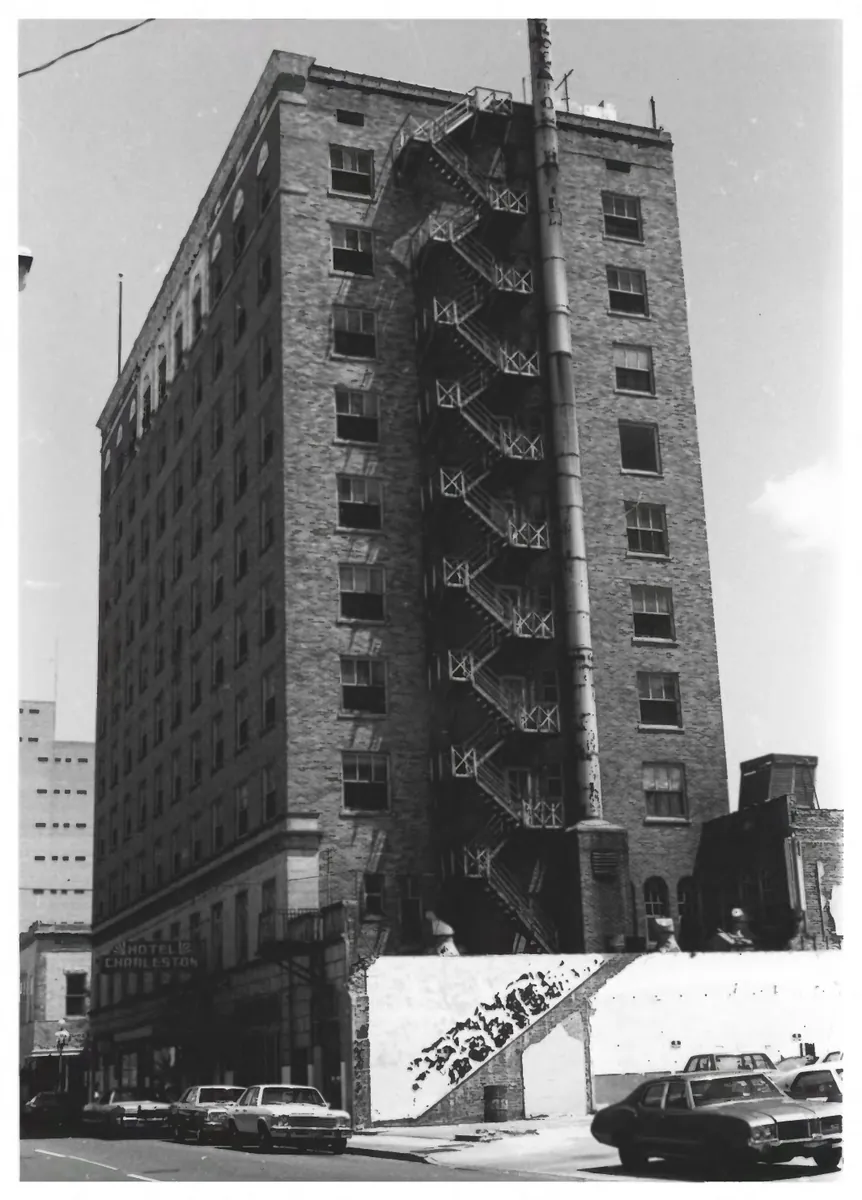
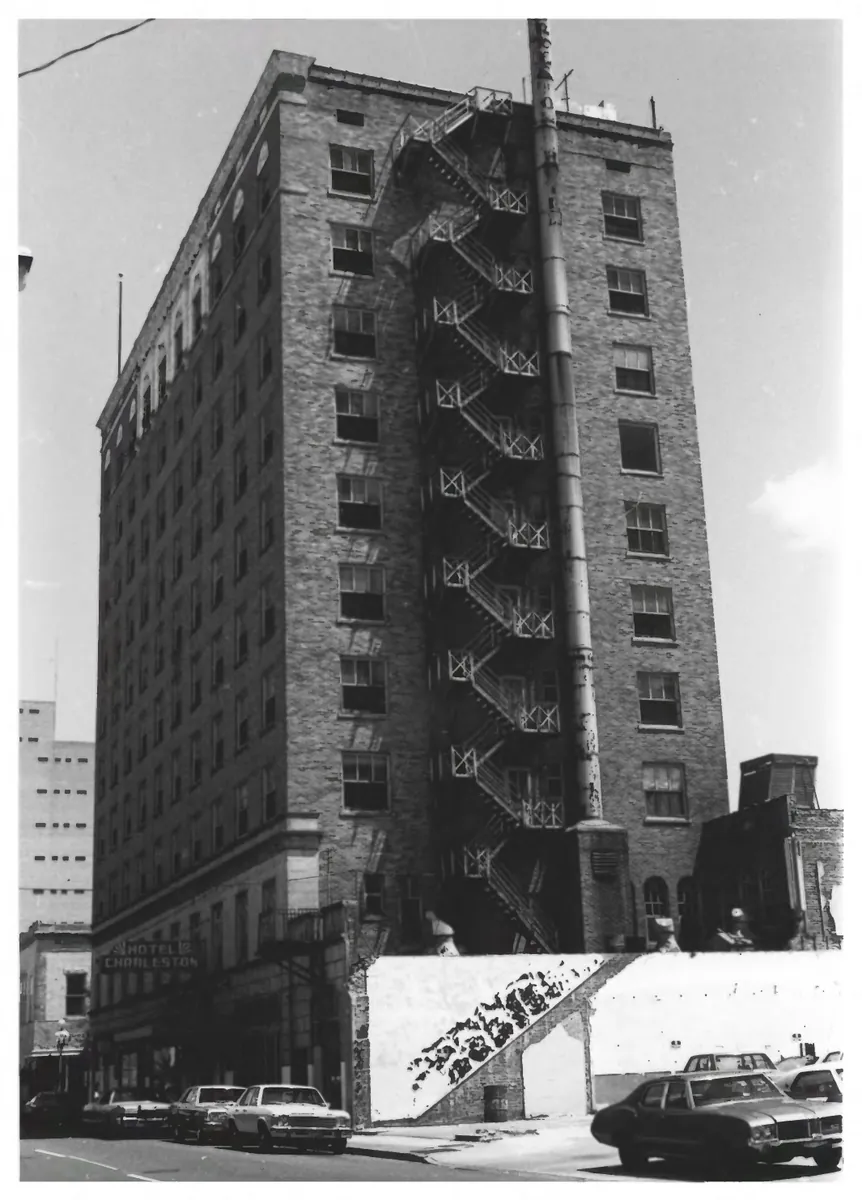
The Charleston Hotel was proposed at eight stories, but when work began in 1928 the plans grew to ten floors. The cost jumped $50,000 to $600,000. When the hotel was completed in 1929, during Mayor Henry J. Geary's administration, it was Lake Charles's first skyscraper. The city itself had been incorporated in 1861 as Charleston, named after early settler Charles Sallier, then reincorporated as Lake Charles in 1867. The hotel carried the old name forward. It went up during the transition from lumber economy to oil economy—oak and pine had once been the main economic engine here, but the Calcasieu Ship Channel now allowed ocean-going vessels to sail up from the Gulf. The bottom two stories are faced with cement molded to resemble cut stone blocks. The upper eight are tan brick in the Neo-Classical Beaux Arts style, topped with a stone cornice. Some top-floor windows are framed by pilasters and elaborate spandrel panels. Inside: a two-story lobby, elaborate tile work, upper-level balconies. The Charleston Ballroom on the second floor has Corinthian pilasters. Weekly dances were held on the open roof garden. The building stands at 900 Ryan Street, at the corner with West Pujo—Ryan Street being the commercial spine of downtown Lake Charles. It was listed on the National Register of Historic Places on May 27, 1982. By 2014, rooms had been converted into shops and event space throughout the building. The city has weathered the Great Fire of 1910, Hurricane Rita in 2005, and two hurricanes in 2020—Laura and Delta left it looking, one account said, as if "20 tornadoes came in and wiped the city." The hotel remains at the corner where it opened, the first building in Lake Charles to call itself a skyscraper.
 4Architecture·1900·NRHPWaters Pierce Oil Company Stable Building
The oldest commercial building in Calcasieu Parish to be listed on the National Register of Historic Places is a stable. Built in 1900 for Waters Pierce Oil Company — a Standard Oil affiliate — it housed horse-drawn wagons used to deliver oil. Lake Charles was incorporated as the town of Charleston in 1861. Six years later, it was reincorporated as the City of Lake Charles. In April 1910, the Great Fire devastated much of the city. Lake Charles rebuilt. During and after World War II, petrochemical refineries arrived, and the city grew into a major industrial center. The stable predates all of it. It was listed on the National Register in 1980. In 2005, Hurricane Rita heavily damaged the city. In 2020, Category 4 Hurricane Laura battered Lake Charles on August 26–27; Hurricane Delta followed on October 9. After the hurricanes, the city was described as if "20 tornadoes came in and wiped the city." The Junior League of Lake Charles operates here now. The building that once stabled working animals for a company that no longer exists serves a volunteer organization in a city that has endured catastrophe and rebuilding across three centuries. It's still standing.
 5Religious Site·1912·NRHPCathedral of the Immaculate Conception
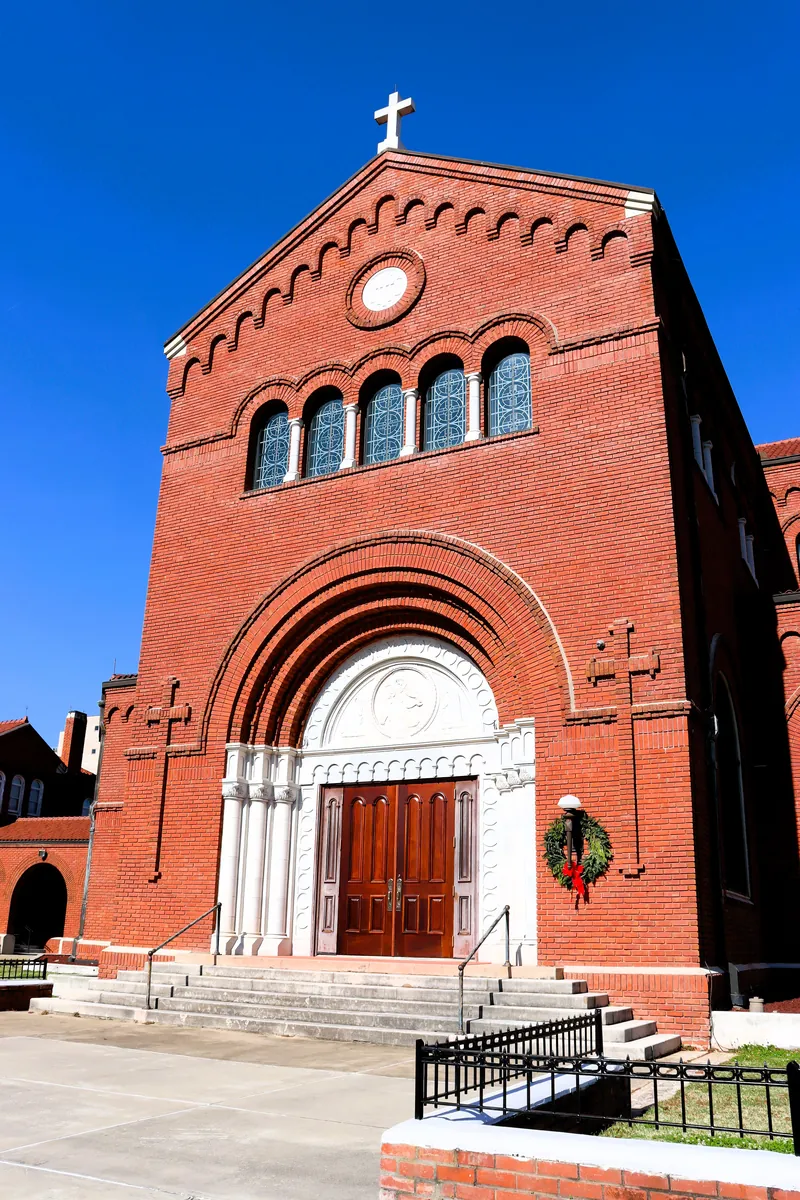
Two years after the Great Fire of April 1910 devastated much of Lake Charles, destroying the church building, other parish structures, and neighboring buildings and homes, construction began on what stands today. The parish had organized in 1869 as St. Francis de Sales, received its first resident priest that year, and rebuilt as Immaculate Conception after an 1879 hurricane damaged the original church. The 1910 fire took that building too. The firm Favrot & Livaudais of New Orleans designed the replacement in a regional Romanesque Revival style typical of Lombardy. The church, attached rectory, and garage were completed in 1913. Three marble altars in the Gothic style were installed in 1923—acquired from a church in Salt Lake City that was remodeling. Around 1950, marble wainscot was added to the side aisles and chancel, the nave columns were sheathed in marble, and a marble pulpit was installed. A rubble stone grotto containing a statue of the Blessed Virgin Mary was added in 1948. In 1973, the architectural firm of Dunn and Quinn completed a brick wing on the northeast side, designed to match the Romanesque architecture, with a small chapel and a courtyard between the addition and the church. On January 29, 1980, Pope John Paul II established the Diocese of Lake Charles. Immaculate Conception became the cathedral for the new diocese—the mother church, the bishop's seat. The building itself did not change. What it carried did. The National Register of Historic Places listed it in 1994, recognizing its architectural significance. It is the only Romanesque Revival building in Lake Charles, and one of only ten architecturally noteworthy non-residential buildings left in the city after a demolition and modernization campaign from the 1950s to the 1970s. Hurricane Laura struck Lake Charles on August 27, 2020, with gusts reaching 137 mph. The cathedral and the diocesan chancery building sustained roof damage; the chancery became uninhabitable. Hurricane Delta followed weeks later. The church enshrines a century-old image of the Blessed Virgin Mary made of Carrara marble, granted a canonical coronation by Pope Benedict XVI in 2012. A full renovation was completed in 2019, the year before the storms came. You go to see the only Romanesque Revival building in a city that has burned and been struck by hurricanes and rebuilt each time. The form is Lombardy by way of New Orleans, completed in 1913, elevated to cathedral in 1980. It stands in the Charpentier Historic District, part of what endured.