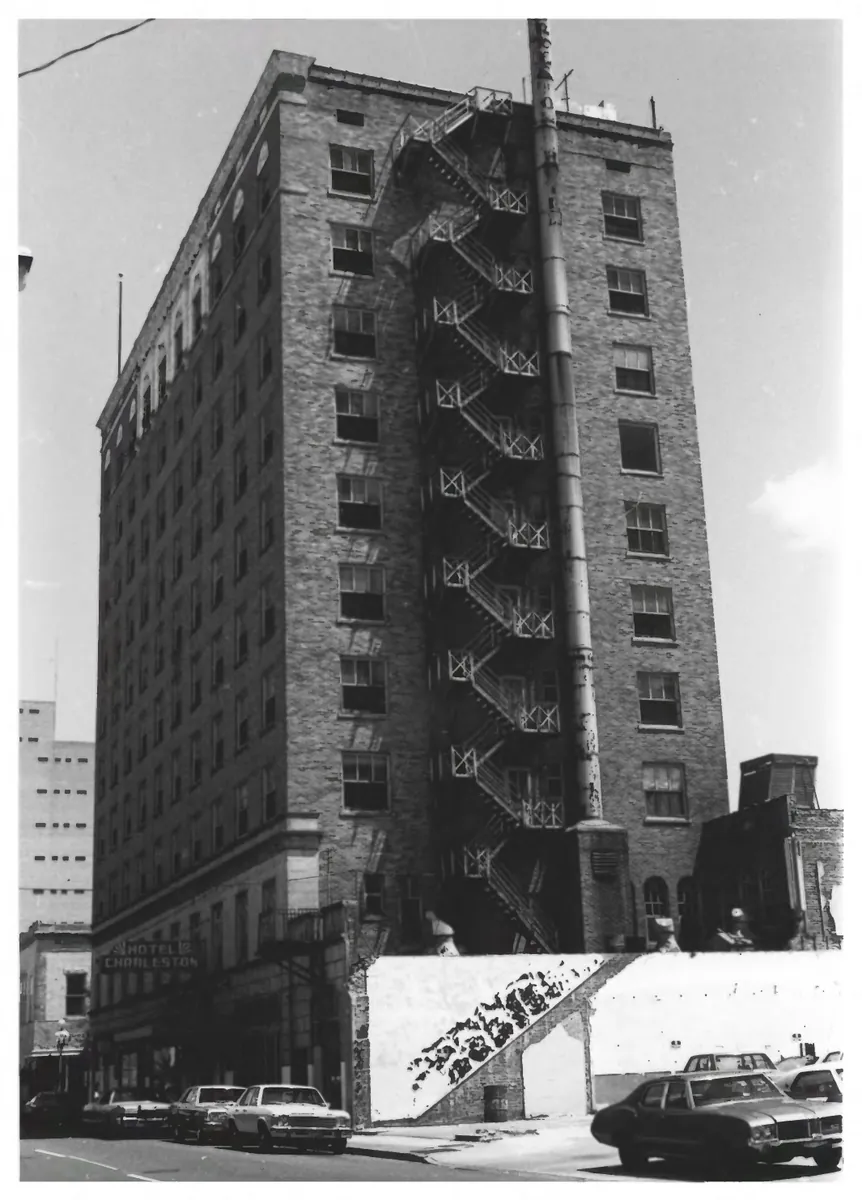
The Charleston Hotel was proposed at eight stories, but when work began in 1928 the plans grew to ten floors. The cost jumped $50,000 to $600,000. When the hotel was completed in 1929, during Mayor Henry J. Geary's administration, it was Lake Charles's first skyscraper.
The city itself had been incorporated in 1861 as Charleston, named after early settler Charles Sallier, then reincorporated as Lake Charles in 1867. The hotel carried the old name forward. It went up during the transition from lumber economy to oil economy—oak and pine had once been the main economic engine here, but the Calcasieu Ship Channel now allowed ocean-going vessels to sail up from the Gulf.
The bottom two stories are faced with cement molded to resemble cut stone blocks. The upper eight are tan brick in the Neo-Classical Beaux Arts style, topped with a stone cornice. Some top-floor windows are framed by pilasters and elaborate spandrel panels. Inside: a two-story lobby, elaborate tile work, upper-level balconies. The Charleston Ballroom on the second floor has Corinthian pilasters. Weekly dances were held on the open roof garden.
The building stands at 900 Ryan Street, at the corner with West Pujo—Ryan Street being the commercial spine of downtown Lake Charles. It was listed on the National Register of Historic Places on May 27, 1982. By 2014, rooms had been converted into shops and event space throughout the building.
The city has weathered the Great Fire of 1910, Hurricane Rita in 2005, and two hurricanes in 2020—Laura and Delta left it looking, one account said, as if "20 tornadoes came in and wiped the city." The hotel remains at the corner where it opened, the first building in Lake Charles to call itself a skyscraper.
- ·First skyscraper in Lake Charles — nine stories of Mission Revival architecture, completed 1929.
- ·Listed on the National Register of Historic Places in 1982.
- ·Located on Ryan Street, the commercial spine of downtown Lake Charles.
- ·Built during the transition from lumber economy to oil economy.
Memories
Editorial content compiled with AI assistance. Place details verified against public records.