Huey Long built the tallest state capitol in America in 14 months and was shot dead inside it three years later. He took LSU's mid-decade move off the downtown bluff and turned it into his project, demolished the 1857 mansion to build a new governor's residence in 1930 because he meant to live in the real one, and built a tunnel from the capitol complex to a hotel so the political machine could move unseen. He is buried in the sunken garden out front, under a 12-foot bronze of himself, facing the building that killed him.
The route
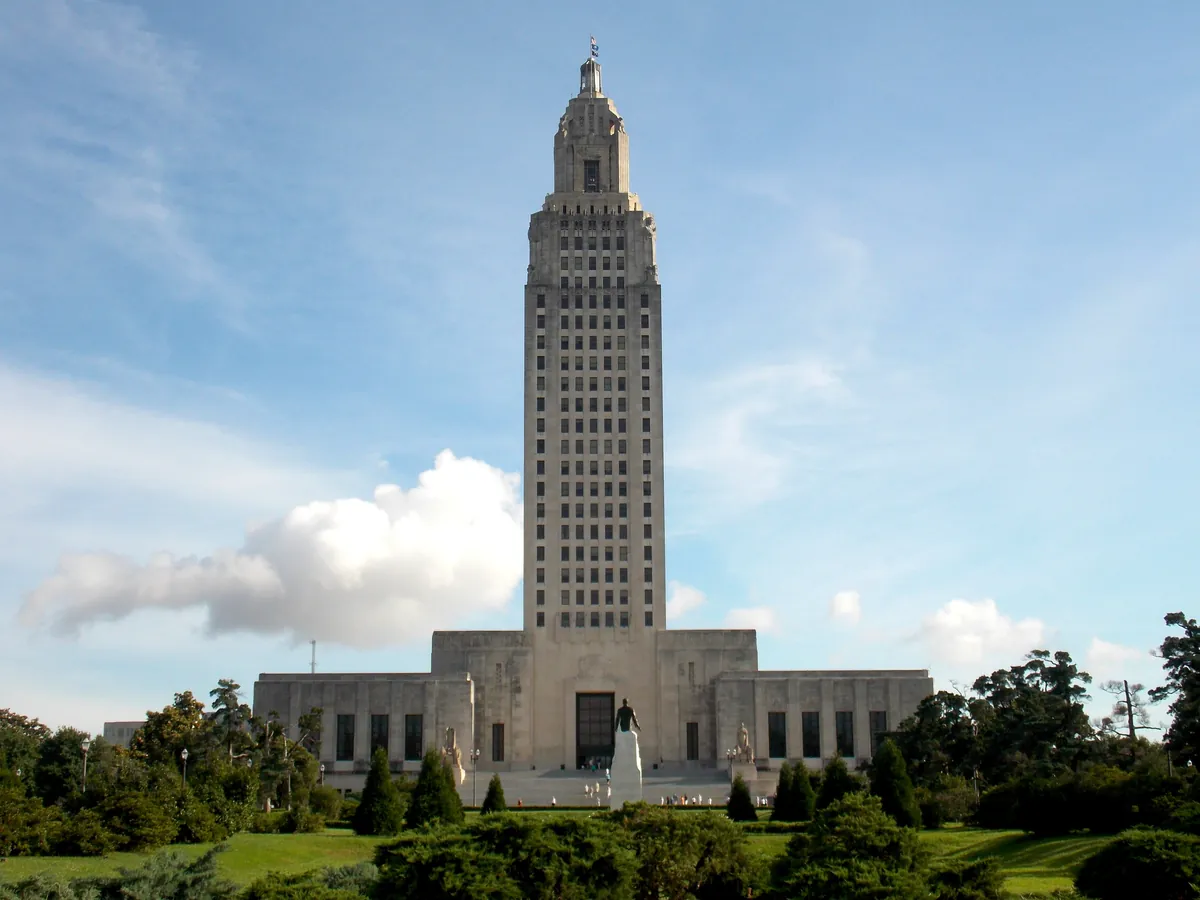 1Architecture·1932·NHLLouisiana State Capitol
Huey Long, elected Louisiana governor in 1928 as a populist candidate, seized upon the idea of a new capitol to symbolize the end of political domination by the state's traditional social and economic elite. In January 1930, he secured funds from the Board of Liquidation and hired the architectural firm Weiss, Dreyfous and Seiferth — by using funds he controlled to start design work, Long prevented the Legislature from stopping construction. In September 1930, the Legislature approved a $5 million bond issue for the final cost. Construction started December 16, 1930. A spur from the nearby Yazoo and Mississippi Valley Railroad was built to deliver 2,500 carloads of materials. Long insisted work progress rapidly to complete the building under his governorship; it was finished in little over a year. Long, who had been elected to the U.S. Senate in 1930, delayed taking the oath of office until January 1932 to prevent a political adversary, Paul N. Cyr, from becoming governor. The capitol was dedicated May 16, 1932, during the inauguration of Governor Oscar K. Allen. Upon completion, Long claimed, "Only one building compares with [the Capitol] in architecture. That's St. Peter's Cathedral in Rome, Italy." At 450 feet and 34 stories, it is the tallest state capitol in the United States and the seventh tallest building in Louisiana. The facade is Alabama limestone. A frieze designed by Ulric Ellerhusen runs along the top of the tower's base at the fifth floor, depicting Louisianans in wartime and peace from colonization to World War I. Twenty-two square portraits of important persons in Louisiana history appear between pilasters on the outside of the House and Senate chambers. The front doors are reached by a monumental stairway of 49 Minnesota granite steps; each step has engraved the name of a U.S. state in order of statehood. Alaska and Hawaii, admitted after the capitol's completion, are both on the last step along with "E pluribus unum." On September 8, 1935, Dr. Carl Weiss assassinated Huey Long in the State Capitol. Weiss was gunned down shortly thereafter by members of the Louisiana State Police acting as Long's bodyguards. His alleged motivation was that his father-in-law, Judge Benjamin Pavy, was going to be gerrymandered out of office by Long. Long lingered for two days at Our Lady of the Lake Hospital before he died on September 10. His body lay in state at the capitol where approximately 100,000 people — some from as far away as Arkansas, Mississippi and Texas — paid their respects. On September 13, Long was interred on the grounds in front of the capitol. In 1938, the Legislature appropriated $50,000 to replace Long's original gravemarker, a simple tombstone, with a more monumental one; two years later, a marble pedestal surmounted by a bronze statue was erected. The monument is 30 feet tall and includes a 12-foot bronze statue of Long, designed by Charles Keck, that faces the capitol. The front entrance opens directly into the four-story, rectangular Memorial Hall, 124 feet long and 40 feet wide. Embedded in the floor is a bronze plaque 10 feet in diameter and weighing 3,290 pounds depicting a relief map of Louisiana showing parish boundaries and seats, industries and exports, and the flora and fauna of the state. The 27th-floor observation deck offers a free 360-degree view of the city, the Mississippi River, and on clear days, the Atchafalaya Basin 20+ miles west. Open Mon–Fri 8am–4:30pm, Sat–Sun 9am–3pm. Free admission including the observation deck.
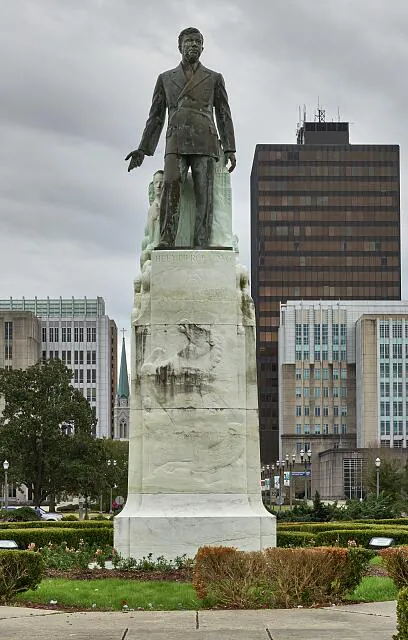 2Religious Site·1940·NRHPHuey Long's Tomb — State Capitol Gardens
He was 42 when they shot him in the building he built. Huey Long was assassinated in the State Capitol on September 8, 1935, by Dr. Carl Weiss, who was gunned down moments later by state police acting as Long's bodyguards. Weiss's alleged motive: his father-in-law, Judge Benjamin Pavy, was going to be gerrymandered out of office. Long lingered two days at Our Lady of the Lake Hospital before he died. On September 13 he was interred on the capitol grounds, in front of the building itself. Roughly 100,000 people came to pay their respects when the body lay in state — some traveling from Arkansas, Mississippi, and Texas. The tomb sits in the sunken garden at the center of the south park, 600 feet square, where the walks cross. A marble pedestal rises to a 12-foot bronze figure of Long in a business suit, the whole monument standing 30 feet. Charles Keck designed it. His first marker was a simple tombstone; in 1938 the State Legislature appropriated $50,000 to replace it, and two years later this went up. Long had arranged his own burial site. The garden was dedicated in 1940, five years after the killing. The statue faces the capitol. That's not incidental — it faces the building where he was shot. This is the tower Long secured funding for, insisted on designing as a skyscraper, and pushed to completion in little over a year. By using funds he controlled to start the work, he kept the legislature from stopping it. At 450 feet, it remains the tallest capitol in the United States, and the man buried out front is the reason it stands. The grounds hold live oaks over 200 years old, azaleas, camellias, magnolias. The tomb is free, and it's the first thing you see coming up on the building. Long in front, Long's tower behind — the order he arranged.
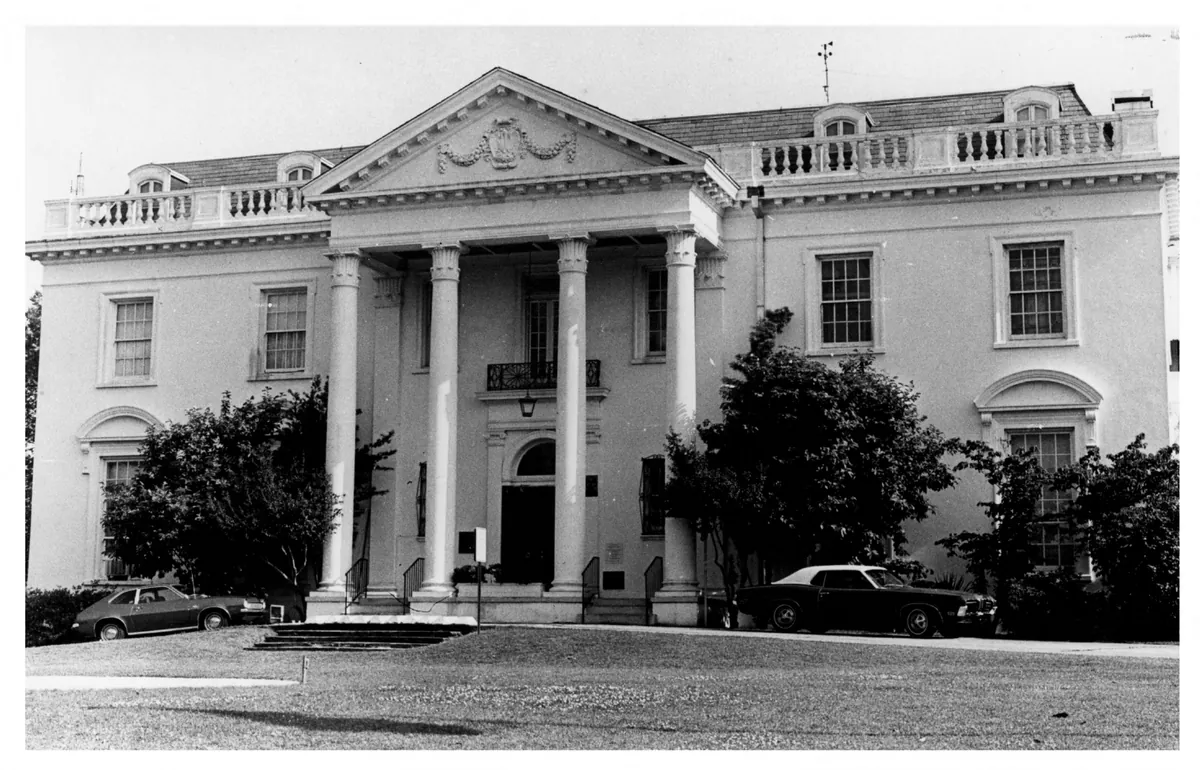 3Architecture·1930·NRHPLouisiana Old Governor's Mansion
Huey Long had a room in this house furnished to replicate the Lincoln Bedroom so he could rehearse being president. The mansion itself, completed in 1930, was commissioned as a deliberate copy of the White House — the building is reported to be inspired by the original White House design attributed to Thomas Jefferson. Long wanted to be familiar with the place he planned to occupy, so he built his own version in Baton Rouge. The construction cost nearly $150,000, with an additional $22,000 spent on damask and velvet drapes and crystal chandeliers, all during the Depression. Long tore down the previous governor's mansion in February 1929, enlisting local convicted criminals to disassemble it, and had plans approved for the new building the next day. The demolition became part of the unsuccessful impeachment proceedings against him in 1930. Nine Louisiana governors lived here between 1930 and 1963, when the current Governor's Mansion was built. The Old Governor's Mansion was listed on the National Register of Historic Places in 1975. It underwent restoration from 1996 to 1998 and now operates as a historic house museum under the management of Louisiana's Secretary of State. Tours are available by appointment — call ahead. The mansion also hosts events. You're standing inside the architectural expression of Long's presidential ambition, built at a scale and cost that made his intentions impossible to miss.
- 4Food & DrinkThe Speakeasy — Hilton Baton Rouge Capitol Center
Beneath the Hilton Baton Rouge Capitol Center — originally the Heidelberg Hotel, Huey Long's base of operations — runs a brick-lined tunnel built for the Long political machine. It connected the capitol complex to the hotel and let Huey and Earl Long move between the statehouse and their preferred quarters for drinking and deal-making without attracting attention. The tunnel is now The Speakeasy, a basement bar reached through what looks like a utility corridor, built into the restored 1920s ballroom space where the political machine operated. The bar leans into the legend hard. The legend earns it.
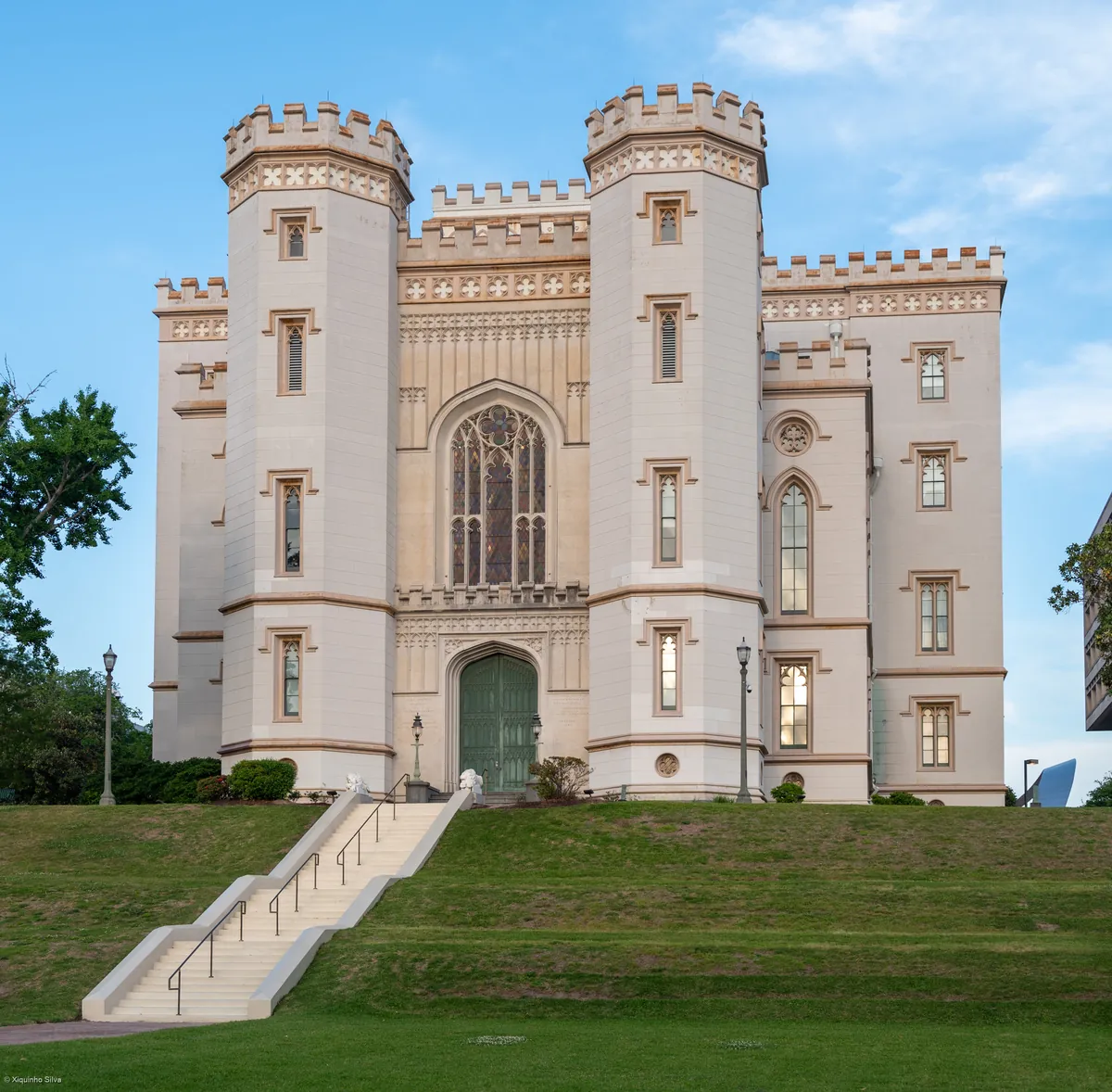 5Architecture·1852·NRHPOld State Capitol
Mark Twain piloted steamboats past this bluff in the 1850s and loathed the sight of it: "It is pathetic ... that a whitewashed castle, with turrets and things ... should ever have been built in this otherwise honorable place." The insult only increased its fame. The building had been designed by New York architect James H. Dakin after the state legislature decided in 1846 to move the seat of government from New Orleans to Baton Rouge—a city of 2,269 people facing down the fourth-largest metropolis in the United States. Representatives from other parts of Louisiana feared a concentration of power. Baton Rouge donated a $20,000 parcel of land atop a bluff facing the Mississippi in 1847, and Dakin gave them a Neo-Gothic medieval-style castle instead of the standard national Capitol knockoff most states commissioned. By 1859 it was featured favorably in De Bow's Review, the most prestigious periodical in the antebellum South. In 1862, after Union Admiral David Farragut captured New Orleans, the seat of government retreated from Baton Rouge. Union forces used the castle first as a prison, then as a garrison for African-American troops under General Culver Grover. The building caught fire twice while used as a garrison, leaving Louisiana's capitol a gutted shell. By 1882 architect William A. Freret had rebuilt it completely, installing the spiral staircase and stained glass dome that define the interior now. The legislature met here until 1932, when it was abandoned for the new Louisiana State Capitol building. Restored in the 1990s, it now houses the Museum of Political History—exhibits on Louisiana's governors, original gubernatorial ballots, an interactive gallery featuring figures including Huey P. Long. A theatrical production called "The Ghost of the Castle" brings visitors face to face with Sarah Morgan Dawson, a young Baton Rouge resident who loved the castle and wrote about it in her Civil War diary. Admission is free. The staircase and dome are reason enough to go.