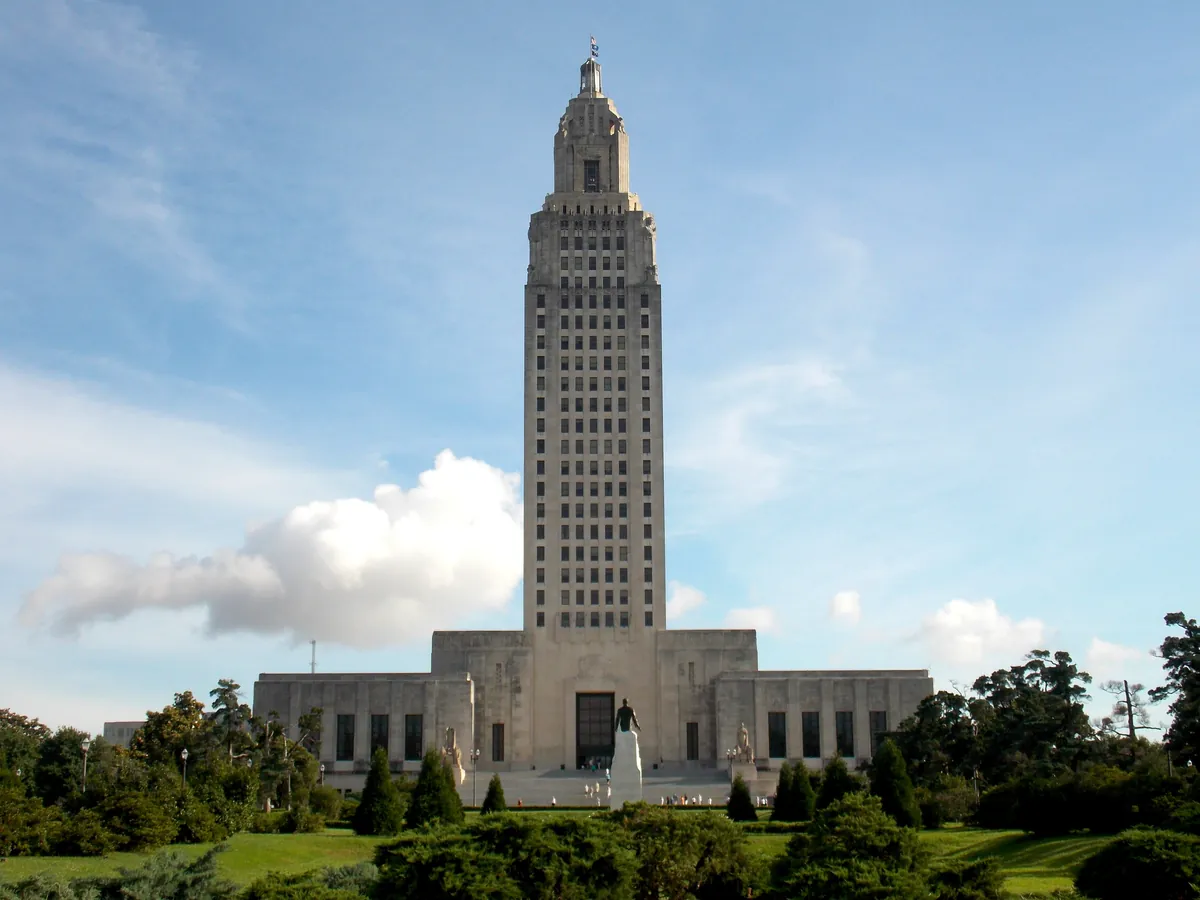
Huey Long, elected Louisiana governor in 1928 as a populist candidate, seized upon the idea of a new capitol to symbolize the end of political domination by the state's traditional social and economic elite. In January 1930, he secured funds from the Board of Liquidation and hired the architectural firm Weiss, Dreyfous and Seiferth — by using funds he controlled to start design work, Long prevented the Legislature from stopping construction. In September 1930, the Legislature approved a $5 million bond issue for the final cost. Construction started December 16, 1930. A spur from the nearby Yazoo and Mississippi Valley Railroad was built to deliver 2,500 carloads of materials. Long insisted work progress rapidly to complete the building under his governorship; it was finished in little over a year. Long, who had been elected to the U.S. Senate in 1930, delayed taking the oath of office until January 1932 to prevent a political adversary, Paul N. Cyr, from becoming governor. The capitol was dedicated May 16, 1932, during the inauguration of Governor Oscar K. Allen. Upon completion, Long claimed, "Only one building compares with [the Capitol] in architecture. That's St. Peter's Cathedral in Rome, Italy."
At 450 feet and 34 stories, it is the tallest state capitol in the United States and the seventh tallest building in Louisiana. The facade is Alabama limestone. A frieze designed by Ulric Ellerhusen runs along the top of the tower's base at the fifth floor, depicting Louisianans in wartime and peace from colonization to World War I. Twenty-two square portraits of important persons in Louisiana history appear between pilasters on the outside of the House and Senate chambers. The front doors are reached by a monumental stairway of 49 Minnesota granite steps; each step has engraved the name of a U.S. state in order of statehood. Alaska and Hawaii, admitted after the capitol's completion, are both on the last step along with "E pluribus unum."
On September 8, 1935, Dr. Carl Weiss assassinated Huey Long in the State Capitol. Weiss was gunned down shortly thereafter by members of the Louisiana State Police acting as Long's bodyguards. His alleged motivation was that his father-in-law, Judge Benjamin Pavy, was going to be gerrymandered out of office by Long. Long lingered for two days at Our Lady of the Lake Hospital before he died on September 10. His body lay in state at the capitol where approximately 100,000 people — some from as far away as Arkansas, Mississippi and Texas — paid their respects. On September 13, Long was interred on the grounds in front of the capitol. In 1938, the Legislature appropriated $50,000 to replace Long's original gravemarker, a simple tombstone, with a more monumental one; two years later, a marble pedestal surmounted by a bronze statue was erected. The monument is 30 feet tall and includes a 12-foot bronze statue of Long, designed by Charles Keck, that faces the capitol.
The front entrance opens directly into the four-story, rectangular Memorial Hall, 124 feet long and 40 feet wide. Embedded in the floor is a bronze plaque 10 feet in diameter and weighing 3,290 pounds depicting a relief map of Louisiana showing parish boundaries and seats, industries and exports, and the flora and fauna of the state. The 27th-floor observation deck offers a free 360-degree view of the city, the Mississippi River, and on clear days, the Atchafalaya Basin 20+ miles west. Open Mon–Fri 8am–4:30pm, Sat–Sun 9am–3pm. Free admission including the observation deck.
- ·At 450 feet and 34 stories, it is the tallest state capitol building in the United States — and the seventh-tallest building in Louisiana.
- ·Huey Long pushed the building to completion in just 14 months (1931–1932) at a cost of $5 million during the Great Depression.
- ·Long was assassinated in a first-floor corridor on September 8, 1935, by Dr. Carl Weiss. The bullet scar is still visible in the marble wall.
- ·Long is buried on the grounds directly in front of the building beneath a bronze statue that faces the capitol.
- ·The 27th-floor observation deck offers a free 360-degree view of the city, the Mississippi River, and on clear days, the Atchafalaya Basin 20+ miles west.
- ·Open Mon–Fri 8am–4:30pm, Sat–Sun 9am–3pm. Free admission including the observation deck. Self-guided tours available.
Memories
Editorial content compiled with AI assistance. Place details verified against public records.