Louisiana's industrial origin story starts in these parishes, not in New Orleans. On September 21, 1901, drillers near Jennings brought in the state's first oil well at 7,000 barrels a day — four months after Spindletop. The 1923 Kansas City Southern depot in DeQuincy is one of three urban depots left in the state. DeRidder's 1914 jail connects to its courthouse by an underground tunnel — the accused walked to trial without crossing daylight. Whiskey Chitto runs sand-bottomed and clear by Louisiana standards. Lacassine's 35,000 acres winter the Mississippi Flyway. None of this was built for visitors.
The route
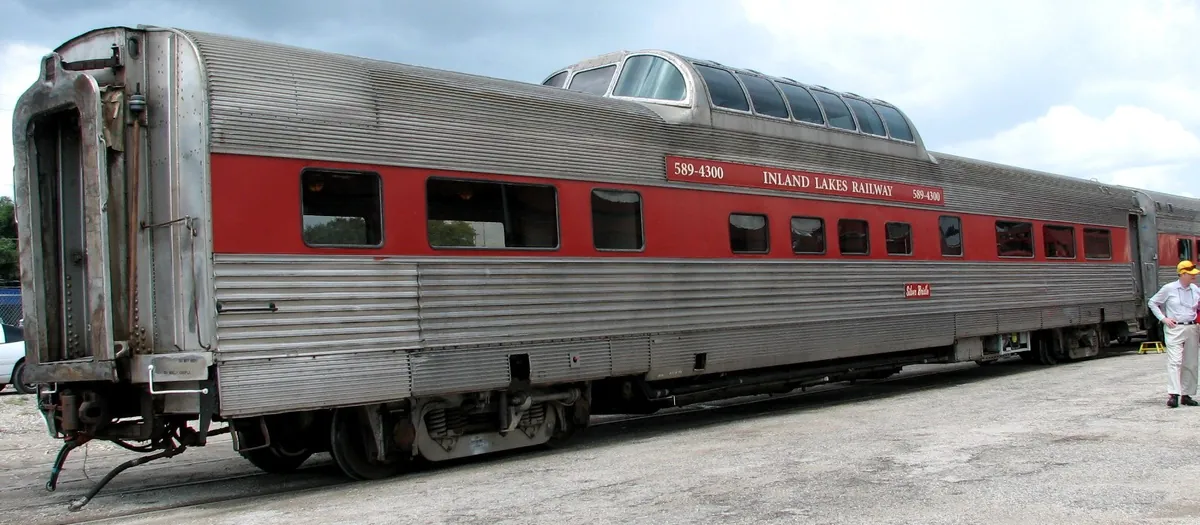 1Museum·1923·NRHPDeQuincy Railroad Museum
DeQuincy didn't exist before the railroad — the railroad built the town. When the Kansas City Southern Railroad completed its line from Shreveport to Lake Charles in 1897, the track split at this point, one route heading to Beaumont and Port Arthur, Texas. The community incorporated in 1903. The depot came twenty years later, in 1923, Mission Revival architecture — multi-story, urban-scale, built to announce arrival. Urban depots of that era announced themselves with recognizable style, unlike the simpler board and batten structures that served villages. This is one of three such urban railroad stations still standing in Louisiana. The others are the Central Railroad Station in Shreveport and the Texas and Pacific Railroad Depot in Bunkie. All three are listed on the National Register of Historic Places. This one was added in 1983. The depot became a museum in 1974. Inside: railroad artifacts from the Kansas City Southern, Missouri Pacific, and Union Pacific Railroads. Outside: a steam engine, passenger car, and caboose. In 2013, Union Pacific awarded the town membership in the Train Town USA registry, a designation shared with Natchitoches and Bunkie in Louisiana and reserved for towns and cities along the railroad with shared heritage. DeQuincy hosts the annual Louisiana Railroad Days Festival on the museum grounds, second weekend in April. Admission is free. It's thirty minutes north of Lake Charles.
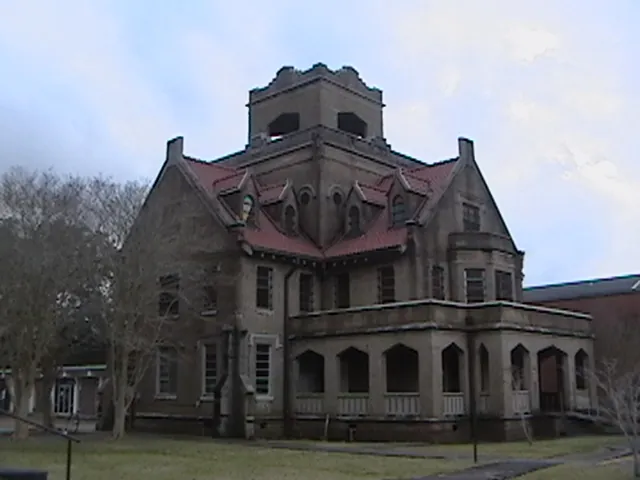 2Historic Site·1914·NRHPGothic Jail — Beauregard Parish's Hanging Jail
In 1914, the newly formed Beauregard Parish Police Jury — carved out of Imperial Calcasieu Parish — commissioned a jail unlike any other in the country. Stevens-Nelson of New Orleans designed it. Falls City Construction Company built it on land Hudson River Lumber Company donated to the city, completing both the jail and adjacent courthouse in 1915 at a cost of $168,000. What emerged was a Gothic Revival jailhouse that architectural historian Johnathan Fricker said holds "the possible distinction of being the only penal institution in the country using 'Collegiate Gothic' design in the first decade of the 20th century." The structure housed over fifty prisoners. Each cell had a toilet, shower, lavatory, and window — amenities that made history alongside the architecture. A large spiral staircase gave access to each cell. Jailers' quarters and a kitchen occupied the bottom floor. A tunnel connected the jail to the Beauregard Parish Courthouse, used to transport prisoners to trial without exposing them to the street. The jail earned its second name on March 9, 1928, when Joe Genna and Molton Brasseaux were hanged for the murder of taxi driver J. J. Brevelle. Deputy Sheriffs Jim Crumpler and Gill served as hangmen. Genna, age 25, was pronounced dead at 1:06 PM. Brasseaux followed at 1:29 PM. Neither man was buried in Beauregard Parish. After that execution, the Gothic Jail became the Hanging Jail. Listed on the National Register of Historic Places on December 17, 1981, the building no longer operates as a jail. The Beauregard Parish Police Jury owns it; the Beauregard Parish Rehabilitation Committee preserves it. The structure appeared on the Travel Channel's Most Terrifying Places in 2019 and Ghost Brothers: Lights Out on Discovery+ in 2021, both paranormal programs investigating reports of hauntings. The jail sits fifty miles north of Lake Charles in DeRidder. Tours are available.
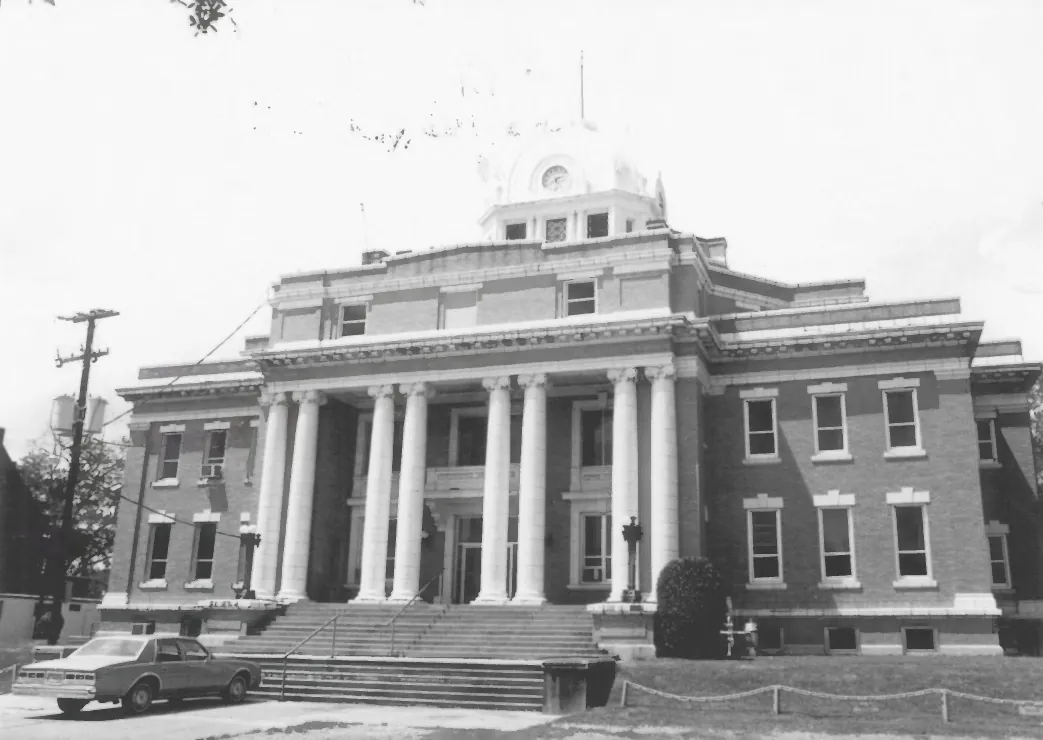 3Architecture·1914Beauregard Parish Courthouse
The Beaux-Arts courthouse in DeRidder was finished in 1915, the same year as the Gothic jail that stands beside it. Both buildings were designed by Stevens-Nelson of New Orleans and built by Falls City Construction Company for $168,000. What makes the pair unusual among Louisiana civic architecture is the underground tunnel that connects them — incorporated into the design to move prisoners to and from the jail to stand trial while maintaining safety. Beauregard Parish had just been carved out of Imperial Calcasieu Parish when the police jury bought property from the First Baptist Church and an adjacent tract donated by the Hudson River Lumber Company. The tunnel is no longer in use. It has been completely blocked off somewhere between the two buildings, and the small portion visible from the jail side now collects standing water. The jail itself has been renovated and is open for public tours on weekdays, with occasional lantern tours at night and a haunted house around Halloween. A trial held here ended in two hangings at the jail, the last on March 9, 1928, which earned the complex its nickname "Hanging Jail." The courthouse was added to the National Register of Historic Places in 1983. It remains an active courthouse, open to the public during business hours — a working building where you can walk through Beaux-Arts civic architecture while knowing that somewhere beneath you, a passage once connected courtroom to cell.
- 4Nature & ParksWhiskey Chitto Creek
The Choctaw called it Ouiska Chitto—Big Cane Creek—for the canebrakes lining the banks, and the name stuck even after French and Anglo settlers couldn't quite pronounce it. By the 1830s, a Choctaw village sat south of Sugartown along a tributary, and the displaced people who'd left Mississippi found the 86.4-mile spring-fed creek familiar: cold, fast-running, wilderness enough to feel like home. The creek begins at present-day Fort Polk in Vernon Parish and threads through mixed pine-hardwood forest down to the Calcasieu River, passing near Sugartown, Grant, and Mittie. The water runs clear by Louisiana standards, sandy-bottomed, holding largemouth bass, spotted bass, bream, catfish, and turtles. Between the 1870s and World War I, timber companies floated logs down Whiskey Chitto to the mills in Lake Charles. Near Mittie, a federal agent found evidence of illegal cutting on federal lands—evidence that ignited the Calcasieu Log War of 1877-1879 and shut down logging operations until the issue was resolved. The creek carried the region's economic bloodstream for decades. Two historic bridge crossings still mark the Mittie section: the La 26 bridge, a concrete span built in the early 1970s to replace a 1929 wooden bridge destroyed by fire—purposely built 777 feet long, the "Lucky Bridge"—and Carpenter's Bridge downstream, named for the family that settled the area in the early 1870s and replaced in 2024 after more than a century of wooden spans. In 1970, Louisiana designated Whiskey Chitto a scenic waterway under the Scenic Rivers Act, administered by Louisiana Wildlife and Fisheries. The U.S. Army Corps of Engineers declared it a navigable stream of the United States in 2008. The northern section passes through Kisatchie National Forest, overseen by the Vernon Unit of the Calcasieu Ranger District. Local outfitters run shuttle service for canoeists and kayakers; the section near Mittie is known for paddling and fishing, best in spring and summer when water levels hold. The creek threads through some of the oldest continuously settled ground in southwest Louisiana—Sugartown since the 1820s, the lower stretch from Mittie to Leblanc since the 1850s and 1860s. The sandy soil along the banks grows Sugartown Watermelons. Ernest S. Clements, who served as a Louisiana state senator, Secretary of Wildlife and Fisheries, and Public Service Commissioner, kept a camp near Mittie and spent his time on the water. Descendants of early settlers still call themselves River People, a term the Choctaw used, and some carry family stories of Choctaw ancestry. The United Methodist Church operates the UskiChitto Retreat Center along the creek north of Leblanc, 120 acres where you can still imagine log rafts moving downstream in the quiet.
 5Historic Site·1901Louisiana Oil and Gas Park
On September 21, 1901, drillers near Jennings brought in Louisiana's first oil well — 7,000 barrels a day. The discovery launched the state's petroleum industry and transformed the Southwest Louisiana economy. Before that strike, this was timber-and-trapping country. After, it was oil country. Jennings calls itself the Cradle of Louisiana Oil, and this park marks the spot. Exhibits cover the early drilling technology and the history of the discovery. The park also houses the Gator Chateau, a baby alligator rescue and rehabilitation facility that releases animals back into the wild. The site sits in Jennings, thirty-five miles east of Lake Charles on I-10. It's a short stop, but it's the place where Louisiana's petroleum story began — the moment the ground gave up what would remake the region.
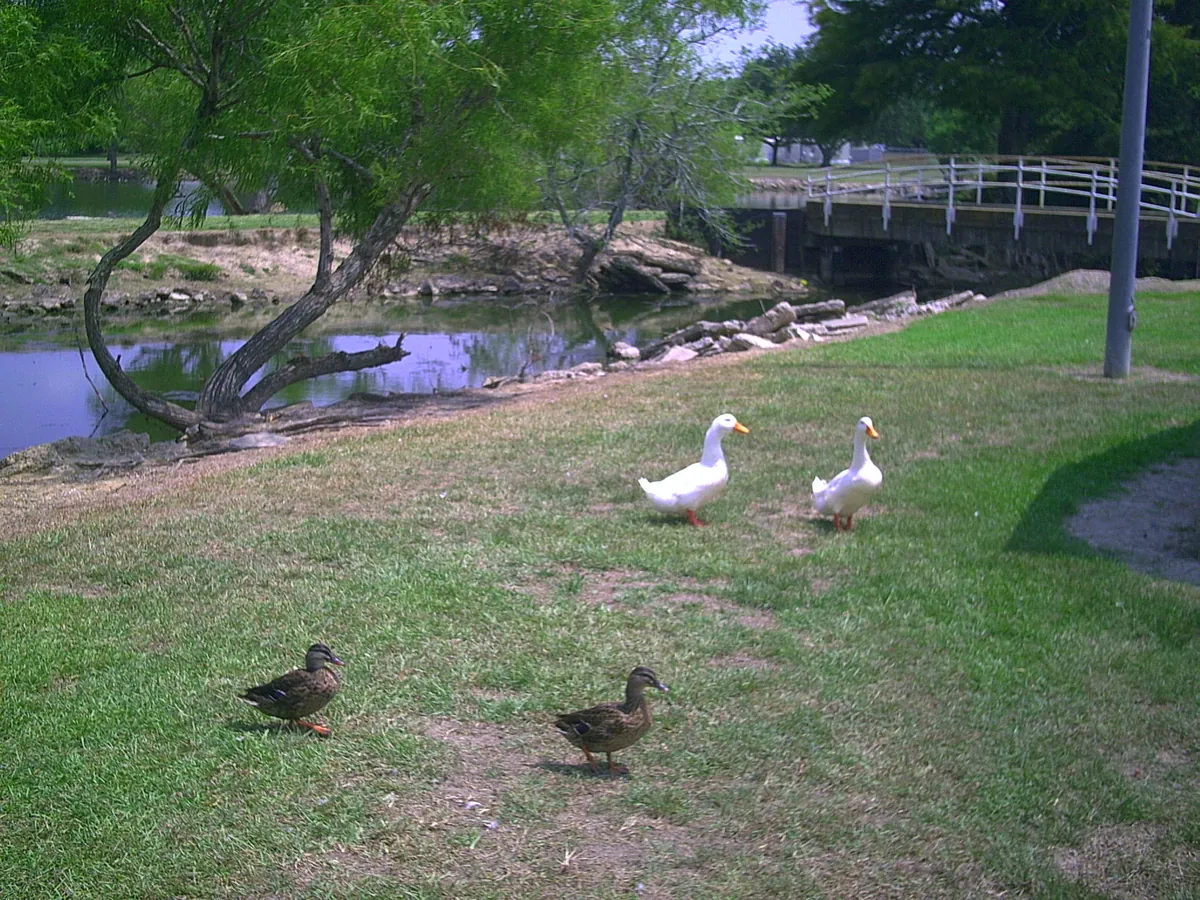
 6Nature & Parks·1937Lacassine National Wildlife Refuge
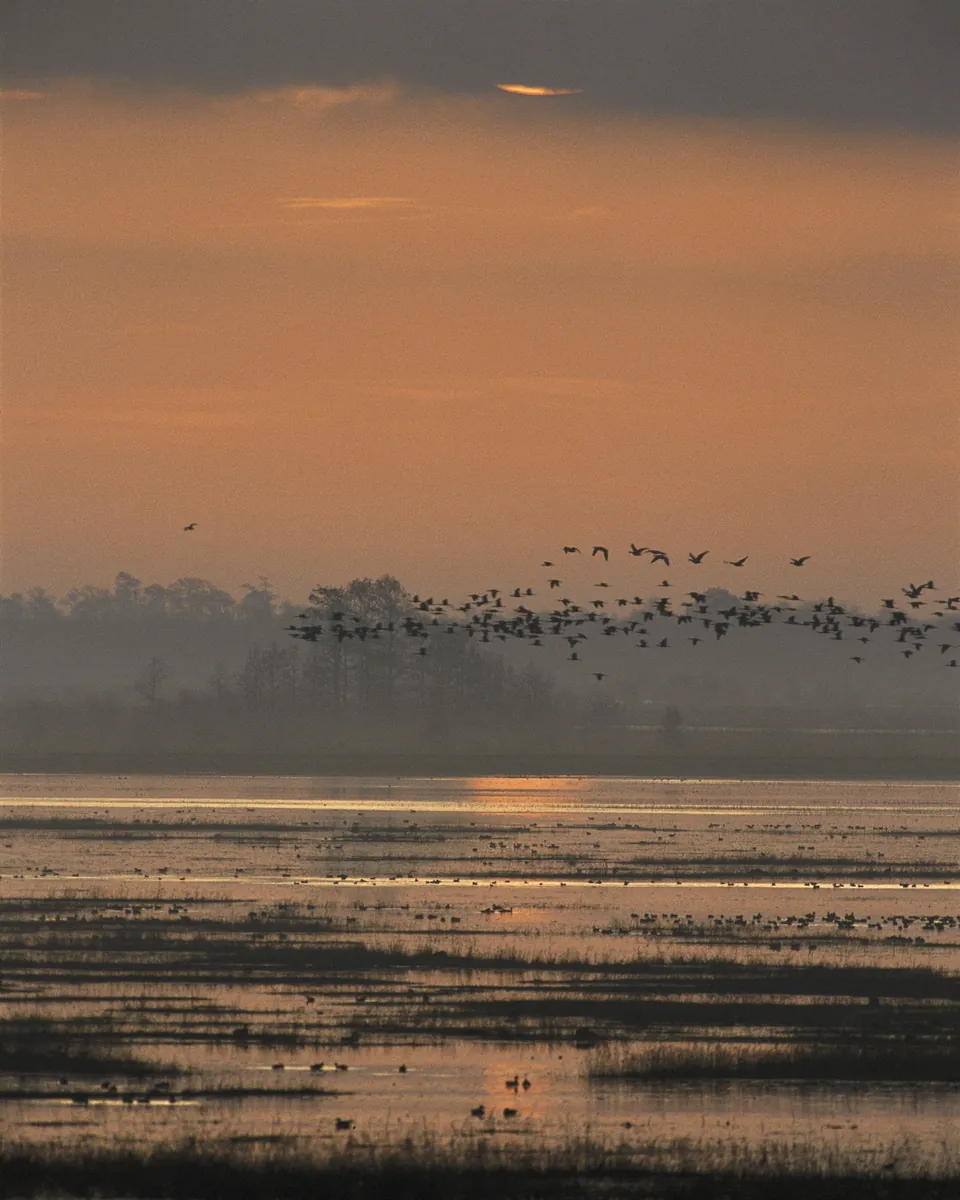
The 16,000-acre Lacassine Pool is one of the most important wintering waterfowl sites in the Mississippi Flyway. Several hundred thousand ducks and geese use the refuge as wintering habitat. At its peak, Lacassine drew 300,000 pintails each winter. The refuge hosted numbers well over 100,000 until the mid-1980s, then saw the peaks reduced by half in the 1990s. Drought in the mid-2000s brought numbers down from 30,000 to around 18,000. The birds concentrate in the northwest and northeast sections of the Pool. The refuge was established in 1937 by Executive Order No. 7780 as "a refuge and breeding ground for migratory birds and other wildlife." It was formed with 13,000 acres purchased from The Lacassane Company for $51,774.00. The land had been part of two plantations, the Illinois Plantation and the Lowery Plantation. The refuge now covers nearly 35,000 acres in Cameron and Evangeline Parishes. In 1976 the United States Congress designated 3,345.6 acres of the southern portion as the Lacassine Wilderness. The habitat divides into 16,500 acres of natural, freshwater marsh and open water, 16,000 acres of managed, freshwater marsh (Lacassine Pool), 2,200 acres of rice, wheat, soybean, and natural moist soil fields, 350 acres of flooded gum and cypress trees, and 350 acres of restored tallgrass prairie. Vegetation in the undeveloped marshes is dominated by bulltongue and maidencane. Water levels are manipulated to manage naturally occurring marsh and moist soil plants. Crops are planted to provide food for wintering waterfowl that migrate down the Mississippi and Central Flyways. Native prairies and marshes are periodically burned on a 3-5 year rotational basis to invigorate native grasses and forbs, and to set back cool season plant growth or to reduce the fuel load and organic accumulations in the marshes. Wood ducks, fulvous and black-bellied whistling ducks, and mottled ducks nest on the refuge during the breeding season. Nesting colonies of wading birds such as ibis, roseate spoonbills, and egrets are found on the refuge. Alligators live here, along with furbearers such as mink, otter, raccoon, and nutria. Threatened and endangered species that have used the refuge include bald eagles, peregrine falcons, and Louisiana black bears. The refuge offers fishing, hunting, boating, wildlife observation, and hiking. A nature drive, foot trails, and observation towers are available year-round. Admission is free.
- 7MuseumZigler Art Museum
The Zigler Art Museum sits in Jennings, a rice town in Jeff Davis Parish, holding European and American works spanning centuries. The collection exists because the Zigler family believed a rice town deserved museum-caliber art—the same access as any city. The museum is considered one of the best small art museums in the South. The nearby regional center, Lake Charles, has been battered by catastrophe: the Great Fire of 1910, Hurricane Rita in 2005, then Hurricane Laura and Hurricane Delta in 2020, the latter with wind gusts to 137 mph and storm surge the National Weather Service called "unsurvivable." The city rebuilt each time, but the landscape around it—oak and pine on level coastal plain, bayous threading through—carries the memory of what wind and water can do. The Zigler is a statement about what deserves to endure in a place like this. Admission is free or nominal. Go because someone decided art was worth building for, and worth keeping.