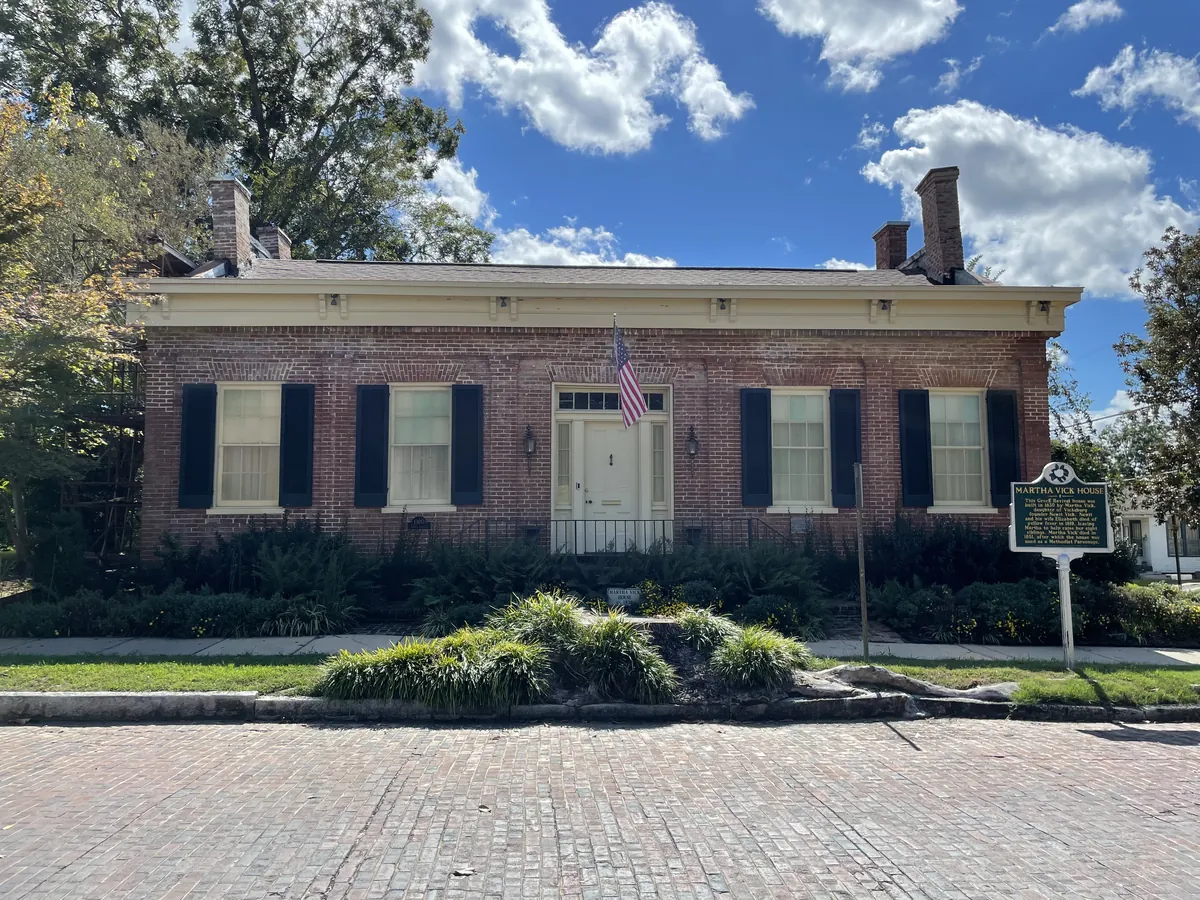
Her father drew the streets. In 1812, the Methodist minister Newit Vick bought a thousand acres and platted the town that would bear his name. Around 1830, he built this house for his daughter Martha. She married and moved away. She never lived here.
That absence sits at the center of one of Vicksburg's oldest surviving structures. The house went up in a city whose fate would be decided three decades later, when Union forces under Ulysses S. Grant crossed the Mississippi River south of town, won battles at Port Gibson and Raymond, captured the state capital at Jackson, and drove Lieutenant General John C. Pemberton's Confederate Army into Vicksburg's defensive lines. On May 25, 1863, after two failed assaults, Grant began a siege. The garrison held for more than forty days. Supplies ran out. On July 4, Pemberton surrendered. The fall of Vicksburg, combined with the Confederate defeat at Gettysburg the day before, is sometimes considered the war's turning point. Lincoln called Vicksburg "the key to the war." When Port Hudson surrendered five days later, the Union controlled the Mississippi River for the rest of the conflict, splitting the Confederacy in two.
The house on Grove Street predates all of that. It stands now in the historic district, a private residence open for tours by appointment. You go to see what was built before the siege, when a father still imagined his daughter might stay.
- ·Built c. 1830 for Martha Vick, daughter of city founder Newit Vick.
- ·Newit Vick was a Methodist minister who bought 1,000 acres and platted the city in 1812.
- ·Martha married and moved away — she never lived in the house that bears her name.
- ·One of the oldest surviving structures in Vicksburg.
- ·Now a private residence open for tours by appointment.
- ·Located on Grove Street in the historic district.
Memories
Editorial content compiled with AI assistance. Place details verified against public records.