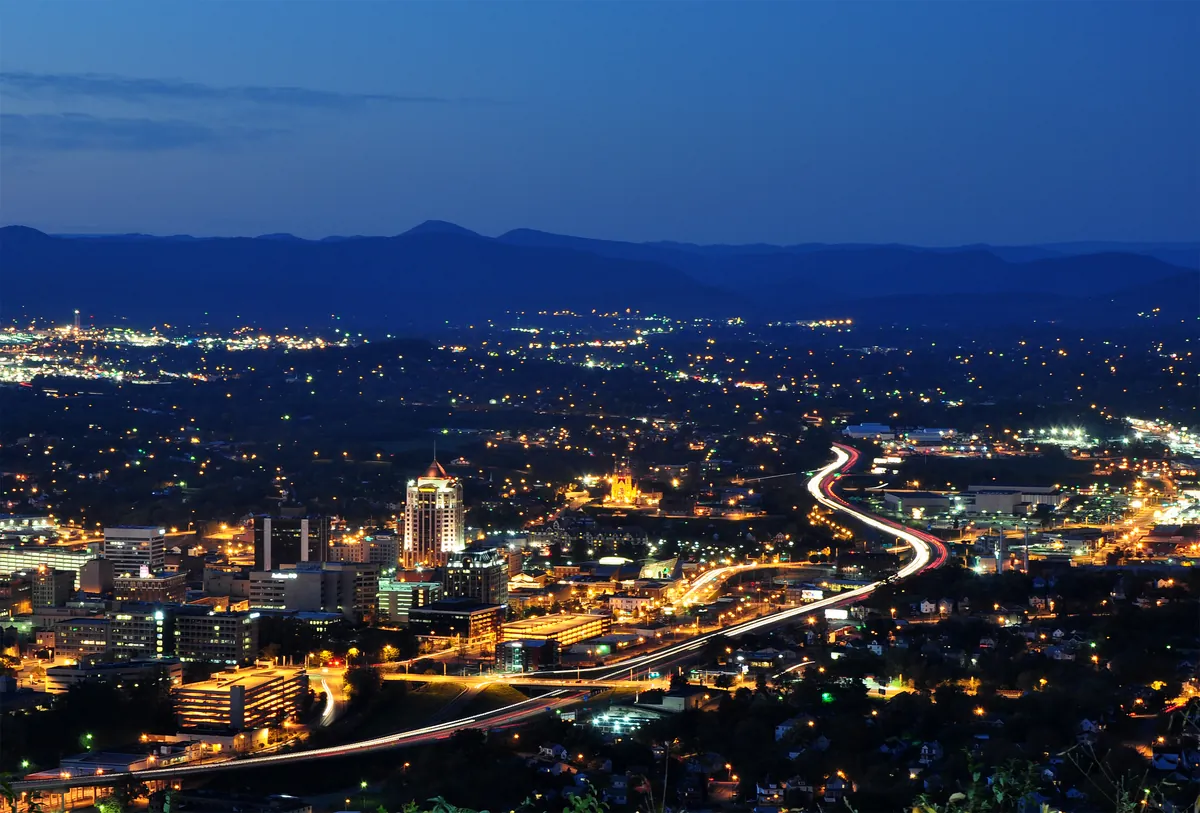
In 1882, a crossroads village of 500 called Big Lick became the junction point for the Norfolk & Western Railway. The company built its headquarters there, and within a decade the population hit 25,000. The village renamed itself Roanoke. No other city in Virginia was built this fast by this narrow a cause.
The name came reluctantly. Residents voted to call it "Kimball" after Frederick J. Kimball, the railroad executive who chose them. Kimball refused: "On the Roanoke River in Roanoke County – name it Roanoke." On February 3, 1882, they did. That same year, Kimball picked a wheat field for the company's hotel. The 69-room Hotel Roanoke opened in 1882.
The railroad shops went up. The hotels. The downtown grid. Everything you see was built in a single generation by a single industry. The 1880s population grew by 22 times — under 700 residents in 1880, over 16,000 in 1890 — earning the nickname "The Magic City." Infrastructure lagged: no sewers, marshy terrain, regular cholera and diphtheria outbreaks. But the trains ran.
Historical markers downtown trace the 1882 founding and the Big Lick → Roanoke renaming. They mark the year a wheat field became a city, the year the railroad became the reason for nearly everything that followed. Roanoke is what happens when a company decides a place should exist, and the place agrees.
- ·In 1882, the Norfolk & Western Railway chose a crossroads village called Big Lick as its junction point.
- ·Within a decade the population exploded from 500 to 25,000.
- ·The village renamed itself Roanoke and never looked back.
- ·The railroad shops, the hotels, the downtown grid — everything you see was built in a single generation by a single industry.
- ·No other city in Virginia was built this fast by this narrow a cause.
- ·Historical markers downtown trace the 1882 founding and the Big Lick → Roanoke renaming.
Memories
Editorial content compiled with AI assistance. Place details verified against public records.