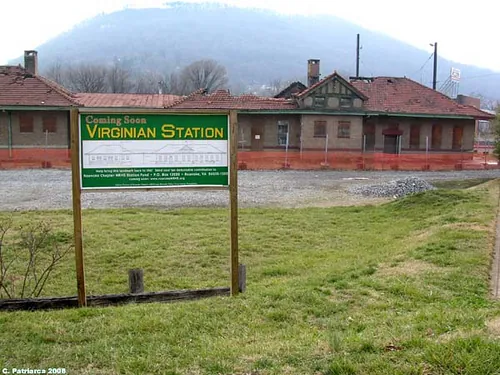
The Norfolk & Western Railway picked Big Lick in 1882 as the site of its corporate headquarters and railroad shops. Within two years, Big Lick had become the City of Roanoke. By 1909, another railroad was coming — the Virginian Railway, built to break N&W's coal-hauling monopoly. That September, construction began on a passenger station at the intersection of Jefferson Street and Williamson Road.
The station opened in 1910. It measured 162 feet long by 32 feet wide: a pair of one-story buildings connected by a covered overhang, with a tile roof, blond brick façade, and terrazzo floors. It was the only brick station built along the entire 608 miles of the Virginian's network. It stood at the division point between the New River Division and the Norfolk Division. Passenger service ran between West Virginia and Norfolk through 1956, when it was discontinued. The Virginian merged with Norfolk & Western in 1959.
After the merger, the station was leased and operated as a feed and seed store. By the late 1990s, it was threatened with demolition to make way for an expansion of the Carilion bio-tech campus, landing it on the Roanoke Valley Preservation Foundation's 2000 list of Most Endangered Sites. Fire on January 29, 2001 caused severe damage while the building operated as the Depot Country Store.
Despite the fire, the station was cited for its unique design and contribution to the railroad industry in Roanoke. It was listed on the Virginia Landmarks Register in April 2003 and the National Register of Historic Places in June 2003. That year, Norfolk Southern donated the building to the Roanoke Chapter of the National Railway Historical Society. Phase I restoration — asbestos and lead removal, stabilization, and roof replacement — was completed in 2012. Phase II finished in 2016: interior completion, parking, landscaping, and terrazzo floor restoration. As of 2023, the station operates as an event venue for weddings and banquets. Exterior viewing only.
- ·The 1910 Virginian Railway station is a Mission Revival landmark downtown.
- ·Built by coal magnate Henry Huttleston Rogers to break N&W's coal-hauling monopoly.
- ·Architectural proof that Roanoke was a two-railroad town.
- ·The rivalry shaped the city's identity as much as either line alone.
- ·Visitor tip: located on South Jefferson Street; exterior viewing only.
Memories
Editorial content compiled with AI assistance. Place details verified against public records.