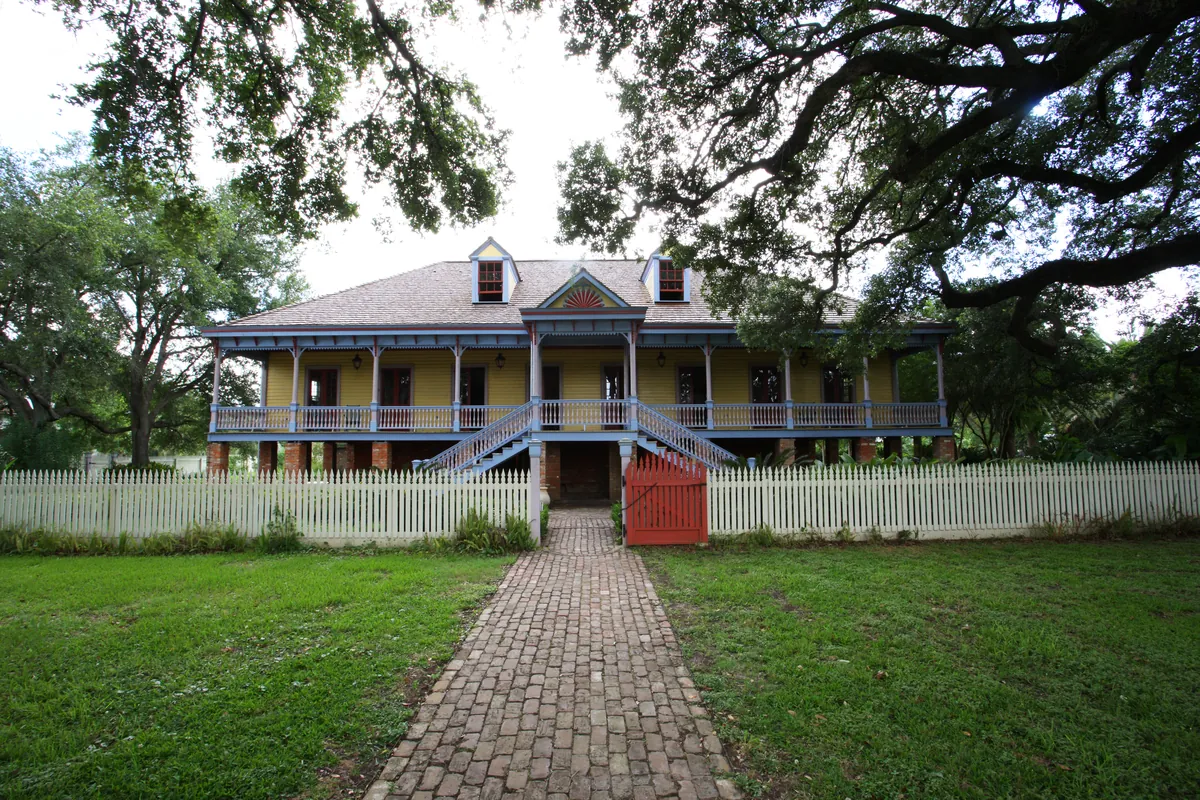
Guillaume Duparc was a Frenchman who fought in the American Revolutionary War. In 1804 he petitioned Thomas Jefferson for land. Jefferson granted him acreage along the Mississippi River. Duparc's enslaved workers built the house during 1804 and 1805. The big house has a raised brick basement story and a briquette-entre-poteaux upper floor — brick between posts. Much of the house was pre-fabricated, its wooden beams pre-cut off-site. It is one of only 30 substantial Créole raised houses in the state. The floor plan consists of two rows of five rooms that all open directly into each other without any hallways. Duparc lived at the plantation for four years, dying in 1808.
His daughter Elisabeth married into the Locoul family. Laura Locoul Gore was born in the big house in 1861. She inherited the plantation and ran it as a sugar cane business until 1891, when she sold it. The plantation was run by women for three consecutive generations.
The sugar mill was located about a mile behind the big house. By the time of the Civil War, there were 186 slaves working the farm. The slave quarters included approximately 69 cabins. Each cabin was occupied by two families, who had separate doors and shared a central double fireplace. Four original slave cabins survive. Farm workers continued to live in the slave quarters until 1977. It is one of only 15 plantation complexes in Louisiana with this many complete structures.
In the 1870s, Alcée Fortier visited the plantation to listen to the freedmen. He collected stories told in the Louisiana Creole language about Compair Lapin and Compair Bouki — the clever rabbit and stupid fool. The Br'er Rabbit and Br'er Fox tales are variations on traditional stories that originated in Senegal and were brought by enslaved Senegalese to America around the 1720s. In 1894, Fortier published *Louisiana Folk Tales: In French Dialect and English Translation*.
On August 9, 2004, an electrical fire destroyed 80 percent of the house. Restoration work was completed in 2006. The plantation is open daily. Admission is charged.
- ·A Creole plantation — raised, galleried, painted yellow and red — distinct from the Anglo-American Greek Revival style across the road.
- ·Run by women for three consecutive generations.
- ·This is where the Uncle Remus stories originated — folklorist Alcée Fortier collected the Br'er Rabbit tales from Senegalese workers here in the 1870s.
- ·Joel Chandler Harris later published the stories without attribution to either Fortier or the West African trickster tradition.
- ·One of the best-interpreted plantation tours on River Road.
- ·Open daily. Admission charged. Located in Vacherie on River Road.
Memories
Editorial content compiled with AI assistance. Place details verified against public records.