The oaks came first. Twenty-eight live oaks planted in the early 18th century, aligned in a double row 800 feet long, facing the river. The property was originally called Bon Séjour. Valcour Aime, known as the "King of Sugar" and one of the wealthiest men in the South, purchased the land in 1830 to grow sugarcane. In 1836, he exchanged it with his brother-in-law Jacques Télesphore Roman. The following year, people enslaved by Roman began building the mansion under the oversight of George Swainy. It was completed in 1839. Roman's father-in-law, Joseph Pilié, was an architect and probably designed it.
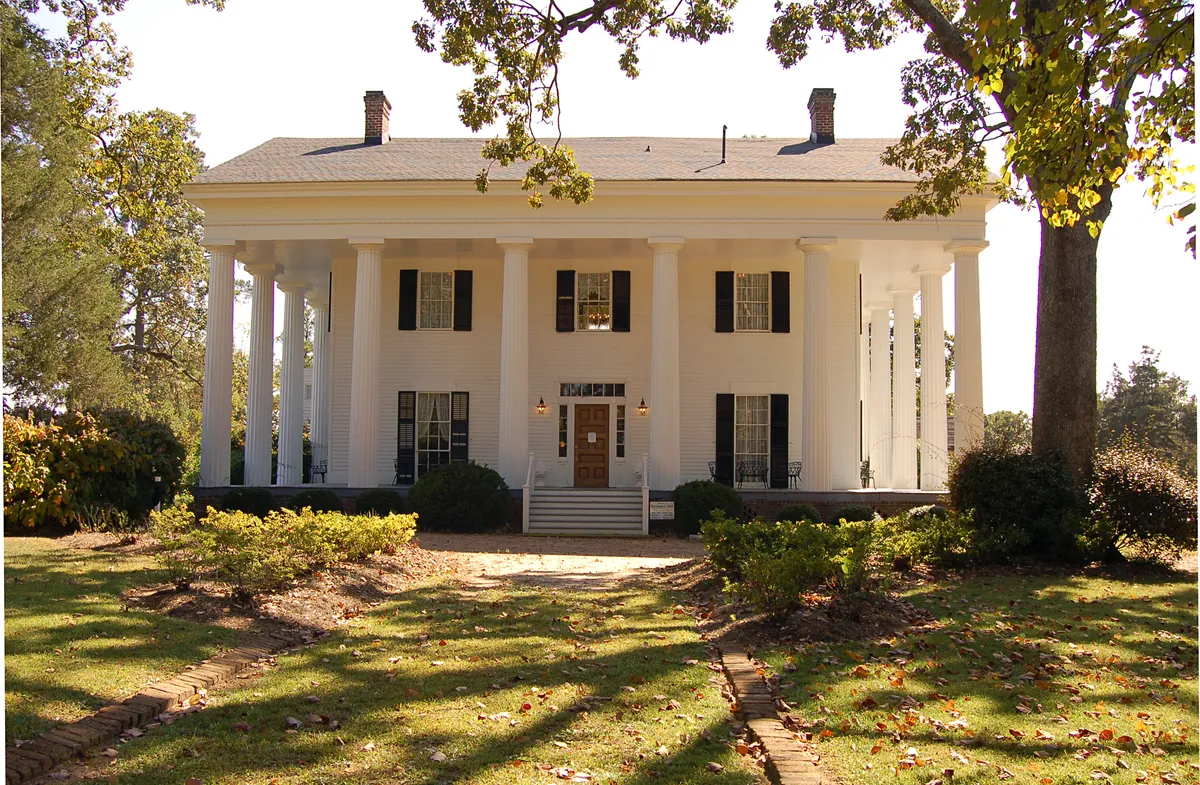
The design is Greek Revival. Sixteen-inch brick walls made on site, finished with stucco painted white to resemble marble. The floor plan: a square organized around a central hall running front to rear on both floors. High ceilings, large windows, a slate roof. The exterior features a free-standing colonnade of 28 Doric columns on all four sides—corresponding to the 28 oaks in the alley. The river was the front door.
In the winter of 1846, an enslaved gardener named Antoine grafted a pecan variety so successful it won a prize at the 1876 Centennial Exposition in Philadelphia. The shell was so thin it was dubbed the paper-shell pecan, cracked by hand. The property was designated a National Historic Landmark partly for this agricultural innovation. Antoine's original trees were cleared for more sugarcane after the Civil War.
Jacques Roman died of tuberculosis in 1848. His wife Celina managed the estate but nearly bankrupted it with heavy spending. Their son Henri took control in 1859, but the Civil War's economic dislocations and the end of slavery made the plantation unviable. In 1866, Henri's uncle Valcour Aime and his sisters Octavie and Louise put it up for auction. It sold for $32,800.
By the 1920s the buildings had fallen into disrepair. Andrew Stewart bought the property in 1925 as a gift to his wife Josephine, who commissioned architect Richard Koch to restore the house. The Stewarts ran it as a cattle ranch—Josephine had grown up on one in Texas. When she died in 1972, she left the house and grounds to the Oak Alley Foundation, which opened them to the public.
The slave quarters behind the house are now interpreted as part of the tour. One of the most photographed sites in Louisiana.
- ·The 300-year-old quarter-mile alley of 28 live oaks runs from the house to the Mississippi River — not to the road.
- ·The house was designed and oriented to face the river: guests arrived by boat, walked the oak alley to the front door.
- ·Today visitors approach from River Road, which is the historical back of the house. The levee blocks the river entirely.
- ·HABS documentation: LOC item la0544, includes site plan showing river orientation axis.
- ·Time Layer: the oak alley points at the river. The levee is why you can't see what it's pointing at.
- ·Source: HABS LA, item la0544.
Memories
Editorial content compiled with AI assistance. Place details verified against public records.