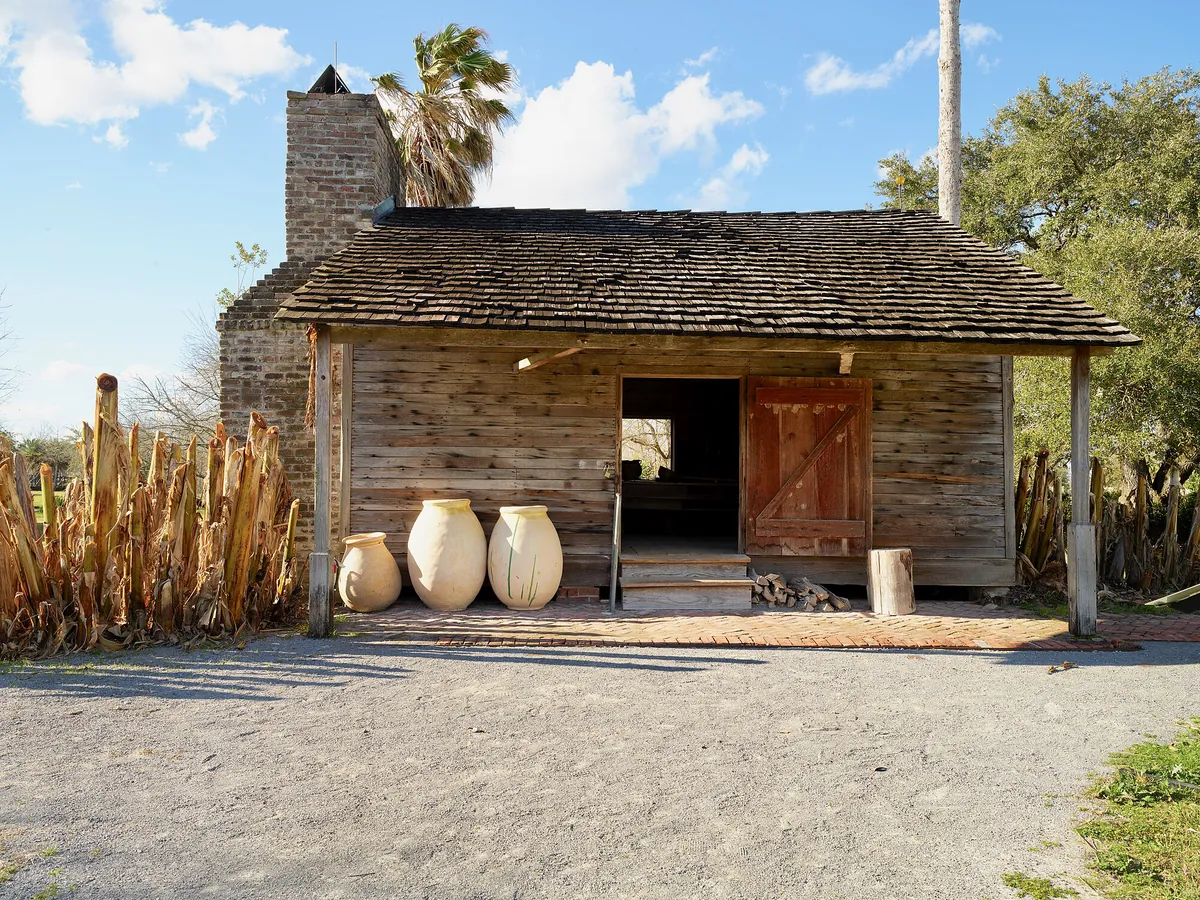
Every other plantation museum on River Road built its story around the house. Whitney tells the story of the people who built it. It is the only plantation museum in Louisiana focused entirely on the experience of the enslaved.
More than 2,200 enslaved individuals are identified by name from church records and slave inventories. Their stories are told through life-size sculptures of children, first-person testimony from the 1930s Federal Writers' Project, and intact 1790s buildings. Many of those who survived enslavement were interviewed as adults during the Great Depression. The federal government published those oral histories to preserve them. The transcripts and some audio recordings are held by the Library of Congress.
What was originally known as Habitation Haydel was founded in 1752 by Ambroise Heidel, a German immigrant. His descendants owned it until 1860. In 1866, after the Civil War, businessman Bradish Johnson bought it and renamed it Whitney in honor of his daughter, who had married into the Whitney family. The plantation ceased operations in 1975.
Trial attorney John Cummings acquired the complex in 1999 and spent more than $10 million of his own fortune restoring it. He worked on the project for 20 years before opening it to the public in December 2014. In 2019, he donated the Whitney. It is now a 501(c)(3) organization governed by a board of directors. The director of research is Dr. Ibrahima Seck, a Senegalese scholar specializing in the history of slavery.
The grounds contain several memorial sites dedicated to the more than 100,000 men, women, and children who were enslaved in Louisiana. The French Creole raised-style main house, built around 1790, is an important architectural example in the state. The plantation has numerous outbuildings: a pigeonnier, a plantation store, the only surviving French Creole barn in North America, a detached kitchen, an overseer's house, a mule barn, and two slave cabins.
Open Wednesday through Monday. Admission charged. Advance tickets recommended.
- ·The only plantation museum in Louisiana focused entirely on the experience of the enslaved.
- ·More than 2,200 enslaved individuals identified by name from church records and slave inventories.
- ·Stories told through sculpture, first-person testimony from the 1930s Federal Writers' Project, and intact 1790s buildings.
- ·Opened in 2014 after 16 years of restoration by trial lawyer John Cummings.
- ·Every other plantation on River Road tells the story of the house. Whitney tells the story of the people who built it.
- ·Open Wed–Mon. Admission charged. Advance tickets recommended. Located in Wallace on River Road.
Memories
Editorial content compiled with AI assistance. Place details verified against public records.