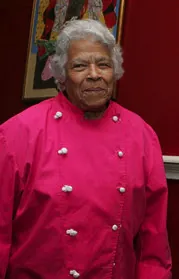
Leah Chase ran the kitchen at Dooky Chase's Restaurant for over seventy years, and during the 1960s, the upstairs meeting rooms became one of the only public places in New Orleans where African Americans could gather to plan civil rights strategy. She served gumbo and fried chicken to A. P. Tureaud, Ernest "Dutch" Morial, Martin Luther King Jr., and the Freedom Riders while they held meetings the city knew were happening but could not shut down without risking public backlash. When King and the Freedom Riders came to organize the Montgomery bus boycott, they met with civil leaders from New Orleans and Baton Rouge in those rooms to learn from the Baton Rouge Bus Boycott—the lessons from Baton Rouge inspired the plan and organization of the Montgomery boycott.
Chase married jazz trumpeter Edgar "Dooky" Chase II in 1946. His parents had founded a street corner stand in Tremé in 1941 that sold lottery tickets and po-boy sandwiches. During the 1950s, Leah began working in the kitchen, and she and Dooky converted the stand into a sit-down restaurant. She updated the menu to reflect her own family's Creole recipes and added dishes like Shrimp Clemenceau that had been available only in whites-only establishments. On Friday nights, she and her husband cashed checks for trusted patrons at the bar.
Chase was born in 1923 in Madisonville, Louisiana, to Catholic Creole parents of African, French, and Spanish ancestry. She moved to New Orleans to attend St. Mary's Academy because Madisonville did not have a Catholic high school for Black children. After high school, she worked as a waitress at the Colonial Restaurant and The Coffee Pot in the French Quarter. She was fifty-four the first time she visited an art museum—museums were segregated in the Jim Crow South. After her husband gave her a Jacob Lawrence painting, she began collecting African-American art, eventually displaying dozens of paintings and sculptures by artists including Elizabeth Catlett and John T. Biggers. The collection became one of the most significant collections of African-American art in private hands.
Hurricane Katrina flooded the restaurant in 2005. Chase and her husband spent more than a year living in a FEMA trailer across the street. The New Orleans restaurant community held a benefit lunch on April 14, 2006, that raised forty thousand dollars for the eighty-two-year-old Chase. After reopening, she fed U.S. Presidents George W. Bush and Barack Obama. She received the James Beard Lifetime Achievement Award in 2016. In 2018, Food & Wine named Dooky Chase's one of the forty most important restaurants of the past forty years.
Chase died in 2019 at ninety-six. Her family continues to operate the restaurant. Come for the Creole gumbo—Ray Charles sang about it in "Early in the Morning," and it is not negotiable.
- ·During Jim Crow, this was the restaurant where Black and white civil rights leaders met to plan strategy over fried chicken and gumbo.
- ·Leah Chase, the 'Queen of Creole Cuisine,' ran the kitchen for over 70 years.
- ·She fed Thurgood Marshall, Ray Charles, and three sitting U.S. presidents.
- ·Leah died in 2019 at 96; her family continues to operate the restaurant.
- ·The art collection on the walls is one of the most significant collections of African American art in private hands.
- ·Come for the Creole gumbo. It is not negotiable.
- ·Located at 2301 Orleans Avenue in Tremé.
Memories
Editorial content compiled with AI assistance. Place details verified against public records.