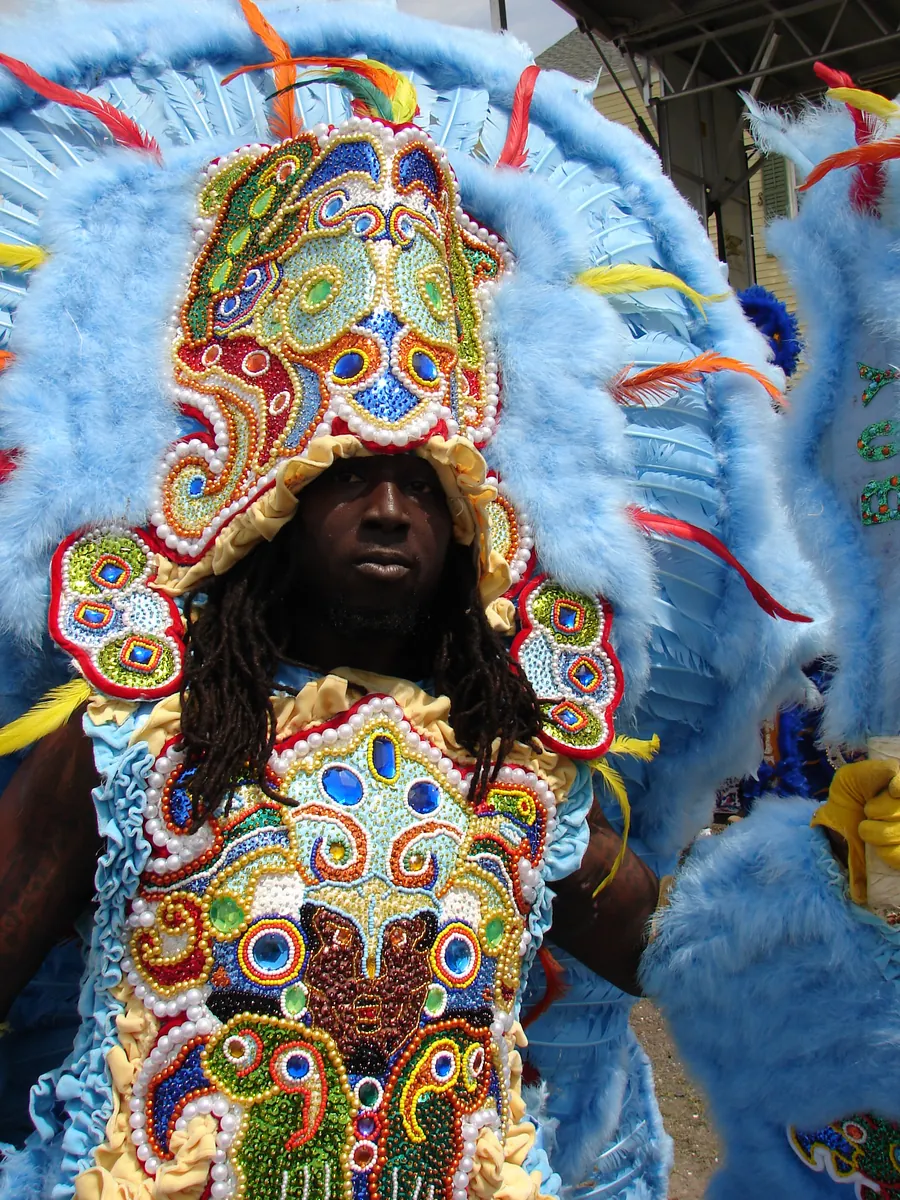
On Mardi Gras morning in Central City, you will not find the Indians on any map or schedule. They emerge when they emerge, announced only by the sound of chanting, and you find them by following that sound or by asking someone who knows. The tradition of Black Mardi Gras Indians dates to at least the 1880s, honoring the bond between African Americans and Native Americans who sheltered runaway slaves.
When enslaved Africans escaped, they encountered Indigenous peoples of Louisiana who shared skills and resources with them. New Orleans was surrounded by swamps, bayous, and rivers where maroon settlements formed. The Underground Railroad in Louisiana went southward to these camps because the northern free territories were too far away. Native Americans helped the maroons by providing food and weapons so they could defend themselves from slave catchers. In 1729, during the Natchez Revolt, 280 enslaved Africans joined forces with Natchez people to resist French colonists. The Natchez spared the enslaved Africans; some joined the Natchez, while others escaped to freedom. This history of shared resistance became the foundation for a tradition that would endure.
The Mardi Gras Indian subculture emerged during the late 1800s, founded by Becate Batiste during segregation as a blend of Black American and Native American cultural practices. Batiste—a young Creole man of African, French, and Choctaw heritage—formed the Creole Wild West in the Seventh Ward. The tradition developed when Black Americans were not allowed to partake in certain Mardi Gras celebrations and Black people could not gather in public or wear masks. In response, Black New Orleanians masked as the Native American allies who had shielded their ancestors during slavery. Experts describe it as a combination of African, Caribbean, Indigenous, and European influences—what Tulane University's Joyce Marie Jackson calls "a folk ritual and street theater unique to New Orleans."
The suits are the heart of it. Mardi Gras Indian regalia can weigh upwards of one hundred pounds and cost thousands of dollars in materials alone. A suit takes between six and nine months to complete, sometimes a full year. The beadwork is entirely done by hand. The designs tell stories: some makers incorporate Ghanaian Adinkra symbols, Rastafari colors, images of ancestors and Black historical figures. Beading is often described as a spiritual experience, with practitioners entering a meditative trance when sewing their suits.
On Mardi Gras morning, the Indians parade with no set route. Each gang has a Big Chief, Spy Boy, and Flag Boy—roles with specific responsibilities during the confrontation rituals. Spy Boys scout ahead in light running suits. The Big Chief decides where to go and which tribes to meet. When two tribes encounter each other, they line up and the Big Chiefs taunt each other about their suits. The drum beats of both tribes intertwine, and then both move on. By the 1960s, Allison Montana—known as Chief of Chiefs—worked to end regular violence between the tribes. He said, "I was going to make them stop fighting with the gun and the knife and start fighting with the needle and thread." Today they settle their fights through the prettiness of their suits.
More than forty active tribes range in size from half a dozen to several dozen members, loosely coordinated as Uptown Indians and Downtown Indians. Their suits are displayed in museums including the Smithsonian. On Mardi Gras day, Indian gangs meet, chant, and compete for the prettiest suit along Washington Avenue and LaSalle Street. But there is no set route, no schedule. Follow the chanting.
- ·On Mardi Gras day, Black Mardi Gras Indian gangs emerge in handmade suits weighing up to 100 pounds, covered in beads and feathers sewn over an entire year.
- ·The tradition dates to at least the 1880s and honors the bond between African Americans and Native Americans who sheltered runaway slaves.
- ·Indian gangs meet, chant, and compete for the prettiest suit along the Central City route on Washington Avenue and LaSalle Street.
- ·Each gang has a Big Chief, Spy Boy, and Flag Boy — roles with specific responsibilities during the confrontation rituals.
- ·The tradition is unscheduled and unannounced — you find the Indians by following the chanting.
- ·Central City, Mardi Gras day only. No set route or schedule — ask locals or follow the sound.
Memories
Editorial content compiled with AI assistance. Place details verified against public records.