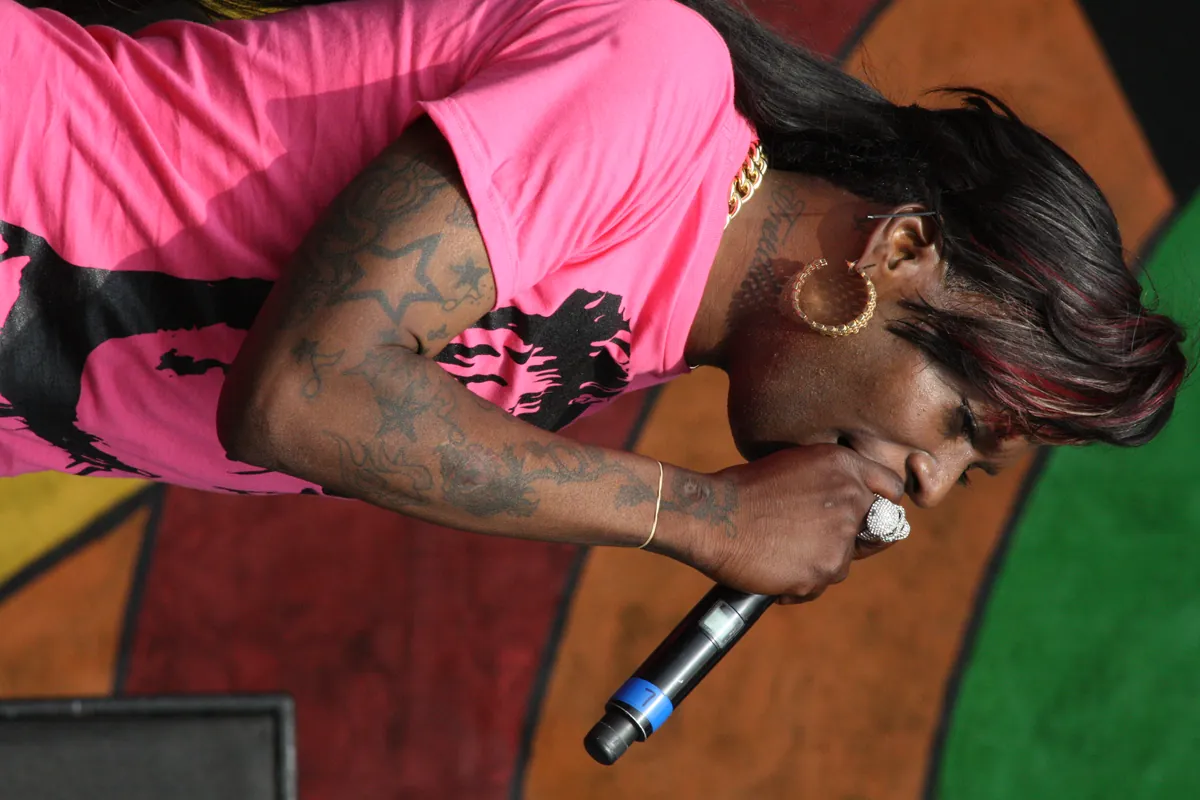
MC T. Tucker's "Where Dey At" was playing at Ghost Town in Uptown Hollygrove in 1991, a year before anyone called it bounce. The track sampled "Drag Rap" by The Showboys, a New York group whose 1986 single had those Triggaman bells and 808 kicks that would become the skeleton of New Orleans hip-hop. But the form didn't belong to New York anymore. Over that beat, New Orleans rappers built something the city had been making for two centuries: call-and-response rooted in Mardi Gras Indian chants and second-line parades, roll calls that named specific wards and neighborhoods, a participatory sound where the crowd wasn't watching — they were part of it.
The sonic toolkit came from outside — Triggaman bells from New York, "Brown Beats" from California DJ Cameron Paul — but the logic was local. When Mannie Fresh created the Cheeky Blakk beat in the mid-1990s, reworking "Brown Beats" for New Orleans rapper Cheeky Blakk, he locked in another signature loop. DJ Jubilee's 1993 single "Do The Jubilee All" introduced the word "twerk" to the recorded lexicon. The genre was percussive, repetitive, built for dance, and deeply specific to the city's African diasporic musical traditions.
Take Fo' Records, founded in 1992 by Earl J. Mackie and Henry F. Holden, was the first independent label to specialize in bounce. It launched DJ Jubilee, 5th Ward Weebie, Katey Red, and Big Freedia. Katey Red pioneered sissy-bounce as the first queer bounce rapper; Big Freedia started as one of her vocalists and became the undisputed queen of bounce, later collaborating with Beyoncé on "Formation." The city's carnival culture made space for queer artists in a genre that elsewhere stayed rigidly heteronormative.
Hurricane Katrina cracked the form wide open. Bounce artists were among the first to articulate the rage at FEMA and the Red Cross, the abandonment of the city's poor Black residents. 10th Ward Buck's "Fasta" pushed the tempo into frenetic territory, and the sound accelerated into what it is now. Preservation Hall, which had been jazz-only for generations, hosted DJ Jubilee for its first bounce show in 2013. WWOZ, which once fired a DJ for playing local rap, now considers bounce part of the New Orleans music canon. The genre moved into the Ogden Museum, Tulane's digital library, and the Amistad Research Center.
Bounce is still being recorded in converted garages in Uptown and Central City. Catch a Big Freedia show or a Tipitina's bounce night. It's a live tradition, not a relic.
- ·New Orleans hip-hop came out of backyard bounce parties in the Magnolia, Calliope, and Melpomene projects in the early 1990s.
- ·DJ Jubilee, Cheeky Blakk, and Big Freedia built bounce out of the Triggerman and Brown Beat loops.
- ·The form uses call-and-response vocals and a different rhythmic logic from East or West Coast rap.
- ·The geography is Uptown and Central City; the form is still being recorded in converted garages.
- ·Visitor tip: catch a Big Freedia show or a Tipitina's bounce night — it's a live tradition, not a museum.
Memories
Editorial content compiled with AI assistance. Place details verified against public records.