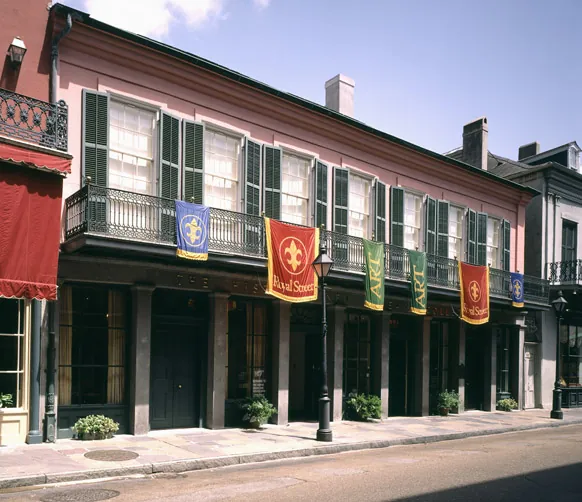
The Merieult House at 533 Royal Street has stood on land in continuous use since the early colonial days in the 1720s. The house itself dates from the 18th century — one of the few buildings in the French Quarter to survive the Great Fire of 1794. In 1938, General Lewis Kemper Williams, a World War I veteran and Brigadier General in World War II, bought the Merieult House and an adjacent late 19th-century residence with his wife Leila. They lived in the latter for 17 years, amassing a substantial collection of Louisiana materials. After both died — Leila in 1966, Kemper in 1971 — a foundation bearing their names was established to keep the collection intact and available to the public. That foundation became The Historic New Orleans Collection.
The holdings today number approximately 350,000 photographs, prints, drawings, paintings, and other artifacts, plus some 35,000 library items. The Williams Research Center on Chartres Street opened in January 1996 in a Beaux Arts building that housed the Second City Criminal Court and Third District Police Station when it was built in 1915. The Collection's holdings are available to the public in the reading room there.
Permanent galleries occupy both floors of the Merieult House — the Louisiana History Galleries on the second floor, the Williams Gallery for rotating exhibitions on the first. The Williams Residence, an 1889 Italianate house museum surrounded by three courtyards, remains furnished as it was in the 1940s and 1950s. A young Tennessee Williams boarded for a time at the Louis Adam House, which the Collection also operates; in 2001, The Collection acquired the largest private collection of Tennessee Williams materials in the world from collector Fred Todd, including typescripts and manuscripts of *A Streetcar Named Desire* and *The Glass Menagerie*.
The William Russell Jazz Collection traces the development of jazz from New Orleans to New York City, Chicago, and beyond, with extensive holdings on Manuel "Fess" Manetta, Bunk Johnson, and Jelly Roll Morton. The William C. Cook collection focuses on the War of 1812 in the South, particularly the Battle of New Orleans, with materials on Major General Andrew Jackson well represented. The Clarence John Laughlin collection contains film negatives, transparencies, photographs, and prints from the 1930s to the 1980s. The Sugar Bowl donated its archives to The Collection after Hurricane Katrina damaged the Superdome — the archives survived, but the Bowl decided they needed a more suitable home.
Exhibitions have covered the Battle of New Orleans, the development of New Orleans cuisine, the Sugar Bowl, and life after Katrina. Many exhibitions are free. Go to the Williams Research Center with a question that matters to you — the holdings are deep enough to answer it.
- ·Over 350,000 items spanning three centuries — the most important research collection on New Orleans and Gulf South history.
- ·Founded in 1966 by collectors Kemper and Leila Williams.
- ·Anchored by the 1792 Merieult House, one of the few French Quarter buildings to survive the Great Fire of 1794.
- ·Permanent galleries are free. Rotating exhibitions draw from a collection deep enough to cover colonial mapmaking to Storyville.
- ·The Williams Research Center on Chartres Street holds the archives and is open to the public.
- ·Located at 533 Royal Street. Open Tue–Sat 9:30am–4:30pm, Sun 10:30am–5pm.
Memories
Editorial content compiled with AI assistance. Place details verified against public records.